3/7/07
Still questing after photos, I tried to go the car wash route on Sunday. My friend Denio, of the palos group, decided to accompany me to Rancho Tipico Las Colinas – if we could get there early, I thought I had a chance of getting something interesting on film, but Denio’s childcare situation didn’t pan out until it was already dark. It didn’t matter too much in the end, because there was no good spot from which to shoot, and the music/dance/bar part was totally separate from the car part, anyway. It was a fun place to spend an evening, though. I danced some merengue, some salsa, some típico, and some bachata, and watched other people doing obscene things on the dance floor to reggaeton. I ran into an old friend from the Centro Leon, Freddy, and then played some pool. After that, we tried to hit a couple of other car washes to see if things would work out camera-wise, but no such luck. Anyway, we were both tired so headed to our respective homes early.
It was just as well, since Monday would be another long day, filled with an inordinate amount of driving, as it turned out. I had to get up early to drive to the capital to check out the salsa and son dancing scenes down there. With my newly rebuilt engine, the mechanic had assured me I could go anywhere I damn well pleased, and I hoped he was right. But this time, just to be sure, I would do my best not to think at all about how the Falcon was running.
As it turned out, the drive down was pretty uneventful, if hot. I enjoyed having a radio to play with this time, and I even stopped for some roadside shopping. The freeway here boasts some great crafts, believe it or not, and stuff that’s not sold in the tourist markets in cities. On the way down I stopped at the wood stalls near (naturally enough) El Pino, where natural and painted wooden dishes and utensils can be found. On the way back up, I’d stop to check out the rag rugs at the less appropriately named Piedra Blanca – the town at the turnoff to Cotui, to which it seems to have lent its weave & tie technique for the creation of the fundú costumes.
Anyway, as I was driving I received a call from “Playero la Salsa,” as my guide to Santo Domingo’s salsa world was known. I’d been planning on going straight to my hotel to check in, shower, and change before meeting anyone, but he suggested I stop and see him on the way in since he lived a little ways out of town. I agreed, and we rendezvoused at a Shell gas station at the barrio of “El 9,” ever-so-picturesquely named after the number of its milepost on the freeway. I thought it would be easy to recognize me, being as always the lone white girl, and also I had described my car to him. But he ended up taking several turns around the parking lot before eventually finding me half expiring from massive amounts of sweating. I always forget how much hotter the capital is!
At the gas station’s small restaurant I ordered some lunch and, most importantly, water, over which to discuss Dominican salsa style. We compared notes on New York vs Dominican steps and men’s and women’s roles, entertaining the restaurant workers with an impromptu and covert demonstration. Then we made plans to meet again that night to visit a salsa club in the Zona Oriental, were hopefully I’d be able to see some dancers in action. I really should have come on a Thursday or Friday when there are regular dance contests and performances by Playero’s group, but unfortunately, I didn’t have any more free weekends left! My stay in the DR this time is beginning to seem way too short.
I dropped Playero off a ways down the road in the barrio of Herrera and then followed his directions to go around a frightening roundabout (approximately ten times the chaos of Grand Army Plaza in Brooklyn) to the 27 de Febrero – where I promptly got caught inside the worst traffic jam ever. Let’s not talk about it. It will be enough to say that I sat inside my un-air-conditioned car in searing afternoon heat, in the middle of a sea of asphalt, for nearly an hour, with no water. If a water-seller had inserted himself into that mess, he would surely have walked out a millionaire.
By the time I finally extracted myself, swearing to hold a grudge against the 27 de Febrero for the rest of eternity, and got to my hotel, I barely had time to shower, change, and rest a few minutes before I had to head back out west to Herrera and meet with Playero and two of his friends and students for a night of dancing. But when I arrived, I found out that the club we were going to was actually across the river to the east, sending me right back to where I’d come from and further. Having spent 4 hours already in my car that day, I was a little annoyed with this nonsensical plan that seemed to have been devised only to force me into spending more money on $4-a-gallon gas and raising my blood pressure.
I did like the place once we finally arrived, though. It was packed with shiny metal tables, all filled, and there was no dance floor to speak of, just a narrow aisle in the middle. The ceiling was filled with colorful paper flags like Mexican papel picado. But the real attraction was the music. The deejay was spinning nonstop old-school salsa, what one of my companions called “salsas raras - stuff they only dig out here, that you would never hear anyplace else.” It was true, but it sure sounded good, and the crowd was really into it. A table of guys behind me had even brought their own instruments and were playing along with maracas and cencerro.
This wasn’t Playero’s usual crowd- he usually only came on Fridays, when a competition is held here weekly. But one friend was here: El Guinguiriano, reported to be the best salsa dancer in the country and the winner of the most competitions. Tonight, he showed off a bit by dancing with two women at once, turning them in perfect spins and executing flawless footwork. He had his moves down, and he was quite the ball of energy to see on the dance floor. Oh – and he’s blind.
It was definitely impressive. I danced with him a bit myself, and knowing I danced New York style, he put in some New York style spins. It was a bit nerve-wracking, though – the tables were so close together and the place so crowded that I kept being afraid of spinning into a table, knocking over beers, and stepping on others’ toes. I don’t know that my partner was aware of just how precarious the situation was! That, combined with the fact that I hadn’t danced much since my last knee surgery a year and a half ago, meant that I didn’t feel my performance was quite up to par. But it was fun, and he wanted to dance some more, offering to meet me at the next night’s destination.
There wasn’t much time to sleep. I had an ever-so-exciting errand to do the next morning: pay a visit to the police headquarters for the recovery of stolen vehicles. See, a year and a half after I bought my car, I still don’t have its papers. At first, the problem was getting a copy of the ID of the woman who had owned the car previously. El Negro, my trusty auto body shop guy, was supposed to get this for me since he had actually sold me the car. But although I had the original registration, this pesky woman seemed always to be out of the country (or, more likely, El Negro just didn’t feel like dealing with it). So last time I left the country, I deposited the matter in the capable hands of my lawyer, Eddy. He managed to get the ID, miraculously enough, but by the time I returned here (seven months after I’d left) the papers still hadn’t gone through. We had to take the Falcon for a second inspection for reasons unknown (as you may recall from last month’s blogging). The problem, as it turned out, was a number missing on the form because of a fold in the photocopy.
The forms were submitted again, together with those of my friend Jon’s car. Jon got his papers back quickly, but mine still didn’t show. Eddy sent a messenger to the Palacio de la Justicia to find out why. Turned out the Falcon appeared on a list of cars that were “stoled, recovered, but not returned.” I’m not so clear on what that was supposed to mean, other than a trip to the capital. Apparently, the police computer system is based in the capital, and for some reason that means that no one in other cities can make changes to the system. So my mission was to show up, talk to a particular Lieutenant, show her my papers, and have her remove the warning from my car’s record. Of course, I knew it would not be so simple. After a year and a half of submitting and resubmitting, how could it be?
I saw the lieutenant and got in line, waited maybe an hour for her to finish with the guy before me, then got passed on to a Lieutenant Captain in an office with ten other people waiting for various things and a desk covered with piles of vehicle-related forms. Both of them were very nice and as helpful as they could be, but how helpful can you be with so much bureaucracy? As I waited for the computer guys to check my car’s record, I talked with another unfortunate waiting room resident. “You’ve been waiting a year and a half? That’s nothing! I’ve been waiting three years! And there are four warnings on MY car!” So when they told me the warning was there and couldn’t be removed without several more steps of work, I was nonetheless getting off pretty easy.
The next step is a bit of detective work that is entirely my responsibility. They gave me the name of a mysterious Freddy who filed the robbery report, although according to my papers he was never the owner of the car. They also gave me a three-year-old phone number likely not to work and a cédula (ID number). With this information, I am supposed to be able to track down this guy and convince him to write a letter to remove the warning from the record. Riiiiiiiiight. (Imagine if I had four of them to take care of!) So it looks like I’m keeping the Falcon rather than selling it this year. It’s just as well I’m getting all the repairs done – we are going to be together for a WHILE.
Cementing our bond further, the Falcon and I then headed back out to Km 9 to meet Playero at the ol’ gas station AGAIN. Well, I couldn’t complain too much; he’d agreed to show me some moves to help me get the hang of Dominican salsa style. By the time I arrived, though, he had decided we might as well kill two birds with one stone and pay a visit to some salsa schools where I could also meet some teachers and observe other dancers. That meant a drive even further out of town, to a peripheral barrio called Los Alcarrizos.
On the way out, el Playero explained that several salsa schools were located in this area, and all had plenty of students. I wondered why Los Alcarrizos was so salsa-happy, but he said that’s just the way it was there. Where Santiago has típico, the capital has salsa! Our destination was a place called “ADPI” after its owner, whose salsa name was “El As de Pi,” which in Dominican means “Ace of Hearts.”
It was a sort of rough-and-ready place, which turned out to be because it was the second ADPI and had only recently opened. This explained the rough cement floors and lack of any accoutrements other than a stereo and a single full-length closet style mirror tacked to the wall. It had, however, been nicely painted in royal blue and with the figures of a ballroom-type couple in black and white. The house across the way was pretty snappy too – also a bright blue with white gratings and an assortment of odd, folksy wood carvings mounted under the eves. I commented on it, and Playero told me, “that’s a witch’s house!” When I expressed incredulity, he added, “well, that’s what people in the neighborhood say. Because it’s so unusual.”
When we arrived the master was on a folding chair on the sidewalk in front of the studio, relaxing with some neighbors before class. But we soon changed that! Before long, all of us were sweating in the capital’s humid air and vying for space in front of the one oscillating fan mounted in a corner. It was an educational time and now I feel confident that I can follow a Dominican lead without trouble. My two hosts made plans to meet me in Santiago for an evening’s dancing at some point in the not-too-distant future.
Time was running short, however, and the sun was about to set. Since I was to meet Rossy, my colleague from INEC (Institute for Caribbean Studies), at 8, I needed to hurry back if I was to have a badly-needed shower. As it turned out, I didn’t even have time to eat before I had to go find her at the corner of Duarte and Paris. Because this wasn’t a very good area, Rossy had told me to me sure to get there on time. I got there 15 minutes early, and found that it was about the worst meeting place ever.
Although it was after dark, the streetcorner was completely packed with vegetable vendors, shoppers, and people looking for the public cars that parked there as they took on passengers. It was ill-lit, wedged under an elevated highway, and in constant motion. There was no good place to park, and though I tried my best to pull well over, people kept getting mad at me anyway, slapping my car and yelling to move on. Eventually I moved over to the side of the public cars, thinking that at least it was a sort of parking place. An attendant came over with a big stick and whacked my car, telling me I couldn’t sit there. But then he took pity on me and allowed me to stay, even fending off the occasional passersby that thought I was a taxi and tried to get a ride. Still, though I waited and waited and waited, there was no sign of Rossy. I thought of moving, taking a drive around the block, but all the streets were one way and I was afraid of getting completely off track. Also, as soon as I left I knew she would show up in the next moment. Surely she would check all four corners of the intersection and notice my car there – but she didn’t. Nearly an hour later, I was ready to give up. As I started to go around the block, my phone rang – it was Dario. Rossy had called him from a public phone, since she didn’t have my number memorized, and he called me. She had been on the opposite corner the whole time.
Annoyed, hungry, and tense from the whole situation, I wasn’t in the world’s best mood, but the prospect of now being able to search out food picked up my spirits. We decided to go straight to our destination in Villa Consuelo and then see what edible matter could be found. I didn’t realize it was so close, but it only took us a few minutes to get there and park, and happily, there was a sidewalk cafeteria on the same block with a good selection. We engorged ourselves on grilled cheese and zapote shakes, and then, feeling a little too full to dance, made our way back down the block.
Our destination was El Secreto Musical, a place well-known (at least among ethnomusicology/folklore types) for its son dancing. Since my last trip, I’d been wanting to check out Santo Domingo’s son scene, and had finally found my opportunity. Rossy had already been here several times as a part of the preparations for this year’s conference on son and salsa at the Centro Leon, and she was warmly greeted by many of the regulars. These consisted mainly of the older Afro-Dominican gentlemen who had formed the Club de los Soneros twenty years ago. They were all well dressed, many in white pants with button-down shirts, some in solid colors and some in bright patterns. One, incongruously, sported a Led Zeppelin shirt. Many wore hats. Their wives and girlfriends wore dresses or slacks, while the younger women on the scene wore revealing outfits that in other contexts could only have been described as “hoochie mama.” There were a few foreigners – including my colleague Martha Ellen Davis. We run into each other in the strangest places. Last year it was in Cabral during carnival. This year, Secreto Musical in Villa Consuelo. What would be next??
The Club de los Soneros was sort of a brotherhood for these men who had grown up dancing to son in the city’s older barrios. Here, the lower and working classes maintain many aspects of Afro-Caribbean religion – what would openly be termed Santeria were it in Cuba, but which here is seldom discussed. At Secreto Musical and other sites the Soneros frequent they have created a syncretic practice, blending popular music and social dance with rituals that to them are highly meaningful. I had come mainly to see how Domnicans dance to son – many Dominicans even claim that son originated here, not in Cuba – but I was also curious to see what else might transpire during the evening.
I had heard aficionados discussing Dominican son music and how it can be distinguished from its Cuban counterpart. The easiest feature to recognize was in its instrumentation – where Cubans used bongó, Dominicans used mongó, a single drum that looks like an upturned tambora. I wanted to know if the dance was also different. It was. While dancing with Led Zeppelin Man at some point in the evening, I told him of my question and explained how I had only danced son in Cuba previously. “Ah! Well, this is Cuban style,” he said, and changed his step. It was the side to side 3-step movement with lots of hip action with which I was already familiar. I followed it easily and comfortably. “And now, this is Dominican style,” and he changed again. Smooth, with subtler hip motion more integrated into the rest of the body, this step moved in a quick circle. Then he stepped in place as he led me back and forth in front of him. Sometimes, the man would execute a quick bit of fancy footwork, or stop to allow the woman to do the same. This was Dominican son: subtle, graceful, elegant, leaving space for both partners to show off and look good.
I was surprised to find out that my friend from the night before, El Guinguiriano, had actually shown up. I hadn’t seen him because he had been seated right next to the dance floor and kind of behind a pillar, while Rossy and I were squished all the way in a back corner because the place had been so crowded already when we’d arrived. He wanted to sit with us but there was no way. So he said, “Come and find me when you want to dance. You must, because I am here with no partner. Or rather, perhaps I have many partners here, only I can’t see them!” So I did, and we did, and everyone had fun.
Around 11 PM, an hour before closing time, the music was shut off for the president of the Club to make some announcements. Tribute must be paid to the soneros who had passed on. A list had been distributed to club members naming all those who were to be remembered tonight. The music came back on, playing a tune that stated, “El son nunca muere” (Son never dies), and the soneros came together, dancing a simple step while following one another in a counterclockwise circle, a dance to remember the dead. After this, a palos tune came on, “Miguelito, Miguelito.” A man appeared seemingly out of nowhere, his head wrapped in a scarf and smoking the cigar that indicated he was in the service of the santos. A fire was started on the dance floor in the middle of the circle, which he and some other men fed by pouring rum on it. Perfume filled the air as he sprinkled scented holy water on the other dancers. A woman passed colorful scarves out to the other women, who unfolded them and twirled joyfully about. One of them was also smoking a cigar. Ten minutes later, it was over. The santero came around with his bottle and bathed us all in perfume – I rubbed it in, hoping it would help with the mosquito situation. We finished our beers and went home feeling satisfied.
That was all the time I had to spend in the capital. In the morning I was up early, bought a quick coffee and banana from a shack on the corner, and was back on the road to Santiago. I had just one more errand to do – purchase some more of the colorful rag rugs I love in Piedra Blanca. The selection wasn’t as good as last year, though, and the prices had gone up. The vendor explained that they got their fabric as remnants from a factory in La Vega, and it had been bought out last year by an American. “That American won’t let anything go!” he complained – presumably, the Dominicans had let the rugmakers take the scraps for free or very cheaply. Now they bought the fabric by the kilo at a higher price. It looked to be the kinds of things used for sport jerseys and tank tops, and it wasn’t as soft as last year’s models, but the colors were still nice. I bought two and hurried home for my meeting with Rafaelito.
Tuesday, March 13, 2007


Sunday, March 04, 2007
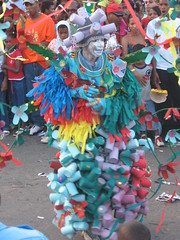
Juampa
Carnival in Cotui. This guy is famous for coming up with a new, outrageous version of the papelú costume each year.
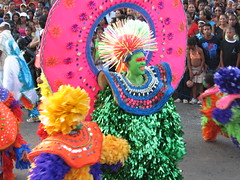
Platanuses
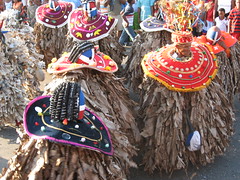
Carnival in Cotui. The still older version of the papelú is the platanú, a costume made out of banana leaves. It is supposedly a direct descendant of some African dance costumes.
3 happy guys - or are they drunk?
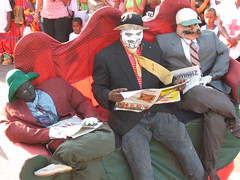
Carnival in Cotui. One of the more creative costumes in the parade.
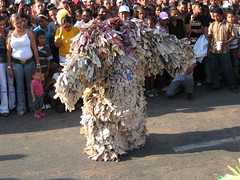
El papelú sin cabeza
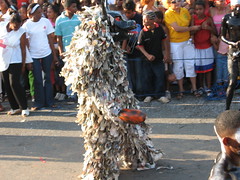
Carnival in Cotui. this traditional papelú costume has been altered to be scarier.
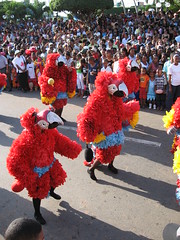
Los Guacamayos
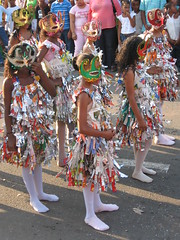
Carnival in Cotui. More funduses- this time, their plastic bag costumes in parrot colors.
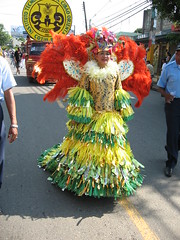
Osos polares
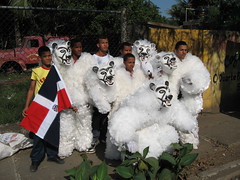
Carnival in Cotui. These polar bears are an example of the fundú, an adaptation of the traditional papelú costume that uses plastic bags in place of old-fashioned paper. Yes- the whole thing is plastic trash bags!
What does it mean?
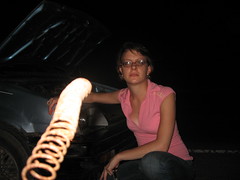
When my car broke down in La Vega on the way back from Cotui, I had to amuse myself until the tow truck came. I snapped this picture with my car using the timer. I thought the weird, shiny spiral must MEAN something - until I realized there was a spring sticking out of the post I was using as a tripod.
Travels with the Falcon
3/3/07
After not quite enough sleep, I was up and ready for a day in the field on Dominican Independence Day – February 27. Or I would be, once I found coffee, which took more doing than one might have thought. I did eventually find a guy with a coffee-and-cracker stand out on the Avenue, though, enabling me to hit the highway and head for Cotui. It was the country’s independence day and the final day of carnival in that town.
The drive out was mostly uneventful, if longer than expected. When I got off the main freeway at Piedra Blanca, near where the beautiful rag rugs are sold, I found myself on a pleasant and surprisingly well-paved country road passing through Maimon on its way east. The sun was hot, but with both windows down there was a good breeze and in spots the road was shaded by bamboo and tall trees. There were so many picturesque houses painted in bright colors, one a sky blue with geese fluttering about in front, but of course every time I saw one I was already too far past to take a picture and there was no place to pull over, anyway – one of the problems with solo road trips.
Of course, my happy road trip moment, speeding through the countryside singing, couldn’t last. At some point the pavement would have to give out, and it did in a big way as I approached the town of La Colimbra. The last ten kilometers were pretty jiggly and painful, but I arrived on Cotui’s town square reasonably intact, if sweaty.
I was set to meet with Felipe Orozco, a local folklorist who wrote a book on carnival in the province of Sanchez Ramirez and currently teaches at a technical university in town. He’d told me to meet in the “park in front of the church” – pretty indefinite directions for someone who had never been to the town and had no map, but I figured I had the hang of small Dominican towns by then. Every one of them has a centrally located town square with a church on it, and the so-called highway would have to run either right by it or close enough so that I could make out the church steeple. Sure enough, just at the point where I was wondering if I’d gone too far, should turn off the main road or stop for directions, I found the church on my right, turned and parked in front of it.
The plaza was already filling up with people, mostly teenagers talking and laughing. Just past the church on my right, a small stage was set up and strung with Dominican flags. The sun was incredibly intense. Luckily, I only had to bake for a few minutes before Felipe showed up and led me to his house. There, his girlfriend was waiting with lunch almost ready. Luckily it wasn’t a big deal that I don’t eat meat, since she wasn’t eating any either during cuaresma (lent). Felipe left me with his book to look over while he went to check on the University comparsa of which he was in charge as lunch made its way to the table.
As we were eating and drinking cold beer in order to cool off a bit, Felipe’s brother and a friend showed up. They’d just returned from the cockfight ring with a winning rooster, who was also along for the ride in a canvas sack. I quizzed them about some of the rooster-related terms I didn’t understand but had come across in merengue lyrics, and they brought their little buddy out to say hello and illustrate the canelo for me (a white bird with some red feathers). He had won, but was a little bit worse for the wear. I thought he was missing an eye but they told me it was just closed. He would go on to fight another day, although he hadn’t earned the right to a name yet – the guys told me that only very special roosters, the big winners, get their own names; the others are simply known by the descriptors of their coloring.
Time was a-wasting, though, and we had to get going if the University’s show was going to get on the road. In the carport of a house some blocks away, the university students prepared for their performance in the carnival parade. In celebration of the school’s anniversary they had made a human-powered “float” (really more of a large, rolling sign) with the number “25”, a book, and a pencil on it. The students would accompany it down the road while dancing, costumed as the various professions one could study there: mining, agriculture, law, etc. I ragged on a couple of the women dressed as miners for being entirely too clean to be convincing: their gloves were brand new and one of them was wearing shoes with rhinestone buckles that I had a hard time imagining covered in coal dust.
There was still much to do, so I went to visit Felipe’s co-author on the carnival book, Ricardo Hernandez, a sociologist with whom I had a very interesting talk about típico, class, politics, and other matters. When the students were finally ready to move, Felipe picked me up again, we drove with his girlfriend and her daughter to as close as we could get to the park what with all the carnival groups now clogging the streets. Eventually we had to ditch the effort and the car and go on foot up to the university group, which was the first in line and dancing to a popular palos tune when we arrived. (I have to say, palos is really moving up in the musical hierarchy here – I’ve heard far more in this year’s carnival than I did last year.)
I walked with them part of the way to where the parade was actually supposed to start, and then ran to the small stage I’d seen earlier, from where I’d be filming. Three other videographers and the entire panel of judges were up there too, which made for crowded times. In the end, the only space for me was on top of a speaker that didn’t balance particularly well, but I’d take it. It was definitely better than the spot in the sweltering sun I’d had before, which had necessitated the employment of the emergency umbrella always in my purse at the ready.
I was in Cotui because I’d heard about the fabulous costume tradition here in this midland town, legendary among Dominican folklorists, and I wanted to see for myself. Like any tradition, though, this one has kept changing with the times, though always maintaining its basic ethos – which seems to be something like reduce, reuse, and recycle. All the outfits are made entirely of recycled materials, the material simply depending on whatever is cheap and plentiful at the time.
The oldest variation is the platanú (plural, platanuses), a voluminous covering of dried, brown plantain leaves, sometimes decorated with a colorful round collar, sometimes accompanied by a simple yet effective mask with rectangular mouth and eye slits. But the typical 20th-century model is made instead of newspaper cut into strips and affixed to old clothing using starch. Naturally enough, a person costumed in this way is called a papelú (plural, papeluses). There is no one traditional mask for a papelu; they can use a papier-mache mask depicting any sort of animal face. More recently, a 21st-century variation has appeared: the fundú (plural, funduses), made of plastic bags woven and tied into clothing using a technique borrowed from the rag rugs made in nearby towns. I don’t think I’ve ever seen a better use of those annoying and ubiquitous plastic grocery bags.
Well, the street was now completely packed with eager onlookers, and more kept arriving and trying to push their kids in front of everyone else, as well as in front of the stage. Some perched on the fence surrounding the church for a better view. Some individual papeluses and funduses wove their way down the street and amid the crowd, occasionally administering a vejigazo, though not often. One had a costume made entirely of rags with a coconut helmet. But soon the parade itself got underway – and a good thing, too, since there were far more groups involved than I could ever have imagined for a town of only 44,000.
After the university group, it was an endless succession of papeluses and funduses until nightfall. Each had about two minutes to perform a choreography for the judges, usually to some kind of carnival merengue tune. In general, they don’t have a particular movement style as do Santiago’s lechones, they just do your standard stage merengue steps. However, the one remaining group of platanuses were something to see not only for their costumes but also because their choreography is made up of spins that made the plantain leaves fly around them.
Like in Santiago, anyone can participate in this parade wearing any type of costume. In fact, this and the economical nature of the papeluses and funduses is a source of pride to the town’s inhabitants; the announcer on stage boasted more than once that Cotui’s was “the most democratic carnival.” (Ricardo, the sociologist, had told me that Cotui had for many years had a strong leftist core.) Thus, there were categories for different types of comparsas beyond the traditional, including one titled “comparsa barrial” (Barrio group) in which the group could depict any kind of character that might be seen in a local barrio. This included girls in pyjamas and mismatched socks, coal vendors, and the like.
Many entrants had also invented creative outfits that had little or no connection to Cotui’s better-known traditions. There was an “hombre de lata” who had carried the recycling theme on to include painted tin cans. There was a woman, her face covered by an old lampshade, who wore a dress of garbage bags with trash stuck to them. It was a statement of protest to the city council: “Thus are the streets of Cotui,” a sign proclaimed. There was a little man in a bizarre sort of “Indian” costume and mask, who appeared to be a carnival regular known to all. Most spectacularly, there was a guy who had constructed an entire sofa with two stuffed men looking a little drunk sitting on either end. He was in the middle in a suit with a fake pair of legs crossed in front, reading the paper and looking very happy indeed.
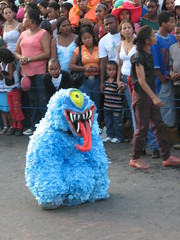
A few mishaps occurred during the course of the afternoon. A few cases of bottled water had been set out for those working on stage – announcing, manning the sound system, judging, etc. After a while, someone discovered it had all disappeared and the emcee announced this fact, stating, “well – I hope you all enjoy it!” A couple of groups went on too long, one group of blue monsters to such an extent that the emcee became angry and announced that they were disqualified. Some of the groups didn’t seem too clear on the judging concept and performed their routines too far back for the judges to see. But mostly, it was simply a beautiful afternoon, particularly as the sun lost some of its force.
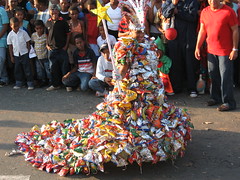
Among the funduses were costumes including polar bears, panda bears, pink panthers, vultures, parrots, and monsters. Some girls had constructed beautiful dresses entirely out of potato chip bags, including the particularly spectacular “Reina de Lay,” who had won a prize at school the day before for her potato chip gown complete with train. Those who had more funds had purchased metallic papers There were papeluses in bull masks and another group with more abstract, spookily featureless horned masks – perhaps a kind of devil? There was even a giant, headless papelú complete with the bloody stump of a neck.
In spite of all the emcee’s attempts to move things along quickly, it was nearly dark by the time the last group paraded in front of the judges. My friend Dario had told me that in Cotui, when carnival is over, all the papers and leaves are torn from the costumes and burnt in the streets – a symbolic representation of the “out with the old, in with the new” spirit of Easter. This may have been true in the past, but it surely didn’t happen today – perhaps the prevalence of the funduses discourages the practice, being that plastic bags don’t make very good campfires. However, I was told that it is still considered essential to make new costumes every year.
It was late and that meant I needed to hit the road ASAP if I wanted any light at all on the iffier sections of the road. I couldn’t wait for the judges to come to their consensus on the prizes – I’d just have to call Felipe for results later. So the Falcon and I got back on the road, albeit a different road this time, one which would come out close to La Vega on the highway. Pretty soon it was really, really dark, making for a decidedly less pleasant drive than I’d had on the way up. The road was medium bad in some places and extremely bad in others, where two cars could barely pass. The hardest point was striking a balance between having my brights on so I could see far enough ahead to go more than 10 mph and turning them down so as not to blind other drivers. Not that they cared about such trivialities – every time someone approached me heading the other direction I was so blinded I nearly had to come to a complete stop in order not to run off the road or fall into an unseen pothole.
About the time I came to Fantino, another town with a strong carnival tradition (they had even sent some representatives to today’s celebration in Cotui), I realized I was pretty hungry. I didn’t want to stop to eat a real meal, and most Dominicans don’t eat a big meal at night anyway, so I decided to look for a place that could prepare me a quick grilled cheese to eat on the road. Finding one, I ordered two sandwiches (the rolls were small) and a zapote juice. That’s when things started to go very, very wrong.
Anyone who has had Dominican street sandwiches will know that they always come with what I term “Dominican Special Sauce” – really just mayo and ketchup. When I got back on the road and started chowing down during the brief respites from blinding lights and uncertainty, I discovered that the woman in Fantino had gone a little overboard. There was almost more Special Sauce than cheese, and it squirted out all over my hand, so much so that it was dripping off onto my fancy jeans. It looked like my hand had been tragically mangles in an incident involving heavy machinery. I tried to fix the situation with whatever was at hand, but she had only put one tiny napkin in the sandwich bag and it couldn’t even manage what was on my thumb. The only other thing I could find was a receipt, and hoping I wouldn’t need it for anything later, I used it to scrape some more off and then threw it out the window.
That was all for immediately accessible paper products and it wasn’t close to enough. I couldn’t figure out how to drive without gumming up the steering wheel with Special Sauce, and also I kind of have a thing about sticky or dirty hands. They disturb me greatly. I had to pull off the road and deal with the situation, but there was no shoulder to pull onto. So I just sat there in the middle of the road, letting the occasional car swerve around me as I cleaned my hands with Kleenex and a little of my precious bottled water. So much for dinner.
Then the road got a little confusing. There was still an Independence Day party going on in one town square, requiring a detour. Then there was a fork I wasn’t quite sure about. I half hour later I still hadn’t reached the highway, so, getting nervous, I stopped and asked some motoconcho (motorcycle taxi) drivers if I was going the right way. They assured me I was, and that in about 20 minutes I’d get to the freeway. So I kept going, but then arrived at another confusing fork. A little girl was sitting on the hood of a car next to the intersection, and I asked her the way to La Vega. She pointed right and I turned, now onto a much better road. Not ten minutes later I was finally on the Autopista Duarte just outside of La Vega.
Freedom at last! Good road, fast driving, space to use my brights - in forty-five minutes or less I’d be back in Santiago, with enough time to bathe quickly and change clothes before heading to my palos friends’ gig at Rancho Tipico Las Colinas. I was singing as I zipped along in the fast lane, and I started thinking about just how much ground the Falcon and I had covered since morning. “My car is really running great! I guess all the money I’ve been spending on it has paid off,” I thought, with the new rotors, CV boots, gas filter, oil change, alignment, and wheel rotation I’d had done in the last week dancing in my head, not to mention the new brake tank and battery Jon had put in it in January. And then, “oops….”
In mid-thought, the car simply cut out. What timing! What irony!
It wasn’t the battery or the alternator cable that had conked out on me once before – the lights and everything else seemed fine. There had been no noise or smell, no overheating, no warning of any kind; just all of a sudden, the accelerator had no effect and I was coasting to a stop along a busy freeway, alone at night. I guess I should have been worried, but I wasn’t particularly. My friend Jon had recently mentioned that he’d had to have his car towed, so I had a plan of action. I called the towing company, and though it was 9 PM on a holiday I made my plight sound pathetic enough that the driver was soon on his way. He told me he’d come with his blinking lights on, and the boss told me to be sure to look and see that it said “Felipe” on the door. They were all very concerned.
So I had some time to kill on the side of the road, and I didn’t want to make any more phone calls since the battery was low and also I was worried about running out of minutes after all the time I’d spent trying to accurately describe my location to the driver. I amused myself by looking at the stars, using the “facilities,” such as they were, and setting up a timer snapshot of me and the Falcon. It came out with a crazy shiny spiral that seemed to emanate from my shoulder, reminding me of so-called “spirit photography.” I thought for sure it must mean something… something like, “never go around thinking your 23-year-old car is running well; it will only get you into trouble.” But then I discovered an old rusty spring coming out of the post I was using as a tripod. So much for my three-second spiritual experience.
Well, eventually the tow truck guy did come. I saw him approaching from Santiago on the other side of the highway, his lights flashing as promised, my parking lights on as promised. He saw me and honked three times; I replied in kind. (Good thing I’d just had my horn fixed.) He did it again just to make sure, and I honked back in a jaunty rhythm. When he got there he expressed relief that I hadn’t been attacked by highway robbers, marauding crusaders, or anything else. On the slow ride back to Santiago, I came up with some probing questions for him about his profession.
“So, what happens if you have to go pick up a broken-down car, and then your tow truck breaks down?”
He laughed. “I call another tow truck.”
“A bigger one?”
“Exactly.”
“So then you have a car on top of a tow truck on top of another tow truck?”
“More or less.”
“And what if that one breaks down?” My enquiring mind wanted to know, and to be prepared for any eventuality.
He laughed again, then became serious. “Actually, it has happened to me.” Not the second one, but the first one, that was. I thought that would have to be pretty much the worst day ever: your car breaks down so you call for assistance, wait an hour, get your hopes up when the truck arrives, and then have to go through the whole thing again.
At least THAT didn’t happen to us. But it was a bit of a hassle to get ahold of El Negro, my trusty car guy, at 11 PM at night and figure out how to get the car to him for repairs. In the end, we dumped it on the sidewalk in front of his shop since the “guachiman” (night watchman) in the parking lot next door had informed us in surly manner that the lot was full. He cheered up a bit and became talkative, even, when the prospect of a tip became apparent, as we needed him to hold on to the keys and give them to the gas station attendant in the morning who would in turn hand them over to El Negro.
This somewhat iffy plan did actually work out in the end, although the trip there from La Vega had made me about $75 lighter. And now, after three days in the shop and $225 worth of work, I have a completely rebuilt car. It turned out that the timing belt had broken, which in turn destroyed several pistons, rings, and the culata, a part that was new to me, meaning that I now know it only in Spanish.
In the midst of all the car-related excitement, which necessitated repeated trips across the river to El Negro’s in Bella Vista in order to examine some part or another, it was a bit difficult to get much work done. Nonetheless, I managed to be interviewed by a reporter on my carnival experiences, meet with Rafaelito to enjoy a tasty lunch from Carmen’s kitchen and toss around the idea of a merengue típico accordion method book, snap some pictures of the masks entered into this year’s carnival competition, and meet with Raul (Rafaelito’s son) for the purposes of (a) teaching him some music theory and reading skills, (b) learning some fancy parts to some merengues I’m working on, and (c) discussing plans for the upcoming Smithsonian recording. This turned into (d) more monetary headaches for me regarding the budget for said recording, headaches that lasted through the night and into Saturday morning.
The good part on Saturday was that I got a new radio put in my car! I’d had a nice one with a CD player and removable face, but it had conked out last year and I’d never gotten around to fixing it. Now I was sufficiently tired of having only my own voice for company on long driving trips that I was ready to sacrifice both money and time on the matter. First to the electrical guy, who found there was no hope for the old thing – it was essentially brain-dead. Then a couple of hours of driving around looking for a suitable replacement. Everyone wanted me to buy a CD player, but I don’t have any CDs here so I didn’t see why I should spend RD$2200 ($66) when I could spend RD$1000 ($30) for one with a tape player that would play from my iRiver just as easily. But since I am the only person left in Santiago who wanted such an outdated thing, it was hard to find. Eventually, success! With that and two cheap speakers I was ready to rock, and I drove away with La Super Regional blasting. It was off to the cockfights for me, since I needed a couple of pictures for an article. I got them quickly, giving me a much-needed night off.
After not quite enough sleep, I was up and ready for a day in the field on Dominican Independence Day – February 27. Or I would be, once I found coffee, which took more doing than one might have thought. I did eventually find a guy with a coffee-and-cracker stand out on the Avenue, though, enabling me to hit the highway and head for Cotui. It was the country’s independence day and the final day of carnival in that town.
The drive out was mostly uneventful, if longer than expected. When I got off the main freeway at Piedra Blanca, near where the beautiful rag rugs are sold, I found myself on a pleasant and surprisingly well-paved country road passing through Maimon on its way east. The sun was hot, but with both windows down there was a good breeze and in spots the road was shaded by bamboo and tall trees. There were so many picturesque houses painted in bright colors, one a sky blue with geese fluttering about in front, but of course every time I saw one I was already too far past to take a picture and there was no place to pull over, anyway – one of the problems with solo road trips.
Of course, my happy road trip moment, speeding through the countryside singing, couldn’t last. At some point the pavement would have to give out, and it did in a big way as I approached the town of La Colimbra. The last ten kilometers were pretty jiggly and painful, but I arrived on Cotui’s town square reasonably intact, if sweaty.
I was set to meet with Felipe Orozco, a local folklorist who wrote a book on carnival in the province of Sanchez Ramirez and currently teaches at a technical university in town. He’d told me to meet in the “park in front of the church” – pretty indefinite directions for someone who had never been to the town and had no map, but I figured I had the hang of small Dominican towns by then. Every one of them has a centrally located town square with a church on it, and the so-called highway would have to run either right by it or close enough so that I could make out the church steeple. Sure enough, just at the point where I was wondering if I’d gone too far, should turn off the main road or stop for directions, I found the church on my right, turned and parked in front of it.
The plaza was already filling up with people, mostly teenagers talking and laughing. Just past the church on my right, a small stage was set up and strung with Dominican flags. The sun was incredibly intense. Luckily, I only had to bake for a few minutes before Felipe showed up and led me to his house. There, his girlfriend was waiting with lunch almost ready. Luckily it wasn’t a big deal that I don’t eat meat, since she wasn’t eating any either during cuaresma (lent). Felipe left me with his book to look over while he went to check on the University comparsa of which he was in charge as lunch made its way to the table.
As we were eating and drinking cold beer in order to cool off a bit, Felipe’s brother and a friend showed up. They’d just returned from the cockfight ring with a winning rooster, who was also along for the ride in a canvas sack. I quizzed them about some of the rooster-related terms I didn’t understand but had come across in merengue lyrics, and they brought their little buddy out to say hello and illustrate the canelo for me (a white bird with some red feathers). He had won, but was a little bit worse for the wear. I thought he was missing an eye but they told me it was just closed. He would go on to fight another day, although he hadn’t earned the right to a name yet – the guys told me that only very special roosters, the big winners, get their own names; the others are simply known by the descriptors of their coloring.
Time was a-wasting, though, and we had to get going if the University’s show was going to get on the road. In the carport of a house some blocks away, the university students prepared for their performance in the carnival parade. In celebration of the school’s anniversary they had made a human-powered “float” (really more of a large, rolling sign) with the number “25”, a book, and a pencil on it. The students would accompany it down the road while dancing, costumed as the various professions one could study there: mining, agriculture, law, etc. I ragged on a couple of the women dressed as miners for being entirely too clean to be convincing: their gloves were brand new and one of them was wearing shoes with rhinestone buckles that I had a hard time imagining covered in coal dust.
There was still much to do, so I went to visit Felipe’s co-author on the carnival book, Ricardo Hernandez, a sociologist with whom I had a very interesting talk about típico, class, politics, and other matters. When the students were finally ready to move, Felipe picked me up again, we drove with his girlfriend and her daughter to as close as we could get to the park what with all the carnival groups now clogging the streets. Eventually we had to ditch the effort and the car and go on foot up to the university group, which was the first in line and dancing to a popular palos tune when we arrived. (I have to say, palos is really moving up in the musical hierarchy here – I’ve heard far more in this year’s carnival than I did last year.)
I walked with them part of the way to where the parade was actually supposed to start, and then ran to the small stage I’d seen earlier, from where I’d be filming. Three other videographers and the entire panel of judges were up there too, which made for crowded times. In the end, the only space for me was on top of a speaker that didn’t balance particularly well, but I’d take it. It was definitely better than the spot in the sweltering sun I’d had before, which had necessitated the employment of the emergency umbrella always in my purse at the ready.
I was in Cotui because I’d heard about the fabulous costume tradition here in this midland town, legendary among Dominican folklorists, and I wanted to see for myself. Like any tradition, though, this one has kept changing with the times, though always maintaining its basic ethos – which seems to be something like reduce, reuse, and recycle. All the outfits are made entirely of recycled materials, the material simply depending on whatever is cheap and plentiful at the time.
The oldest variation is the platanú (plural, platanuses), a voluminous covering of dried, brown plantain leaves, sometimes decorated with a colorful round collar, sometimes accompanied by a simple yet effective mask with rectangular mouth and eye slits. But the typical 20th-century model is made instead of newspaper cut into strips and affixed to old clothing using starch. Naturally enough, a person costumed in this way is called a papelú (plural, papeluses). There is no one traditional mask for a papelu; they can use a papier-mache mask depicting any sort of animal face. More recently, a 21st-century variation has appeared: the fundú (plural, funduses), made of plastic bags woven and tied into clothing using a technique borrowed from the rag rugs made in nearby towns. I don’t think I’ve ever seen a better use of those annoying and ubiquitous plastic grocery bags.
Well, the street was now completely packed with eager onlookers, and more kept arriving and trying to push their kids in front of everyone else, as well as in front of the stage. Some perched on the fence surrounding the church for a better view. Some individual papeluses and funduses wove their way down the street and amid the crowd, occasionally administering a vejigazo, though not often. One had a costume made entirely of rags with a coconut helmet. But soon the parade itself got underway – and a good thing, too, since there were far more groups involved than I could ever have imagined for a town of only 44,000.
After the university group, it was an endless succession of papeluses and funduses until nightfall. Each had about two minutes to perform a choreography for the judges, usually to some kind of carnival merengue tune. In general, they don’t have a particular movement style as do Santiago’s lechones, they just do your standard stage merengue steps. However, the one remaining group of platanuses were something to see not only for their costumes but also because their choreography is made up of spins that made the plantain leaves fly around them.
Like in Santiago, anyone can participate in this parade wearing any type of costume. In fact, this and the economical nature of the papeluses and funduses is a source of pride to the town’s inhabitants; the announcer on stage boasted more than once that Cotui’s was “the most democratic carnival.” (Ricardo, the sociologist, had told me that Cotui had for many years had a strong leftist core.) Thus, there were categories for different types of comparsas beyond the traditional, including one titled “comparsa barrial” (Barrio group) in which the group could depict any kind of character that might be seen in a local barrio. This included girls in pyjamas and mismatched socks, coal vendors, and the like.
Many entrants had also invented creative outfits that had little or no connection to Cotui’s better-known traditions. There was an “hombre de lata” who had carried the recycling theme on to include painted tin cans. There was a woman, her face covered by an old lampshade, who wore a dress of garbage bags with trash stuck to them. It was a statement of protest to the city council: “Thus are the streets of Cotui,” a sign proclaimed. There was a little man in a bizarre sort of “Indian” costume and mask, who appeared to be a carnival regular known to all. Most spectacularly, there was a guy who had constructed an entire sofa with two stuffed men looking a little drunk sitting on either end. He was in the middle in a suit with a fake pair of legs crossed in front, reading the paper and looking very happy indeed.
A few mishaps occurred during the course of the afternoon. A few cases of bottled water had been set out for those working on stage – announcing, manning the sound system, judging, etc. After a while, someone discovered it had all disappeared and the emcee announced this fact, stating, “well – I hope you all enjoy it!” A couple of groups went on too long, one group of blue monsters to such an extent that the emcee became angry and announced that they were disqualified. Some of the groups didn’t seem too clear on the judging concept and performed their routines too far back for the judges to see. But mostly, it was simply a beautiful afternoon, particularly as the sun lost some of its force.
Among the funduses were costumes including polar bears, panda bears, pink panthers, vultures, parrots, and monsters. Some girls had constructed beautiful dresses entirely out of potato chip bags, including the particularly spectacular “Reina de Lay,” who had won a prize at school the day before for her potato chip gown complete with train. Those who had more funds had purchased metallic papers There were papeluses in bull masks and another group with more abstract, spookily featureless horned masks – perhaps a kind of devil? There was even a giant, headless papelú complete with the bloody stump of a neck.
In spite of all the emcee’s attempts to move things along quickly, it was nearly dark by the time the last group paraded in front of the judges. My friend Dario had told me that in Cotui, when carnival is over, all the papers and leaves are torn from the costumes and burnt in the streets – a symbolic representation of the “out with the old, in with the new” spirit of Easter. This may have been true in the past, but it surely didn’t happen today – perhaps the prevalence of the funduses discourages the practice, being that plastic bags don’t make very good campfires. However, I was told that it is still considered essential to make new costumes every year.
It was late and that meant I needed to hit the road ASAP if I wanted any light at all on the iffier sections of the road. I couldn’t wait for the judges to come to their consensus on the prizes – I’d just have to call Felipe for results later. So the Falcon and I got back on the road, albeit a different road this time, one which would come out close to La Vega on the highway. Pretty soon it was really, really dark, making for a decidedly less pleasant drive than I’d had on the way up. The road was medium bad in some places and extremely bad in others, where two cars could barely pass. The hardest point was striking a balance between having my brights on so I could see far enough ahead to go more than 10 mph and turning them down so as not to blind other drivers. Not that they cared about such trivialities – every time someone approached me heading the other direction I was so blinded I nearly had to come to a complete stop in order not to run off the road or fall into an unseen pothole.
About the time I came to Fantino, another town with a strong carnival tradition (they had even sent some representatives to today’s celebration in Cotui), I realized I was pretty hungry. I didn’t want to stop to eat a real meal, and most Dominicans don’t eat a big meal at night anyway, so I decided to look for a place that could prepare me a quick grilled cheese to eat on the road. Finding one, I ordered two sandwiches (the rolls were small) and a zapote juice. That’s when things started to go very, very wrong.
Anyone who has had Dominican street sandwiches will know that they always come with what I term “Dominican Special Sauce” – really just mayo and ketchup. When I got back on the road and started chowing down during the brief respites from blinding lights and uncertainty, I discovered that the woman in Fantino had gone a little overboard. There was almost more Special Sauce than cheese, and it squirted out all over my hand, so much so that it was dripping off onto my fancy jeans. It looked like my hand had been tragically mangles in an incident involving heavy machinery. I tried to fix the situation with whatever was at hand, but she had only put one tiny napkin in the sandwich bag and it couldn’t even manage what was on my thumb. The only other thing I could find was a receipt, and hoping I wouldn’t need it for anything later, I used it to scrape some more off and then threw it out the window.
That was all for immediately accessible paper products and it wasn’t close to enough. I couldn’t figure out how to drive without gumming up the steering wheel with Special Sauce, and also I kind of have a thing about sticky or dirty hands. They disturb me greatly. I had to pull off the road and deal with the situation, but there was no shoulder to pull onto. So I just sat there in the middle of the road, letting the occasional car swerve around me as I cleaned my hands with Kleenex and a little of my precious bottled water. So much for dinner.
Then the road got a little confusing. There was still an Independence Day party going on in one town square, requiring a detour. Then there was a fork I wasn’t quite sure about. I half hour later I still hadn’t reached the highway, so, getting nervous, I stopped and asked some motoconcho (motorcycle taxi) drivers if I was going the right way. They assured me I was, and that in about 20 minutes I’d get to the freeway. So I kept going, but then arrived at another confusing fork. A little girl was sitting on the hood of a car next to the intersection, and I asked her the way to La Vega. She pointed right and I turned, now onto a much better road. Not ten minutes later I was finally on the Autopista Duarte just outside of La Vega.
Freedom at last! Good road, fast driving, space to use my brights - in forty-five minutes or less I’d be back in Santiago, with enough time to bathe quickly and change clothes before heading to my palos friends’ gig at Rancho Tipico Las Colinas. I was singing as I zipped along in the fast lane, and I started thinking about just how much ground the Falcon and I had covered since morning. “My car is really running great! I guess all the money I’ve been spending on it has paid off,” I thought, with the new rotors, CV boots, gas filter, oil change, alignment, and wheel rotation I’d had done in the last week dancing in my head, not to mention the new brake tank and battery Jon had put in it in January. And then, “oops….”
In mid-thought, the car simply cut out. What timing! What irony!
It wasn’t the battery or the alternator cable that had conked out on me once before – the lights and everything else seemed fine. There had been no noise or smell, no overheating, no warning of any kind; just all of a sudden, the accelerator had no effect and I was coasting to a stop along a busy freeway, alone at night. I guess I should have been worried, but I wasn’t particularly. My friend Jon had recently mentioned that he’d had to have his car towed, so I had a plan of action. I called the towing company, and though it was 9 PM on a holiday I made my plight sound pathetic enough that the driver was soon on his way. He told me he’d come with his blinking lights on, and the boss told me to be sure to look and see that it said “Felipe” on the door. They were all very concerned.
So I had some time to kill on the side of the road, and I didn’t want to make any more phone calls since the battery was low and also I was worried about running out of minutes after all the time I’d spent trying to accurately describe my location to the driver. I amused myself by looking at the stars, using the “facilities,” such as they were, and setting up a timer snapshot of me and the Falcon. It came out with a crazy shiny spiral that seemed to emanate from my shoulder, reminding me of so-called “spirit photography.” I thought for sure it must mean something… something like, “never go around thinking your 23-year-old car is running well; it will only get you into trouble.” But then I discovered an old rusty spring coming out of the post I was using as a tripod. So much for my three-second spiritual experience.
Well, eventually the tow truck guy did come. I saw him approaching from Santiago on the other side of the highway, his lights flashing as promised, my parking lights on as promised. He saw me and honked three times; I replied in kind. (Good thing I’d just had my horn fixed.) He did it again just to make sure, and I honked back in a jaunty rhythm. When he got there he expressed relief that I hadn’t been attacked by highway robbers, marauding crusaders, or anything else. On the slow ride back to Santiago, I came up with some probing questions for him about his profession.
“So, what happens if you have to go pick up a broken-down car, and then your tow truck breaks down?”
He laughed. “I call another tow truck.”
“A bigger one?”
“Exactly.”
“So then you have a car on top of a tow truck on top of another tow truck?”
“More or less.”
“And what if that one breaks down?” My enquiring mind wanted to know, and to be prepared for any eventuality.
He laughed again, then became serious. “Actually, it has happened to me.” Not the second one, but the first one, that was. I thought that would have to be pretty much the worst day ever: your car breaks down so you call for assistance, wait an hour, get your hopes up when the truck arrives, and then have to go through the whole thing again.
At least THAT didn’t happen to us. But it was a bit of a hassle to get ahold of El Negro, my trusty car guy, at 11 PM at night and figure out how to get the car to him for repairs. In the end, we dumped it on the sidewalk in front of his shop since the “guachiman” (night watchman) in the parking lot next door had informed us in surly manner that the lot was full. He cheered up a bit and became talkative, even, when the prospect of a tip became apparent, as we needed him to hold on to the keys and give them to the gas station attendant in the morning who would in turn hand them over to El Negro.
This somewhat iffy plan did actually work out in the end, although the trip there from La Vega had made me about $75 lighter. And now, after three days in the shop and $225 worth of work, I have a completely rebuilt car. It turned out that the timing belt had broken, which in turn destroyed several pistons, rings, and the culata, a part that was new to me, meaning that I now know it only in Spanish.
In the midst of all the car-related excitement, which necessitated repeated trips across the river to El Negro’s in Bella Vista in order to examine some part or another, it was a bit difficult to get much work done. Nonetheless, I managed to be interviewed by a reporter on my carnival experiences, meet with Rafaelito to enjoy a tasty lunch from Carmen’s kitchen and toss around the idea of a merengue típico accordion method book, snap some pictures of the masks entered into this year’s carnival competition, and meet with Raul (Rafaelito’s son) for the purposes of (a) teaching him some music theory and reading skills, (b) learning some fancy parts to some merengues I’m working on, and (c) discussing plans for the upcoming Smithsonian recording. This turned into (d) more monetary headaches for me regarding the budget for said recording, headaches that lasted through the night and into Saturday morning.
The good part on Saturday was that I got a new radio put in my car! I’d had a nice one with a CD player and removable face, but it had conked out last year and I’d never gotten around to fixing it. Now I was sufficiently tired of having only my own voice for company on long driving trips that I was ready to sacrifice both money and time on the matter. First to the electrical guy, who found there was no hope for the old thing – it was essentially brain-dead. Then a couple of hours of driving around looking for a suitable replacement. Everyone wanted me to buy a CD player, but I don’t have any CDs here so I didn’t see why I should spend RD$2200 ($66) when I could spend RD$1000 ($30) for one with a tape player that would play from my iRiver just as easily. But since I am the only person left in Santiago who wanted such an outdated thing, it was hard to find. Eventually, success! With that and two cheap speakers I was ready to rock, and I drove away with La Super Regional blasting. It was off to the cockfights for me, since I needed a couple of pictures for an article. I got them quickly, giving me a much-needed night off.
Armando la morcilla
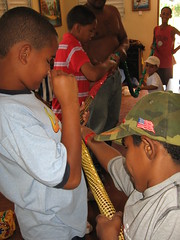
It took five people - well, 4.5 - to put the cover on this morcilla on the last day of carnival.
Lechones rebel!!
2/25/07
On Saturday night, I had sort of vaguely been planning on heading to Rancho Merengue to hear Kinito Mendez. It was an out-of-the-ordinary event for RM, as Kinito is not a típico musician but an orquesta one who has become famous for his fusions with palos music. I was curious to see him live, although I was also kind of tired from our late night in Moca the night before. At any rate, my dilemma over evening plans was solved for me when I received a call from my friend Denio of the palos group, Grupo Mello. They were planning on rehearsing tonight and would like me to come. So I decided to exchange expensive commercial palos for free down-home palos. The exchange paid off in the form of some balsie practice, the learning of some new coros, and of course, beer, rum, and conversation.
I couldn’t party too much though, since Sunday was the final day of Santiago’s carnival and I needed to be well-rested in order to endure the rigors of the parade route. As usual, I went early to Tonito’s house to do some last-minute preparations. Tonito was of course doing the same: he and his son had decided to use white costumes from a few years back, loaning last year’s golden models to those who wanted to dress up but couldn’t afford costumes of their own. This meant they had to glue back on all the bells and buttons that had been stripped from the old costumes for recycling, fill in empty spaces with scraps of glitter fabric and sequined trim, and re-cover an old morcilla (the tube-shaped cummerbund) in sequin and lame remnants. The last part was the funniest: when the morcilla was unwrapped and laid out, it reached all the way from the living room into the kitchen, and I compared it to an anaconda in the jungle. Getting the tube of fabric Tonito had prepared onto it involved the efforts of four people, bucket brigade-style.
There had been no time for me to get my own whip, but it was just as well: after last week’s practice I’d woken the next day with intense neck and shoulder pain. I could suffer plenty without that added burden. My newly-purchased bladders, now, thankfully, dried out and mostly smell-free, would be enough for me. Over at Betania’s we all got dressed, a much larger group now than at any of the previous events. One was a kid who had grown up in New York but was sent back here four years ago after getting mixed up in some trouble at school. He was anxious to practice his English with me, and hopes to go back to NY soon to finish high school and then attend college. Jose was also there. He told me that some of the other groups of lechones have numerous New York members who come back specifically for carnival; back in the Big Apple they have stateside branches of the group in order to dress up and participate in New York’s carnival and Dominican Day parades.
The previous day had been cool and breezy, so I’d been hoping Sunday would be the same, but no such luck. It was a hot one and I was sweating and thirsty inside my suit before we even started. There was a lot more waiting around this week, as all the groups attempted to get in line in a somewhat orderly fashion along Av. Imbert, while news reporters weaved their way in and out, looking for comments on the “situation.”
Here’s the situation: last year, differences between the Federation of (barrio) carnival groups and the Carnival Committee of (wealthy) official types were finally resolved in the last week, and all the groups ended up following the designated parade route along Las Carreras and around the Monument area. This year, the differences worsened and the governor of Santiago refused to negotiate with the Federation; thus, all Federation member groups agreed not to parade on the official route in protest. Instead we would parade through the barrios where carnival has always had a home and the support of the people, and where, some argued, the “true” carnival still existed. In effect, this served to divide the celebration into two carnivals this year, one for the rich and one for the poor, something that hasn’t been seen since the days of the “Carnaval Social” in the elite Centro de Recreo during the Trujillo era.
The only groups that went up to the monument area were the random, unorganized groups that always appear on the last day, the officially sponsored floats, and the few groups of lechones that do not belong to the Federation who have their own sources of funding and do not belong to the Federation. If this had happened in New York, the giant inflatable rat would surely have made an appearance, greeting them all at the Monument.
At any rate, we counted are Carnaval Barrial a success. We made the point we intended to make, and we brought carnival to the people. The people liked. I even ran into my friend, folklorist Rafael Almanzar, down by the Plaza Valerio. (As a good leftie, he was conscience-bound to attend our carnival and not the other.) The only bad moment was when, coming down a sidestreet, we passed a badly decaying animal carcass of some sort, and then got stuck in a carnival traffic jam when right in the midst of that ungodly stench. It was not as bad as the fresh bladders in my car, but close, and there was no relief other than a lechon sleeve over the nose.
Our route took us once again through the traditional carnival barrios of Pueblo Nuevo, Baracoa, and La Joya. As night fell, we arrived back at Betania’s, and one of our helpers jumped on top of their wall to make a speech detailing how we could be proud because we’d just done something unmentionable to the governor in an unmentionable spot. We cheered.
No one knows where carnival will take us next year, or if there will be water to drink there, but plans are already underway for the costume we will use.
The next morning, I crossed the street to visit my neighbor, Raudy, the Robalagallina. As a member of the Santiago elite he had naturally been at the “other” carnival and expressed his disappointment that I hadn’t been able to see him in costume. I didn’t feel like getting into a political argument, so I shrugged and said I was also sorry he hadn’t been able to see me in costume. We both smiled in agreement of our disagreement. He was on his way to the Gran Gala de Carnaval in the capital, and told me that he could provide me with tickets for me and my friends if I came. I did feel that, after all my barrio carnival experience, I should see the other face of the festivities, so I decided to make the trip. Over the last few weeks I’ve had a lot of work done on the car, and so I though it would be good to put it to a road test. I felt sure the Falcon would pass, what with its new battery, brake tank, lights, rotors, CV boots, oil, oil cap, and gas filter. After lunch, a few hasty phone calls, and an alignment and tire rotation for my car, the Falcon and I were on our way.
We made it fine to the capital, although it took as long to cover the last kilometer in Gazcue than it had to go the previous 60 k. This was because of the construction of the Metro, whose future tunnel passes just a few blocks from where I usually stay, meaning that half of the Av. Maximo Gomez is currently missing. But we did make it eventually, just in time to meet my friend Dario for a hasty dinner purchased from the Supermercado Nacional’s cafeteria and pick up his friend, Marta, before going to the Teatro Nacional.
I thought Raudy had said the show would start at 8:00, but Dario assured me that everything in this theater started promptly at 8:30. In fact, he told me, there had been a whole series of commercials stating this fact a few months back, in an effort to get people to show up on time rather than on Dominican time. The only thing was that we needed to be there early if we wanted to get the tickets from Raudy, and it was 8:26 when we picked up Marta. I was a little worried. I was a little more worried when I couldn’t get ahold of Raudy on either of his two cell phones (“in case one doesn’t get a signal,” he’d told me). I was still more worried when the ushers told us they didn’t have our tickets and they couldn’t get Raudy for us as the show had started at 8. But luck was with us: a manager took pity on us and let us go up to the balcony. Still luckier: when we got into the theater, we found the house lights were still on. Apparently, things hadn’t started yet. As we took our seats, the emcee was making an announcement to the effect that, because so many people had arrived late, they had been forced to delay the show a half an hour.
The performance consisted of a couple of introductory dance numbers, one provided by Ocean World park near Puerto Plata and featuring sea-inspired costumes, and another that was a sort of modern dance/merengue number with a background of lechones, provided by the Santiago group of Los Tuaregs. Then there was a competition between five towns: Bonao, Santo Domingo, Puerto Plata, San Francisco de Macoris, and Santiago. Each had brought a “comparsa” (they called them that, even though they didn’t in the least resemble the semi-theatrical carnival street troupes that the term usually refers to) that performed about six minutes of choreography on a certain theme in elaborate costumes.
Bonao’s was “Soy Dominicano,” so they were naturally costumed in red, white, and blue, and performed mostly merengue moves. The tambora was used as a central symbol, and giant cutouts of accordion and güira also appeared on stage. In the middle of the piece, the dancers went offstage and out came ice cream vendors ringing their bells, a guy talking on his cell phone while buying fruit, etc, to the great amusement of the audience. Santo Domingo’s theme was simply “Fantasia,” a catch-all term used for anything that doesn’t fall into any traditional carnival theme but that captures its colorful exuberance. Both costumes and choreography were nice to see, but it didn’t really say anything. Puerto Plata’s was the most confusing, as it seemed to be a sort of a South Pacific theme that combined tiki masks, a smoking volcano, and grass skirts, but it also gave you the most to look at. San Francisco de Macoris had a religious theme, with a living Madonna on a platform and the dancers in white, even featuring a section of palos music (but which seemed to have little to do with the movements or costumes that accompanied it).
And finally, Santiago, whose theme was its own carnival. A single lechon posed on stage with whip in hand as a film projected on the wall behind showed scenes of busy streets like Las Carreras and the Monument. Then the dancers emerged, their costumes evocative of lechones, Nicolas Den Den, and the Indios; near the end, a comical Robalagallina even made an appearance.
I enjoyed the show, because the choreography was interesting and the dancers were quite good. But I was a bit confused as to what it all had to do with carnival – or at least, what it had to do with Dominican carnival. The costumes consisted principally of spangled bikinis and feathered headdresses, or Carmen Miranda-esque ruffled gowns. I really didn’t see anything that resembled anything one would see in the streets of this country in February until we got to the Santiago number. But, I guess that is a difference between the carnivals of the elite and the carnivals of the barrios. The winners were announced: for choreography, Puerto Plata; for costumes, Santiago; third place overall San Francisco, second place Santiago (the crowd near me, mostly members of Los Tuaregs, went wild), and first, Puerto Plata. I guess they voted in favor of spectacle over theme.
After the show, we mingled with the elite and the intelligentsia. The Secretary of Culture was there; the great folklorist Dagoberto was there; a couple of very tall transvestites in absolutely incredible tiered and embroidered dresses were there with an entourage of the flamboyantly gay. The scene in the lobby was almost better than what we’d seen on the stage. By the time we exited, Raudy was already on the bus with the Tuaregs, ready to head back to Santiago, but we managed to at least say hello before they left. After that, a beer at our local colmado – accompanied by a new flavor of Lay’s, “pescado con coco.” It tasted like coconut, sure, but I wasn’t sure about the fish part.
On Saturday night, I had sort of vaguely been planning on heading to Rancho Merengue to hear Kinito Mendez. It was an out-of-the-ordinary event for RM, as Kinito is not a típico musician but an orquesta one who has become famous for his fusions with palos music. I was curious to see him live, although I was also kind of tired from our late night in Moca the night before. At any rate, my dilemma over evening plans was solved for me when I received a call from my friend Denio of the palos group, Grupo Mello. They were planning on rehearsing tonight and would like me to come. So I decided to exchange expensive commercial palos for free down-home palos. The exchange paid off in the form of some balsie practice, the learning of some new coros, and of course, beer, rum, and conversation.
I couldn’t party too much though, since Sunday was the final day of Santiago’s carnival and I needed to be well-rested in order to endure the rigors of the parade route. As usual, I went early to Tonito’s house to do some last-minute preparations. Tonito was of course doing the same: he and his son had decided to use white costumes from a few years back, loaning last year’s golden models to those who wanted to dress up but couldn’t afford costumes of their own. This meant they had to glue back on all the bells and buttons that had been stripped from the old costumes for recycling, fill in empty spaces with scraps of glitter fabric and sequined trim, and re-cover an old morcilla (the tube-shaped cummerbund) in sequin and lame remnants. The last part was the funniest: when the morcilla was unwrapped and laid out, it reached all the way from the living room into the kitchen, and I compared it to an anaconda in the jungle. Getting the tube of fabric Tonito had prepared onto it involved the efforts of four people, bucket brigade-style.
There had been no time for me to get my own whip, but it was just as well: after last week’s practice I’d woken the next day with intense neck and shoulder pain. I could suffer plenty without that added burden. My newly-purchased bladders, now, thankfully, dried out and mostly smell-free, would be enough for me. Over at Betania’s we all got dressed, a much larger group now than at any of the previous events. One was a kid who had grown up in New York but was sent back here four years ago after getting mixed up in some trouble at school. He was anxious to practice his English with me, and hopes to go back to NY soon to finish high school and then attend college. Jose was also there. He told me that some of the other groups of lechones have numerous New York members who come back specifically for carnival; back in the Big Apple they have stateside branches of the group in order to dress up and participate in New York’s carnival and Dominican Day parades.
The previous day had been cool and breezy, so I’d been hoping Sunday would be the same, but no such luck. It was a hot one and I was sweating and thirsty inside my suit before we even started. There was a lot more waiting around this week, as all the groups attempted to get in line in a somewhat orderly fashion along Av. Imbert, while news reporters weaved their way in and out, looking for comments on the “situation.”
Here’s the situation: last year, differences between the Federation of (barrio) carnival groups and the Carnival Committee of (wealthy) official types were finally resolved in the last week, and all the groups ended up following the designated parade route along Las Carreras and around the Monument area. This year, the differences worsened and the governor of Santiago refused to negotiate with the Federation; thus, all Federation member groups agreed not to parade on the official route in protest. Instead we would parade through the barrios where carnival has always had a home and the support of the people, and where, some argued, the “true” carnival still existed. In effect, this served to divide the celebration into two carnivals this year, one for the rich and one for the poor, something that hasn’t been seen since the days of the “Carnaval Social” in the elite Centro de Recreo during the Trujillo era.
The only groups that went up to the monument area were the random, unorganized groups that always appear on the last day, the officially sponsored floats, and the few groups of lechones that do not belong to the Federation who have their own sources of funding and do not belong to the Federation. If this had happened in New York, the giant inflatable rat would surely have made an appearance, greeting them all at the Monument.
At any rate, we counted are Carnaval Barrial a success. We made the point we intended to make, and we brought carnival to the people. The people liked. I even ran into my friend, folklorist Rafael Almanzar, down by the Plaza Valerio. (As a good leftie, he was conscience-bound to attend our carnival and not the other.) The only bad moment was when, coming down a sidestreet, we passed a badly decaying animal carcass of some sort, and then got stuck in a carnival traffic jam when right in the midst of that ungodly stench. It was not as bad as the fresh bladders in my car, but close, and there was no relief other than a lechon sleeve over the nose.
Our route took us once again through the traditional carnival barrios of Pueblo Nuevo, Baracoa, and La Joya. As night fell, we arrived back at Betania’s, and one of our helpers jumped on top of their wall to make a speech detailing how we could be proud because we’d just done something unmentionable to the governor in an unmentionable spot. We cheered.
No one knows where carnival will take us next year, or if there will be water to drink there, but plans are already underway for the costume we will use.
The next morning, I crossed the street to visit my neighbor, Raudy, the Robalagallina. As a member of the Santiago elite he had naturally been at the “other” carnival and expressed his disappointment that I hadn’t been able to see him in costume. I didn’t feel like getting into a political argument, so I shrugged and said I was also sorry he hadn’t been able to see me in costume. We both smiled in agreement of our disagreement. He was on his way to the Gran Gala de Carnaval in the capital, and told me that he could provide me with tickets for me and my friends if I came. I did feel that, after all my barrio carnival experience, I should see the other face of the festivities, so I decided to make the trip. Over the last few weeks I’ve had a lot of work done on the car, and so I though it would be good to put it to a road test. I felt sure the Falcon would pass, what with its new battery, brake tank, lights, rotors, CV boots, oil, oil cap, and gas filter. After lunch, a few hasty phone calls, and an alignment and tire rotation for my car, the Falcon and I were on our way.
We made it fine to the capital, although it took as long to cover the last kilometer in Gazcue than it had to go the previous 60 k. This was because of the construction of the Metro, whose future tunnel passes just a few blocks from where I usually stay, meaning that half of the Av. Maximo Gomez is currently missing. But we did make it eventually, just in time to meet my friend Dario for a hasty dinner purchased from the Supermercado Nacional’s cafeteria and pick up his friend, Marta, before going to the Teatro Nacional.
I thought Raudy had said the show would start at 8:00, but Dario assured me that everything in this theater started promptly at 8:30. In fact, he told me, there had been a whole series of commercials stating this fact a few months back, in an effort to get people to show up on time rather than on Dominican time. The only thing was that we needed to be there early if we wanted to get the tickets from Raudy, and it was 8:26 when we picked up Marta. I was a little worried. I was a little more worried when I couldn’t get ahold of Raudy on either of his two cell phones (“in case one doesn’t get a signal,” he’d told me). I was still more worried when the ushers told us they didn’t have our tickets and they couldn’t get Raudy for us as the show had started at 8. But luck was with us: a manager took pity on us and let us go up to the balcony. Still luckier: when we got into the theater, we found the house lights were still on. Apparently, things hadn’t started yet. As we took our seats, the emcee was making an announcement to the effect that, because so many people had arrived late, they had been forced to delay the show a half an hour.
The performance consisted of a couple of introductory dance numbers, one provided by Ocean World park near Puerto Plata and featuring sea-inspired costumes, and another that was a sort of modern dance/merengue number with a background of lechones, provided by the Santiago group of Los Tuaregs. Then there was a competition between five towns: Bonao, Santo Domingo, Puerto Plata, San Francisco de Macoris, and Santiago. Each had brought a “comparsa” (they called them that, even though they didn’t in the least resemble the semi-theatrical carnival street troupes that the term usually refers to) that performed about six minutes of choreography on a certain theme in elaborate costumes.
Bonao’s was “Soy Dominicano,” so they were naturally costumed in red, white, and blue, and performed mostly merengue moves. The tambora was used as a central symbol, and giant cutouts of accordion and güira also appeared on stage. In the middle of the piece, the dancers went offstage and out came ice cream vendors ringing their bells, a guy talking on his cell phone while buying fruit, etc, to the great amusement of the audience. Santo Domingo’s theme was simply “Fantasia,” a catch-all term used for anything that doesn’t fall into any traditional carnival theme but that captures its colorful exuberance. Both costumes and choreography were nice to see, but it didn’t really say anything. Puerto Plata’s was the most confusing, as it seemed to be a sort of a South Pacific theme that combined tiki masks, a smoking volcano, and grass skirts, but it also gave you the most to look at. San Francisco de Macoris had a religious theme, with a living Madonna on a platform and the dancers in white, even featuring a section of palos music (but which seemed to have little to do with the movements or costumes that accompanied it).
And finally, Santiago, whose theme was its own carnival. A single lechon posed on stage with whip in hand as a film projected on the wall behind showed scenes of busy streets like Las Carreras and the Monument. Then the dancers emerged, their costumes evocative of lechones, Nicolas Den Den, and the Indios; near the end, a comical Robalagallina even made an appearance.
I enjoyed the show, because the choreography was interesting and the dancers were quite good. But I was a bit confused as to what it all had to do with carnival – or at least, what it had to do with Dominican carnival. The costumes consisted principally of spangled bikinis and feathered headdresses, or Carmen Miranda-esque ruffled gowns. I really didn’t see anything that resembled anything one would see in the streets of this country in February until we got to the Santiago number. But, I guess that is a difference between the carnivals of the elite and the carnivals of the barrios. The winners were announced: for choreography, Puerto Plata; for costumes, Santiago; third place overall San Francisco, second place Santiago (the crowd near me, mostly members of Los Tuaregs, went wild), and first, Puerto Plata. I guess they voted in favor of spectacle over theme.
After the show, we mingled with the elite and the intelligentsia. The Secretary of Culture was there; the great folklorist Dagoberto was there; a couple of very tall transvestites in absolutely incredible tiered and embroidered dresses were there with an entourage of the flamboyantly gay. The scene in the lobby was almost better than what we’d seen on the stage. By the time we exited, Raudy was already on the bus with the Tuaregs, ready to head back to Santiago, but we managed to at least say hello before they left. After that, a beer at our local colmado – accompanied by a new flavor of Lay’s, “pescado con coco.” It tasted like coconut, sure, but I wasn’t sure about the fish part.
Thursday, March 01, 2007
Chiqui Taveras "a trio"
My friend Chiqui plays in the rain in Moca as wife Laura helps out with the umbrella. This was an impromptu midnight serenade for a sick musician.
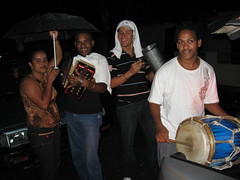
Music in Moca
2/21-2/24/07
I had my first actual accordion lesson of the year at Rafaelito’s, and while I was at it, I had Manaury start pimping my MySpace profile. He’d been itching to do this for sometime. We started with an electric blue background, but rest assured that that is just a start.
Much of the rest of the week was spent fighting various species of itches. Itchiness and warfare with various insects seems to be integral to my way of life here. So far the new strategy I’ve employed against the evil ant army seems to be working. I have been studying the behavior of the little tiny light brown ants that have been plaguing me ever since I first came here in 2004. They move incredibly fast compared to their sluggish U.S. counterparts and in chaotic patterns, rather than along the neat pathways. They also send out lone little scout ants all over the place in search of food, but there is a significant time lag between when the scouts make a discovery and when they are able to return home, communicate the information to their neighbors, and amass sufficient forces for invasion of my kitchen. Therefore, I can keep my cereal on top of the refrigerator until the scouts show. Then I move it to the counter, and vice versa. Ha! You ants will never get your filthy, microscopic hands on my Kashi!
I did have a brief intermission to conduct another carnival-related interview, however, and to attend the opening of a carnival-related exhibit at the Centro Leon. I enjoyed the photographs of the bladders much more than I’d enjoyed their smell last week.
I had recovered from a particularly nasty form of itch by Friday, which was lucky, as it enabled me to take a quick trip to the nearby town of Moca where my friend Chiqui Taveras was scheduled to play some tunes for a friend’s birthday party. Equally luckily, I’d just got new CV boots put on the Falcon so we were ready to rock. We picked up Chiqui, Laura, and the tambora and güira player that were to accompany him at the mini-gig and headed east out of town, on the “good” road through Licey al Medio to Moca. One thing I really hate in this country is driving on “highways” at night: when the power is out (which is usually) you can’t see where the potholes are hiding (which is everywhere), and the other drivers who refuse to turn down their brights (all of them) blind you from seeing those motorbikes that have no lights or reflectors (most of them). It is a harrowing experience, and when we eventually made it to Moca my eyes were burning. I realized I hadn’t blinked the entire time from the strain of watching for potholes in the darkness.
Nothing much was happening yet when we arrived. It was a large two-story house with a carport and tile floors, indicating the licenciado’s position in life as a successful businessman in this medium-sized town. He and his friends were seated around a table on the patio in back, separated by a barbed-wire fence from a plantain grove behind. The light from the energy-saving bulb everyone here uses was kind of eerie in the midst of all that darkness. Someone was getting a barbecue fired up on the other end of the porch, and most of the women were busy in the kitchen. We took our seats at one end of the table and were soon brought beer. Before long, hors d’oeuvres were served too: olives and cheese, peanuts and raisins, and guacamole and chips.
The licenciado told me about how he’d met Chiqui. Many years ago, he’d been traveling in Dajabon, where he got into a discussion with some friends about who was the best musician in the area. A difference of opinion arose, and one of the others suggested that they weren’t in possession of all the facts. “There’s an accordionist here who you really must see. This guy knows how to play.” He took the others to Chiqui’s house where they requested a few merengues. The licenciado ended up agreeing that Chiqui was the best in Dajabon, and they have been friends ever since.
Though not an old man, this guy seemed to be a real traditional rural leader type, the kind of “big man” in the country that has always supported merengue típico. So to him, a party just wasn’t a party without a perico ripiao. He said that he liked to hear “merengues de mangas largas,” an expression I’d never heard. Just what would a “long-sleeved merengue” be? They said they were the classics, the kind people here usually called “merengues de fiesta,” but that didn’t explain why they were long-sleeved. Laura suggested it was because long sleeves keep out the cold. It’s an interesting metaphor.
While the music was traditional Cibaeño fare, the audience for it was quite international. Besides myself, there were two Cubans there: one an old man who had been in the country for 20 years, and one a young man who had just come five months ago, disillusioned from his life working in Cuban tourism. Now, he ran his own cafeteria and had purchased a piece of land. He liked merengue típico, though when the dancing began I found he had a much more aggressive style of dancing it than do the smooth-moving Dominicans. Well, most of them move smoothly. One guy at this party, though, made his appearance at the top of the steps doing some kind of crazy kicking step, jumping from one foot to another in something that looked much more like quebradita than merengue.
The musicians played for some time, joking about getting through “two sets” as if they were in a night club. As at any gathering of true aficionados, they played the older, more difficult Tatico-era repertoire, sometimes joined by “guest vocalists” from among the guests. After a while, they made me play a couple of tunes – something I’d been afraid could happen, since I was completely unprepared. I haven’t really played in months, and so while I remember how to start about 40 merengues, I only remember how to finish about two of them, and my technique sucks. It was pretty embarrassing, but the licenciado cheered me up. “Hey, I’m impressed you can play any merengues at all. I have an accordion in there,” he said, pointing into the house. “It’s been there for ten years and I still can’t play a note.”
Eventually, it was time for food: enormous legs of turkey from the grill (for them, not me, clearly) and slabs of casabe flat bread. This was followed by a round of the birthday song, in both Spanish and English, accompanied by the trio. Dominicans end it with neither the “shave and a haircut” bit nor “and many more…” as Americans might, but with a different tag ending that signifies “se está poniendo viejo" (he’s getting old), to which the celebrant replies that it isn’t viejo but “bueno” (he’d getting good). Finally the cake came out, slathered in Dominican-style dulce de leche. It was definitely a sugar O.D.
Around midnight, it was decided to put an end to the party and the music. But there was still one more thing we had to do. There was an old musician, Manolo, who used to play with Tatico and was now ailing here in town. He was scheduled to go in for heart surgery this very week and everyone was concerned about his health. So in order to cheer him up, we would bring him a serenata and play three merengues for him in front of his house. When we arrived the street was dark, no one was in sight, and it was starting to rain. But as soon as the musicians started playing, a few neighbors came out to hear, including one drunkard that kept pulling at my elbow.
I had my work to do, too, though: holding my umbrella up to keep the tambora dry. It’s kind of hard for a modern-day tamborero to play a serenata, since tamboras no longer have straps attached for playing while standing. Instead, this guy had to balance the drum first on the trunk of the car and then against a tree. It all made for a very picturesque sight. I also found it touching, how bonds are reinforced between musicians by way of a couple of midnight melodies. There is definitely a sense of brotherhood here, and a sense of indebtedness to those musicians who came before.
Soon, Manolo himself appeared, umbrella in hand, a stout, elderly, dark-skinned man in a baseball cap and colorful shirt. He was pleased with the display of affection and shook all our hands. We wished him well and disappeared into the night as quickly as we had appeared.
I had my first actual accordion lesson of the year at Rafaelito’s, and while I was at it, I had Manaury start pimping my MySpace profile. He’d been itching to do this for sometime. We started with an electric blue background, but rest assured that that is just a start.
Much of the rest of the week was spent fighting various species of itches. Itchiness and warfare with various insects seems to be integral to my way of life here. So far the new strategy I’ve employed against the evil ant army seems to be working. I have been studying the behavior of the little tiny light brown ants that have been plaguing me ever since I first came here in 2004. They move incredibly fast compared to their sluggish U.S. counterparts and in chaotic patterns, rather than along the neat pathways. They also send out lone little scout ants all over the place in search of food, but there is a significant time lag between when the scouts make a discovery and when they are able to return home, communicate the information to their neighbors, and amass sufficient forces for invasion of my kitchen. Therefore, I can keep my cereal on top of the refrigerator until the scouts show. Then I move it to the counter, and vice versa. Ha! You ants will never get your filthy, microscopic hands on my Kashi!
I did have a brief intermission to conduct another carnival-related interview, however, and to attend the opening of a carnival-related exhibit at the Centro Leon. I enjoyed the photographs of the bladders much more than I’d enjoyed their smell last week.
I had recovered from a particularly nasty form of itch by Friday, which was lucky, as it enabled me to take a quick trip to the nearby town of Moca where my friend Chiqui Taveras was scheduled to play some tunes for a friend’s birthday party. Equally luckily, I’d just got new CV boots put on the Falcon so we were ready to rock. We picked up Chiqui, Laura, and the tambora and güira player that were to accompany him at the mini-gig and headed east out of town, on the “good” road through Licey al Medio to Moca. One thing I really hate in this country is driving on “highways” at night: when the power is out (which is usually) you can’t see where the potholes are hiding (which is everywhere), and the other drivers who refuse to turn down their brights (all of them) blind you from seeing those motorbikes that have no lights or reflectors (most of them). It is a harrowing experience, and when we eventually made it to Moca my eyes were burning. I realized I hadn’t blinked the entire time from the strain of watching for potholes in the darkness.
Nothing much was happening yet when we arrived. It was a large two-story house with a carport and tile floors, indicating the licenciado’s position in life as a successful businessman in this medium-sized town. He and his friends were seated around a table on the patio in back, separated by a barbed-wire fence from a plantain grove behind. The light from the energy-saving bulb everyone here uses was kind of eerie in the midst of all that darkness. Someone was getting a barbecue fired up on the other end of the porch, and most of the women were busy in the kitchen. We took our seats at one end of the table and were soon brought beer. Before long, hors d’oeuvres were served too: olives and cheese, peanuts and raisins, and guacamole and chips.
The licenciado told me about how he’d met Chiqui. Many years ago, he’d been traveling in Dajabon, where he got into a discussion with some friends about who was the best musician in the area. A difference of opinion arose, and one of the others suggested that they weren’t in possession of all the facts. “There’s an accordionist here who you really must see. This guy knows how to play.” He took the others to Chiqui’s house where they requested a few merengues. The licenciado ended up agreeing that Chiqui was the best in Dajabon, and they have been friends ever since.
Though not an old man, this guy seemed to be a real traditional rural leader type, the kind of “big man” in the country that has always supported merengue típico. So to him, a party just wasn’t a party without a perico ripiao. He said that he liked to hear “merengues de mangas largas,” an expression I’d never heard. Just what would a “long-sleeved merengue” be? They said they were the classics, the kind people here usually called “merengues de fiesta,” but that didn’t explain why they were long-sleeved. Laura suggested it was because long sleeves keep out the cold. It’s an interesting metaphor.
While the music was traditional Cibaeño fare, the audience for it was quite international. Besides myself, there were two Cubans there: one an old man who had been in the country for 20 years, and one a young man who had just come five months ago, disillusioned from his life working in Cuban tourism. Now, he ran his own cafeteria and had purchased a piece of land. He liked merengue típico, though when the dancing began I found he had a much more aggressive style of dancing it than do the smooth-moving Dominicans. Well, most of them move smoothly. One guy at this party, though, made his appearance at the top of the steps doing some kind of crazy kicking step, jumping from one foot to another in something that looked much more like quebradita than merengue.
The musicians played for some time, joking about getting through “two sets” as if they were in a night club. As at any gathering of true aficionados, they played the older, more difficult Tatico-era repertoire, sometimes joined by “guest vocalists” from among the guests. After a while, they made me play a couple of tunes – something I’d been afraid could happen, since I was completely unprepared. I haven’t really played in months, and so while I remember how to start about 40 merengues, I only remember how to finish about two of them, and my technique sucks. It was pretty embarrassing, but the licenciado cheered me up. “Hey, I’m impressed you can play any merengues at all. I have an accordion in there,” he said, pointing into the house. “It’s been there for ten years and I still can’t play a note.”
Eventually, it was time for food: enormous legs of turkey from the grill (for them, not me, clearly) and slabs of casabe flat bread. This was followed by a round of the birthday song, in both Spanish and English, accompanied by the trio. Dominicans end it with neither the “shave and a haircut” bit nor “and many more…” as Americans might, but with a different tag ending that signifies “se está poniendo viejo" (he’s getting old), to which the celebrant replies that it isn’t viejo but “bueno” (he’d getting good). Finally the cake came out, slathered in Dominican-style dulce de leche. It was definitely a sugar O.D.
Around midnight, it was decided to put an end to the party and the music. But there was still one more thing we had to do. There was an old musician, Manolo, who used to play with Tatico and was now ailing here in town. He was scheduled to go in for heart surgery this very week and everyone was concerned about his health. So in order to cheer him up, we would bring him a serenata and play three merengues for him in front of his house. When we arrived the street was dark, no one was in sight, and it was starting to rain. But as soon as the musicians started playing, a few neighbors came out to hear, including one drunkard that kept pulling at my elbow.
I had my work to do, too, though: holding my umbrella up to keep the tambora dry. It’s kind of hard for a modern-day tamborero to play a serenata, since tamboras no longer have straps attached for playing while standing. Instead, this guy had to balance the drum first on the trunk of the car and then against a tree. It all made for a very picturesque sight. I also found it touching, how bonds are reinforced between musicians by way of a couple of midnight melodies. There is definitely a sense of brotherhood here, and a sense of indebtedness to those musicians who came before.
Soon, Manolo himself appeared, umbrella in hand, a stout, elderly, dark-skinned man in a baseball cap and colorful shirt. He was pleased with the display of affection and shook all our hands. We wished him well and disappeared into the night as quickly as we had appeared.
Thursday, February 22, 2007
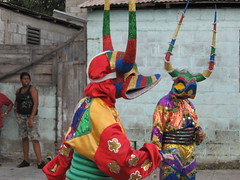
La Captura de Saddam Hussein
New for 2007! This comparsa shows Saddam in his supposed hiding place getting surround by guys with big guns.
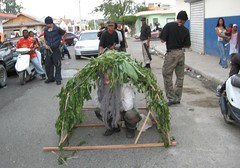
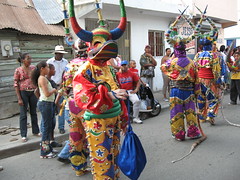
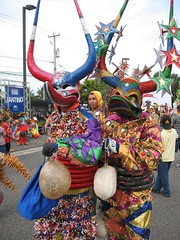
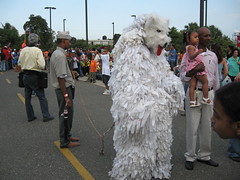
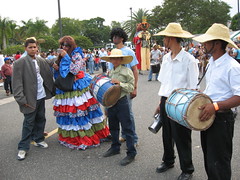
Taimascaro
This is a recently invented tradition from Puerto Plata that draws on Taino imagery with colorful results.

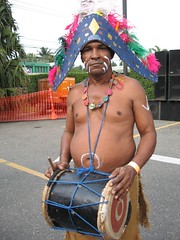

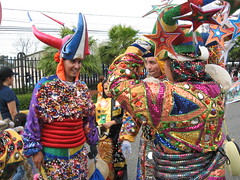
Constanza devils
I guess they're meant to a kind of devil, but this group took their inspiration from leprechauns!
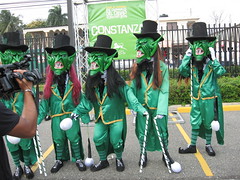
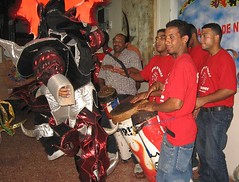
Navarrete devil
The town of Navarrete, northwest of Santiago, has been working for the last ten years on developing its own unique mask style, with results such as this.
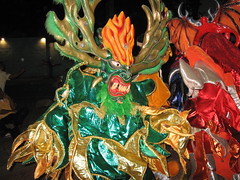
Navarrete Judas
This face of Judas, surrounded by peso coins and hellfire, is the emblem of Navarrete's carnival.
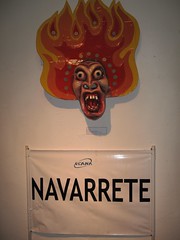
The Laws of the Land
2/16-2/21/07
I went back to Rafaelito’s to set up, finally, a time for my lesson. We did that, and he told me that week he’d dreamed of me twice. I interpreted his dreams for him. First, he had been given some cake, and he decided to share it with me. The cake, I said, represented típico music, which was also sweet: it had been given to him and he was passing it on to me. In the second dream, he was in his bathroom getting ready for something, when I walked in wearing a housedress and got right into the shower, apparently not caring that it was his bathroom and he was already in it. He made clear that I wasn’t naked or anything, but that in the dream he had found it strange that I would just waltz right in like that. I said this meant that he felt I was putting myself in places I didn’t really belong and were a strange context to find me in, places that perhaps belonged to others - like ranchos and galleras. He found my explanations “logical.”
Everyone’s discussing plans for Semana Santa already and I am going to have a hard time deciding between all my invitations. The Turbi brothers, the guys who taught me to play palos, thought we should all go together to their hometown of Las Matas de Farfan, near San Juan de la Maguana in the Southwest. Then, I finally got to see my friend Domingo Arias, and he and his wife offered to take me along with them to their hometown of Bani. Chiqui and Laura will be going to Dajabon, of course, and we’ve been meaning to take that trip together for quite some time. And Almanzar, who took me to Barahona and Cabral last year, will be returning there again – I wouldn’t mind seeing the final day of the Cabral carnival, where the Judas mannequin is burned and all the cachuas gather in the town graveyard to pay homage to cachuas who have passed on with a frenzy of whipcracks. Any votes or suggestions? This is a tough decision.
On Friday, Luis “Terror” Diaz was scheduled to play at my friendly neighborhood bar with the friendly neighborhood name, Te Matare Batista. Clearly, I had to go. I was familiar with his many musical works of the last thirty years, which run the gamut from bachata to merengue to rock and jazz, often in combination. He’s a great guitarist and a great songwriter, but I hadn’t met him in person until this week. I enjoyed talking to him, even though he expressed some ideas about the history of the accordion that could only be described as uniquely his own. (When one finds oneself in the midst of a conversation that seems to have come from a universe only roughly parallel to one’s own, I generally find the best strategy is to stay quiet.)
The gig was basically an affair among friends, which didn’t allow him to truly shine. His young wife joined him, singing in public for only the second time ever, and that was about as good as one could expect from a student making her second appearance. The bar owner then sang vocals on the Cuban tune “Chan Chan.” The most popular performance of the evening was Luis’s solo rendition of his own song, “El gringo dijo, ‘What’s your name’,” which then led the audience into a lengthy political discussion that kept us up way past our bedtimes.
After the brief interlude with my musician friends, it was back to carnival. Though I really meant for carnival to be a side project, it is a very time consuming one and during Feburary I really spend far more time on that than on things típico. But at any rate, I find myself kind of at loose ends on the dissertation research, as I have so many interviews already I don’t really want to do much more there, and I am feeling a bit overloaded with information that still needs to be analyzed. If I could think of a new tack to take with it, that might help, but such inspiration has not yet come to me.
Therefore, on Saturday, I found myself at the Centro Leon for their “tarde de carnaval.” Carnival groups had been invited from all over the region, and representatives had come from Santiago, Constanza, Puerto Plata, Cotui, Bonao, Samana, Sanchez, and Fantino. Costumes and masks were many and varied: menacing leprechauns from Constanza, papuleses in their giant robes of leaves from Cotui, animal figures from Samana, and the taimascaros of Puerto Plata in their creative Taino-inspired masks, pants covered in oyster shells. All the groups took to the streets and made a circuit of Hoya del Caimito, the barrio to the east and south of the Centro Leon to the delight of residents far from the traditional centers of carnival. Then, back at the Centro Leon, they each had time on stage to strut their stuff and to visit with each other.
I took advantage of the chance to make a circuit and made contact with folks from Bonao and Samana, and plans to visit them later. Then I chatted with my fellow Santiagueros. While lechones don’t have any particular music of their own, some of the other local comparsas do and I thought I’d try to find out more about what they played. The head of the comparsa de los Indios carries a small, tambora-like drum on which he plays a simple rhythm he calls “Areito” after the dances the Taino Indians are reported to have done at the time of the conquest. The güira and tambora that accompany Nicolas Den-Den, the dancing bear, play another rhythm that is unique to that character; they demonstrated it for me and explained that was what was used because it was “good for walking.” Robalagallina also has a guira and tambora that follow him/her around, and they reported that they always play a pambiche rhythm, which is not too fast and goes well with the traditional rhyme always shouted after the character.
Although I’d planned on dressing up and participating myself, I didn’t have the chance because of the borrowed mask situation. Still, I have to say that after seeing all the different groups, each beautiful in its own way, I felt really proud to see the lechones. Now that I understand, from inside the mask as it were, what it takes to be one year after year, and now that I personally know those who make that commitment, I feel the pride and the power that all lechones feel when they put on their costumes each year. Their expertise with the whip and their movements - the lechon “dance” – are unique and wonderful to see – a true embodiment of the carnival spirit. I’m usually on the street with and among them, but seeing the lechones on stage, spreading their special brand of joy, was a revelation.
Afterwards, I chatted with a couple of them over their free meals, provided by the Centro Leon. (I didn’t get a meal, but I did get beer!) Juan Carlos, it turns out, was only in his second year as a lechon – just like me! – but one of our companions, a guy who had gone on the trip to Monte Plata with me last year and who wears a very traditional kind of costume made simply of brightly-colored cotton fabric, has been dressing up for 16 years – since he was 7 years old. No wonder his lechon moves and whip technique are so flawless. Polanquito was there, too, and was proud to say that he’s been a lechon every year since 1965. He relished the bouncy lechon dance and loves to tell everyone, “I don’t get tired!” And it’s true. I wondered if he even slept and he assured me that he does. I also asked how he got so into the thing and he credits his childhood in the barrio of Los Pepines for that. He got involved in the years during which carnival was still very violent, and lechones would fight with knives and stones, with a scar from a well-thrown rock on his chin to prove it.
A brief aside: I’ve been surprised and pleased to find out that since I left last year, a number of my carnival friends here have now seen this blog. As a result, Betania and Juan Carlos asked me to put up this new picture of them in costume (see above). So far, all friends, teachers, and informants report who have stumbled across it report that they like it, especially Jose Reyes who says he is happy to see I give credit where credit is due. I explained that I understood what that was about, being that the majority of web sites devoted to merengue típico today have posted a history of típico that I originally wrote for my típico site back in 2001, without crediting me. Jose agrees that that sucks. So we ask that if you cite anything on my blog anywhere else in virtual, print, or spoken form, please give credit, and do not reprint any significant portion anywhere without permission.
Saturday was a long day, and there was another, even longer one, coming up next. I hit the hay early to prepare, but I had also prepared by arranging to bring my own photographer with me: my friend Laura (Chiqui’s wife), famous for cutting off everyone’s heads when she photographed her daughter’s quinceanera last year. I wanted to give her another chance to prove herself, and also I wanted some pictures of Los Confraternos and couldn’t do them myself while I was in costume. As soon as I was ready on Sunday, then, I went and picked up Laura, and then we picked up her daughter and 2 cousins who had decided to come along for the ride, and then all four of us went to Tonito’s. It was not a pleasant ride. I’d bought two bladders in preparation for the day’s parade but they turned out to be rather fresher than I’d imagined, and they filled the Millenium Falcon with an ungodly stench. It was quite possible the worst smell ever. We wrapped them in plastic and threw them in the trunk, but it didn’t help much.
Anyway, I had work to do: I had shoes to decorate lechon-style. This took a couple of hours, so it was lucky that Laura et al had children with whips and a newborn to entertain themselves with. Eventually we did finish and costumed ourselves, and then I had a few minutes in which to undertake some whip practice. I actually improved a bit! If I can get ahold of a whip – Tonito says they get them from the guy who makes them in Los Ciruelitos – then maybe I’ll actually use one next week, although I confess I had second thoughts the next day when I woke up with an incredibly sore neck and shoulder.
The day before, Polanquito had told me this week’s route was shorter than last week’s, but if it was, than I’m the dancing bear’s uncle. It took over three hours to travel the whole length, and we went through parts of Santiago I’d never seen before. The path was so long and twisty and went through so many unfamiliar streets that I became completely disoriented. At one point we were winding our way down a hill in a rather nice area with large houses overlooking what must have been the Rio Yaque, though I couldn’t see it from there. Across the way was a Hollywood Hills-style sign saying “Bermudez,” which I’d never seen before from any other vantage point. I felt as if I might have been magically transported to another city.
At that point we were in a bit of a traffic jam, so I took advantage of the few moments of rest to examine something on my leg that had been vaguely bothering me for a while. It turned out to be a safety pin that had come loose and bent so that it was scraping my leg, and it must have been doing so for quite some time because there were zillions of tiny bloody scratches covering a patch of skin about three inches square on the back of my left shin. One of our lechon assistants helped me pull the pin out and showed me how its shaft was brown: “look, it’s your blood!” “Well, sometimes you have to suffer for art,” I replied. I just hoped I wouldn’t get some kind of horrible infection from the rusty pin – were my tetanus shots up to date? No way to know.
Once we started moving again, however, I quickly forgot my pain in the rush of carnival-fueled adrenaline. There was plenty going on around to distract me: Angelo, the mask-maker, was right behind us taking part in a comparsa depicting a boxing match with its own movable ring. Behind that was a mini theater piece titled “La Captura de Saddam Hussein,” which consisted of a hideout covered in leaves under which a long-bearded Saddam was hiding (he’d apparently been there a while). When some military guys with scary-looking guns stormed the place, he ran out and they hauled him off in dramatic fashion.
It even rained a few drops on us, providing a little relief from the heat, though I was still pouring sweat inside that costume. I sent my friends off to buy me some water and, later, a refreshing Skim Ice popsicle in guanabana flavor. We passed a renovated two-story house on Abua Rodriguez street in Pueblo Nuevo where, apparently, a painter lived: the family sat on the balcony surrounded by surprisingly good paintings of lechones and other carnival scenes, watching the action passing them by. Thus I was able to keep on dancing until we returned home, pausing only to shake confused babies’ hands, and for parents to take pictures of their kids with me. Then I hastily and painfully applied some rubbing alcohol to my wounds. I couldn’t decide if I was more tired or more hungry, but eventually hunger won out and I took the whole group with me to eat some street pizza.
Back to work. My post-carnival routine has become to take the first couple of days of each week to (a) recover and (b) write up notes and organize photos, recordings, etc. This week I continued with that plan, although I also snuck a quick interview in there with Raudy, the famed Robalagallina who lives across the street. It was enlightening. When I asked what were the most important qualities a Robalagallina must have, he told me they must master the “cara de puta” (whore’s face). He had accomplished this feat by studying fashion magazines. “So it’s basically Dominican voguing?” I asked. “Exactly,” he agreed. I don’t think it would ever have occurred to me if I hadn’t had this conversation.
In addition, I went out for a night on the town on Monday. The owner of my friendly neighborhood bar had offered to take me along to a place he sometimes dances to old-school son on Mondays, and it turned out to be the same place the researchers at Centro Leon had mentioned to me. Clearly, it was a sign, so I accepted the invitation. Six of his friends, who were out celebrating a birthday, decided to join us.
It was just a hole-in-the-wall bar on a residential street in Pueblo Nuevo, no sign and no real name. Everyone simply refers to it as “Donde Dorca,” Dorca’s place. My friend explained to me on the way over that Dorca was a retired prostitute, as were many others who frequented the establishment. Perfect! Local color! I did love the place although I was getting a little weirded out about how prostitution seemed to be a theme for the week). It was about the size of my mom’s living room back in Tucson, with the band set up at one end and about ten small plastic tables along the walls in the rest of the space. The tables were populated both by couples and by male soneros sitting alone or in pairs in their dapper hats and shiny shoes. The presumed retired prostitutes sat up by the door, manning the money box.
The band consisted of lead vocalist, tres, congas, güira, bass, keyboards, and another percussionist who played bongos, tambora, or whatever was demanded. A pair of what appeared to be the thigh bones of a large animal lay on a table nearby, and though I was told they were meant to be played as claves, I didn’t see them played while I was there. I’m not a fan of synthesized horns in general, but the band was good to dancing to, and played everything from classic sones to merengue típico to boleros. Their announcer was a guy in his seventies who was pretty funny. He kept referring to the virtues of Dorca’s, as if we needed any reminding: it was “Barato! Y bueeeeeeeeeeno!” (Cheap, and good!)
I videotaped some of the more stylish dancers, one of whom was completely androgenous and somewhat disconcerting in his/her straight-legged jeans, button-down striped shirt, and short haircut. I eventually figured out it was a woman who liked to dance both roles, and for some unknown reason, she presented me with a small green paperback book of Dominican labor laws. “What’s this about?” I asked my friends. “We don’t know; just take it,” they recommended. So I did.
I went back to Rafaelito’s to set up, finally, a time for my lesson. We did that, and he told me that week he’d dreamed of me twice. I interpreted his dreams for him. First, he had been given some cake, and he decided to share it with me. The cake, I said, represented típico music, which was also sweet: it had been given to him and he was passing it on to me. In the second dream, he was in his bathroom getting ready for something, when I walked in wearing a housedress and got right into the shower, apparently not caring that it was his bathroom and he was already in it. He made clear that I wasn’t naked or anything, but that in the dream he had found it strange that I would just waltz right in like that. I said this meant that he felt I was putting myself in places I didn’t really belong and were a strange context to find me in, places that perhaps belonged to others - like ranchos and galleras. He found my explanations “logical.”
Everyone’s discussing plans for Semana Santa already and I am going to have a hard time deciding between all my invitations. The Turbi brothers, the guys who taught me to play palos, thought we should all go together to their hometown of Las Matas de Farfan, near San Juan de la Maguana in the Southwest. Then, I finally got to see my friend Domingo Arias, and he and his wife offered to take me along with them to their hometown of Bani. Chiqui and Laura will be going to Dajabon, of course, and we’ve been meaning to take that trip together for quite some time. And Almanzar, who took me to Barahona and Cabral last year, will be returning there again – I wouldn’t mind seeing the final day of the Cabral carnival, where the Judas mannequin is burned and all the cachuas gather in the town graveyard to pay homage to cachuas who have passed on with a frenzy of whipcracks. Any votes or suggestions? This is a tough decision.
On Friday, Luis “Terror” Diaz was scheduled to play at my friendly neighborhood bar with the friendly neighborhood name, Te Matare Batista. Clearly, I had to go. I was familiar with his many musical works of the last thirty years, which run the gamut from bachata to merengue to rock and jazz, often in combination. He’s a great guitarist and a great songwriter, but I hadn’t met him in person until this week. I enjoyed talking to him, even though he expressed some ideas about the history of the accordion that could only be described as uniquely his own. (When one finds oneself in the midst of a conversation that seems to have come from a universe only roughly parallel to one’s own, I generally find the best strategy is to stay quiet.)
The gig was basically an affair among friends, which didn’t allow him to truly shine. His young wife joined him, singing in public for only the second time ever, and that was about as good as one could expect from a student making her second appearance. The bar owner then sang vocals on the Cuban tune “Chan Chan.” The most popular performance of the evening was Luis’s solo rendition of his own song, “El gringo dijo, ‘What’s your name’,” which then led the audience into a lengthy political discussion that kept us up way past our bedtimes.
After the brief interlude with my musician friends, it was back to carnival. Though I really meant for carnival to be a side project, it is a very time consuming one and during Feburary I really spend far more time on that than on things típico. But at any rate, I find myself kind of at loose ends on the dissertation research, as I have so many interviews already I don’t really want to do much more there, and I am feeling a bit overloaded with information that still needs to be analyzed. If I could think of a new tack to take with it, that might help, but such inspiration has not yet come to me.
Therefore, on Saturday, I found myself at the Centro Leon for their “tarde de carnaval.” Carnival groups had been invited from all over the region, and representatives had come from Santiago, Constanza, Puerto Plata, Cotui, Bonao, Samana, Sanchez, and Fantino. Costumes and masks were many and varied: menacing leprechauns from Constanza, papuleses in their giant robes of leaves from Cotui, animal figures from Samana, and the taimascaros of Puerto Plata in their creative Taino-inspired masks, pants covered in oyster shells. All the groups took to the streets and made a circuit of Hoya del Caimito, the barrio to the east and south of the Centro Leon to the delight of residents far from the traditional centers of carnival. Then, back at the Centro Leon, they each had time on stage to strut their stuff and to visit with each other.
I took advantage of the chance to make a circuit and made contact with folks from Bonao and Samana, and plans to visit them later. Then I chatted with my fellow Santiagueros. While lechones don’t have any particular music of their own, some of the other local comparsas do and I thought I’d try to find out more about what they played. The head of the comparsa de los Indios carries a small, tambora-like drum on which he plays a simple rhythm he calls “Areito” after the dances the Taino Indians are reported to have done at the time of the conquest. The güira and tambora that accompany Nicolas Den-Den, the dancing bear, play another rhythm that is unique to that character; they demonstrated it for me and explained that was what was used because it was “good for walking.” Robalagallina also has a guira and tambora that follow him/her around, and they reported that they always play a pambiche rhythm, which is not too fast and goes well with the traditional rhyme always shouted after the character.
Although I’d planned on dressing up and participating myself, I didn’t have the chance because of the borrowed mask situation. Still, I have to say that after seeing all the different groups, each beautiful in its own way, I felt really proud to see the lechones. Now that I understand, from inside the mask as it were, what it takes to be one year after year, and now that I personally know those who make that commitment, I feel the pride and the power that all lechones feel when they put on their costumes each year. Their expertise with the whip and their movements - the lechon “dance” – are unique and wonderful to see – a true embodiment of the carnival spirit. I’m usually on the street with and among them, but seeing the lechones on stage, spreading their special brand of joy, was a revelation.
Afterwards, I chatted with a couple of them over their free meals, provided by the Centro Leon. (I didn’t get a meal, but I did get beer!) Juan Carlos, it turns out, was only in his second year as a lechon – just like me! – but one of our companions, a guy who had gone on the trip to Monte Plata with me last year and who wears a very traditional kind of costume made simply of brightly-colored cotton fabric, has been dressing up for 16 years – since he was 7 years old. No wonder his lechon moves and whip technique are so flawless. Polanquito was there, too, and was proud to say that he’s been a lechon every year since 1965. He relished the bouncy lechon dance and loves to tell everyone, “I don’t get tired!” And it’s true. I wondered if he even slept and he assured me that he does. I also asked how he got so into the thing and he credits his childhood in the barrio of Los Pepines for that. He got involved in the years during which carnival was still very violent, and lechones would fight with knives and stones, with a scar from a well-thrown rock on his chin to prove it.
A brief aside: I’ve been surprised and pleased to find out that since I left last year, a number of my carnival friends here have now seen this blog. As a result, Betania and Juan Carlos asked me to put up this new picture of them in costume (see above). So far, all friends, teachers, and informants report who have stumbled across it report that they like it, especially Jose Reyes who says he is happy to see I give credit where credit is due. I explained that I understood what that was about, being that the majority of web sites devoted to merengue típico today have posted a history of típico that I originally wrote for my típico site back in 2001, without crediting me. Jose agrees that that sucks. So we ask that if you cite anything on my blog anywhere else in virtual, print, or spoken form, please give credit, and do not reprint any significant portion anywhere without permission.
Saturday was a long day, and there was another, even longer one, coming up next. I hit the hay early to prepare, but I had also prepared by arranging to bring my own photographer with me: my friend Laura (Chiqui’s wife), famous for cutting off everyone’s heads when she photographed her daughter’s quinceanera last year. I wanted to give her another chance to prove herself, and also I wanted some pictures of Los Confraternos and couldn’t do them myself while I was in costume. As soon as I was ready on Sunday, then, I went and picked up Laura, and then we picked up her daughter and 2 cousins who had decided to come along for the ride, and then all four of us went to Tonito’s. It was not a pleasant ride. I’d bought two bladders in preparation for the day’s parade but they turned out to be rather fresher than I’d imagined, and they filled the Millenium Falcon with an ungodly stench. It was quite possible the worst smell ever. We wrapped them in plastic and threw them in the trunk, but it didn’t help much.
Anyway, I had work to do: I had shoes to decorate lechon-style. This took a couple of hours, so it was lucky that Laura et al had children with whips and a newborn to entertain themselves with. Eventually we did finish and costumed ourselves, and then I had a few minutes in which to undertake some whip practice. I actually improved a bit! If I can get ahold of a whip – Tonito says they get them from the guy who makes them in Los Ciruelitos – then maybe I’ll actually use one next week, although I confess I had second thoughts the next day when I woke up with an incredibly sore neck and shoulder.
The day before, Polanquito had told me this week’s route was shorter than last week’s, but if it was, than I’m the dancing bear’s uncle. It took over three hours to travel the whole length, and we went through parts of Santiago I’d never seen before. The path was so long and twisty and went through so many unfamiliar streets that I became completely disoriented. At one point we were winding our way down a hill in a rather nice area with large houses overlooking what must have been the Rio Yaque, though I couldn’t see it from there. Across the way was a Hollywood Hills-style sign saying “Bermudez,” which I’d never seen before from any other vantage point. I felt as if I might have been magically transported to another city.
At that point we were in a bit of a traffic jam, so I took advantage of the few moments of rest to examine something on my leg that had been vaguely bothering me for a while. It turned out to be a safety pin that had come loose and bent so that it was scraping my leg, and it must have been doing so for quite some time because there were zillions of tiny bloody scratches covering a patch of skin about three inches square on the back of my left shin. One of our lechon assistants helped me pull the pin out and showed me how its shaft was brown: “look, it’s your blood!” “Well, sometimes you have to suffer for art,” I replied. I just hoped I wouldn’t get some kind of horrible infection from the rusty pin – were my tetanus shots up to date? No way to know.
Once we started moving again, however, I quickly forgot my pain in the rush of carnival-fueled adrenaline. There was plenty going on around to distract me: Angelo, the mask-maker, was right behind us taking part in a comparsa depicting a boxing match with its own movable ring. Behind that was a mini theater piece titled “La Captura de Saddam Hussein,” which consisted of a hideout covered in leaves under which a long-bearded Saddam was hiding (he’d apparently been there a while). When some military guys with scary-looking guns stormed the place, he ran out and they hauled him off in dramatic fashion.
It even rained a few drops on us, providing a little relief from the heat, though I was still pouring sweat inside that costume. I sent my friends off to buy me some water and, later, a refreshing Skim Ice popsicle in guanabana flavor. We passed a renovated two-story house on Abua Rodriguez street in Pueblo Nuevo where, apparently, a painter lived: the family sat on the balcony surrounded by surprisingly good paintings of lechones and other carnival scenes, watching the action passing them by. Thus I was able to keep on dancing until we returned home, pausing only to shake confused babies’ hands, and for parents to take pictures of their kids with me. Then I hastily and painfully applied some rubbing alcohol to my wounds. I couldn’t decide if I was more tired or more hungry, but eventually hunger won out and I took the whole group with me to eat some street pizza.
Back to work. My post-carnival routine has become to take the first couple of days of each week to (a) recover and (b) write up notes and organize photos, recordings, etc. This week I continued with that plan, although I also snuck a quick interview in there with Raudy, the famed Robalagallina who lives across the street. It was enlightening. When I asked what were the most important qualities a Robalagallina must have, he told me they must master the “cara de puta” (whore’s face). He had accomplished this feat by studying fashion magazines. “So it’s basically Dominican voguing?” I asked. “Exactly,” he agreed. I don’t think it would ever have occurred to me if I hadn’t had this conversation.
In addition, I went out for a night on the town on Monday. The owner of my friendly neighborhood bar had offered to take me along to a place he sometimes dances to old-school son on Mondays, and it turned out to be the same place the researchers at Centro Leon had mentioned to me. Clearly, it was a sign, so I accepted the invitation. Six of his friends, who were out celebrating a birthday, decided to join us.
It was just a hole-in-the-wall bar on a residential street in Pueblo Nuevo, no sign and no real name. Everyone simply refers to it as “Donde Dorca,” Dorca’s place. My friend explained to me on the way over that Dorca was a retired prostitute, as were many others who frequented the establishment. Perfect! Local color! I did love the place although I was getting a little weirded out about how prostitution seemed to be a theme for the week). It was about the size of my mom’s living room back in Tucson, with the band set up at one end and about ten small plastic tables along the walls in the rest of the space. The tables were populated both by couples and by male soneros sitting alone or in pairs in their dapper hats and shiny shoes. The presumed retired prostitutes sat up by the door, manning the money box.
The band consisted of lead vocalist, tres, congas, güira, bass, keyboards, and another percussionist who played bongos, tambora, or whatever was demanded. A pair of what appeared to be the thigh bones of a large animal lay on a table nearby, and though I was told they were meant to be played as claves, I didn’t see them played while I was there. I’m not a fan of synthesized horns in general, but the band was good to dancing to, and played everything from classic sones to merengue típico to boleros. Their announcer was a guy in his seventies who was pretty funny. He kept referring to the virtues of Dorca’s, as if we needed any reminding: it was “Barato! Y bueeeeeeeeeeno!” (Cheap, and good!)
I videotaped some of the more stylish dancers, one of whom was completely androgenous and somewhat disconcerting in his/her straight-legged jeans, button-down striped shirt, and short haircut. I eventually figured out it was a woman who liked to dance both roles, and for some unknown reason, she presented me with a small green paperback book of Dominican labor laws. “What’s this about?” I asked my friends. “We don’t know; just take it,” they recommended. So I did.
Friday, February 16, 2007
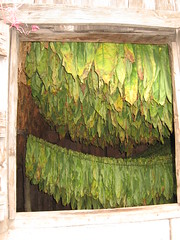

guandules
a very old woman shucking pigeon peas (guandules) in Batey Libertad. The pea harvest had just come in, so that's what everyone in the batey was doing this particular afternoon.
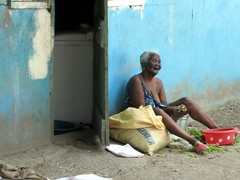
bad guy
This painting is just one of many done by a Haitian artist based in Esperanza in Casco's office. It depicts one of the guys you need to watch out for, because he likes blood.
Casco's office
If you need help, you can get it from Casco Pelao (and San Miguel) in his office. The price: 57 pesos and a bottle of rum. He charges 57 since 7 is a powerful number.
Casco Pelao
that's the name by which this curandero (traditional) healer is known. He decided to pose by the portrait of one of the saints who helps him in his work.
Vodou drums
three drums for playing vodou rhythms, belonging to the curandero of Batey Libertad, Dominican Republic. The two big ones on the left are "mama tambou" and the medium-sized one on the right is a "dudu"
Subscribe to:
Posts (Atom)