mangrove swamp at Rio San Juan
Friday, April 13, 2007


Saturday, April 07, 2007
Travels with Mom, part 2
4/4/07
The path was very steep and muddy, making me glad we were on horseback. A short ways into our trip we came across another group of tourists, Europeans, waiting for the rest of their party next to a little pond. We passed by as many of them as we could – they were too slow for us with two small, saddle-scared children – and made our way slowly and carefully up through grassy slopes and palm trees. Tiny pineapples grew by the side of the path.
At the top of the ridge was the most perfect little house, painted green with white shutters, surrounded by a vast expanse of naturally occurring lawn, reachable only by horse or by foot, its ramshackle outhouse across the path in a field. The guides told me an old man lived there, farming his plantains and other crops with the best view in town from his rocking chair.
About fifteen minutes later we had made our way down the other side and past a crashing cascade they told me was “the small one,” getting out of the saddle next to a kind backwoods colmado looking a bit like an old west trading post. Behind it, one could look very carefully over a precipice at the top of the waterfall, but it was hard to judge distance from that angle and gauge how tall it really was. So we went down the now even steeper, no-horse footpath to get to the pool at the bottom, accompanied by someone’s little black and white dog. At the bottom we found two swimming holes filled with cold water of a glacial green, the waterfall crashing down from above and covering everything and everyone in a cool mist. According to my guide book, the thing is 53 meters high.
A few daring Dominican teenagers managed to climb their way up the rock face under the pounding water, one of them reaching perhaps twenty feet before cannonballing into the pool below. I wasn’t feeling quite that brave, but since we were there, we had to get in, at least enough to take a picture for the old scrapbook. I managed to get thigh-deep – for about four seconds. I have never made any secret of the fact that I am a cold water wimp, and that water was not only cold, but it was not a warm day, either, with the sun coming and going from behind the clouds. A quick dip was enough for me. Mom, on the other hand, long notorious for being even more of a wimp than me, actually swam around the whole thing, something which no one in the family will ever believe but which I swear is true.
Once reclothed, we and our temporary dog tripped our way back up the path, passing a Domninican tour group of perhaps a dozen people, one of them carrying an enormous piece of hand luggage. “Moving in?” we asked. “For a couple of hours,” was his reply. Must have been some party. When we reached the semi-colmado where our horses and second guide awaited, we mounted our trusty steeds, sure-footed Carmelo and stubborn Ceniza, and packed out what we’d packed in. Passing a few other groups hiking in, tiredly enquiring how far they had to go, the guide and I had a bit of fun at their expense by telling each that it was “only another hour or two now.”
If anything, the landscape seemed even more spectacular on the way back. But we’d forgotten entirely about the scenery along the path in our excitement over the falls and so had left our cameras in the backpack, inaccessible, and thus that perfect house and the impossibly steep, impossibly green ridges dropping down on either side of us are only in our memories.
Caked with mud, we took advantage of the little bathroom and sink in the parada’s parking lot to change clothes and wash ourselves and our shoes. We decided to save road time by eating the apples and nuts we had in the car for lunch, but we’d only gone a few yards before we had to stop again. One of our guides, apparently with a sister and small daughter, was madly hailing us from the side of the road, so we cleared out the back seat as best we could to give them a lift. (Gave them an apple, too).
We deposited them at their mother’s house, halfway to Samana, and continued on our way. This time we were hoping to take a bit more time and get some nice pictures of houses and interesting businesses along the way, so we divided our roles into (a) driver and (b) scenery-watcher. (B) was supposed to shout out “Stop!” whenever something impossibly cute or scenic was spotted, but the plan turned out to be completely unworkable because of (A)’s difficulties in making time, avoiding potholes, and keeping the drivers behind from getting overly horn-happy. It became kind of comical to listen to (b): “Oh, look at that! That’s a good one!” and then, “Oooooooh… never mind, too late. Next time, maybe.” This occurred approximately every 90 seconds until we hit Nagua, where we stopped for a bathroom and batida break before pushing on through, this time onto a highway I’d never traveled before, up the northeastern coast.
Now it really felt like a road trip. We were in unknown territory, speeding along a surprisingly well-paved road. The towns we passed through were so tiny they were not marked on either of my two road maps, nor were they mentioned in the guide book. In between them were vast stretches of fields, hills, marshes, and often, the sea visible off to our right – anything and everything except for civilization. The Falcon seemed to be feeling just as fine as we were as it ate up the kilometers. Perhaps the mechanic was right and we could make it to Puerto Rico. Imagine our surprise when we found out we, in fact, had done just that, as one of the ubiquitous blue Brugal-sponsored signs that mark roadside settlements told us we had arrived in a place called “Puerto Rico A Pie” – Puerto Rico By Foot. This definitely wasn’t on our map.
It was tempting to stop and see what exactly this hamlet might have to offer in terms of diversion, or even simply in terms of explanations for itself, but we had a lot of ground to cover before we got to anyplace likely to hold a hotel. We took a quick turn through Cabrera, the small coastal town from which El Prodigio hails, and then pushed on to Cabo Frances. This northeastern tip of the island was marked as a national park on one of our maps and we were curious as to what it might hold.
Eventually we found a friendly Brugal sign marking the turnoff, but the lip of the road was too high and the road too rough-looking for the Falcon to take on without further information. A few yards further, we came across a man walking alongside the road and stopped to ask about the place. He was Haitian and his Spanish wasn’t so hot, though, so we moved on to a clump of teenage boys. One of them filled us in on Cabo Frances. “It’s a lighthouse.” “Oh! Is it nice? Is it pretty there?” “No! It’s falling down,” he answered honestly, and I laughed. We probably would have found it interesting nonetheless, but it wasn’t worth losing an axle over, so we went on. A bit farther we passed some more mysterious ruins, stone walls weathered down to only a few feet tall, under a palm-topped cliff.
According to our guide book, there were some lovely beaches along this coast, but the writer warned us that they had all been bought up by large hotel chains and would be full of tourists and touristic developments in no time. We pulled off the main road to take a look, stopping first at Punta Preciosa. This was not a swimming beach by any means, but a wild rocky point above a short stretch of sand that ended in another cliff, that one with a small islet off its tip. It was exceedingly scenic as well as windy and choppy. Later we learned that there is an old sunken ship under its waters, a bit of which can be seen sticking up above the waves at low tide.
Just about a half-kilometer further was Playa Grande, the one our book had assured us would quickly become over-developed and practically uninhabitable by the more discerning traveler. We turned off where Brugal directed us to, parked on the dirt amidst palm trees, and strolled down to the glorious, long, sandy beach where about four other foreigners were scattered to watch the four Dominicans working at surfing in the choppy waters. “Development!” Mom exclaimed in worried tones, pointing at a half-dozen shacks selling fish and beer back among the palms. It would have been a lovely place to spend the day sunning and consuming Presidente if it hadn’t been so late already. It reminded me of Oahu’s north coast, where I had been similarly watching surfers only a few months earlier.
Pushing ever onward, we came to Rio San Juan, one of our possibilities for lodging that night, but which had few hotels listed in our guide book. Rio San Juan used to have a dive shop offering scuba excursions, but it’s now closed; the town is mostly known for its unusual lagoon. We took a quick turn around the place, noting two hotel possibilities, one on the rocky coast, looking breezy and cool in its white lobby if a bit run down, the other a couple of blocks from the lagoon, and looking somewhat uninhabited. The town had a couple of beaches but just small ones, on either side of the breezy option. We decided to decide after looking at the Laguna Gri-Gri.
It was right there, seemingly in the middle of town: quiet waters with a dozen small boats afloat on it, shaded everywhere by towering trees sprouting right out of the water. Cement steps led from a little plaza down into the lagoon, and next to them an information booth – closed. There was only one person there to talk to, an old man sitting on a step next to the two-spot car park, so we talked to him. He quickly scared up a couple of guys with a boat, who started to make it ready before we’d even agreed to a tour. This turned out to be over-priced, even after a negotiated deduction, but we decided to do it anyway since we were there and all.
Our guide explained that the waters came from a subterranean river that emerged at that very spot, and that the lagoon’s name came from the trees surrounding it, also called gri-gri. They drove us slowly through a stand of mangroves, very slowly because of the illegal fishing nets strung across our path in spots. There was a swamp house on stilts, just like in Louisiana, and then more illegal fisherman – these ones teenage boys in a wooden boat known as a cayuco, pushing themselves along by pole and looking for eels. Egrets flew above us and some kind of vulture strutted along the interwoven tree roots below.
Emerging from the eerie mangrove swamp, we came out into the choppy waters of the ocean, passing by a minuscule island with a bit of ruined wall on the ocean side. The guide told us it used to be a restaurant, but was destroyed by Hurricane David back in the 1970s. It was hard to imagine a restaurant could fit on such a tiny slice of land, but he explained that it used to be larger, with a dock even, until it started getting washed away due to lack of care. We continued all the way down past the Bahia Blanca hotel and the so-called “Playa de la Guardia,” a beach known for the shacks at its back, occupied by military men. Then we returned the way we came, making sure to note another important local site – “Playa del Amor,” so named because “two go in and three come out.” Didn’t look like it could fit more than two anyway, buried in a sort of thicket as it was, but we were assured 8 could fit if a party were required.
The guide also informed me that land was for sale right on the coast for $65 a square meter. “I can’t do much with a meter,” I complained. When they suggested I buy more than one, I pointed out that things would then become expensive very quickly and they nodded sagely. “Well, buy a meter then. You can grow some flowers,” was the guide’s solution.
Manatees were supposed to live in mangroves like this, I remembered, and asked about them. These locals had seen many of them, both here and up the river from which the town takes its name, but they explained that the manatees don’t like to come out in high, rough seas like this. (The maritime conditions also eliminated the possibility for us to visit the Cave of the Swallows, usually the last stop on this trip, two kilometers the other way up the coast.) At any rate, when the manatees appear they are happy to see them and so are the tourists. The guide said they are so calm, quiet, and slow that they stay right by the boat without moving, allowing everyone to photograph them to their hearts’ content. I hope to return in calm seas next year and see them then.
We’d seen all we could. In fact, we’d seen so much it was hard to believe we’d only left Las Terrenas that morning. The sun was still up, though not for much longer. The guide thought we could make it to Cabarete in an hour so we decided to go for it, opting for the tourist mecca over the sleepy seaside town. This way, we’d have plenty of sleeping and dining options, and we’d have a shorter drive back to Santiago the next day.
Unfortunately, we didn’t make it far before the sun went down, and then Mom had to experience the dubious joys of nighttime driving in the DR – the hidden potholes lurking in the darkness, the blinding lights of other drivers, the inadequacy of our own lights in the unlit streets. Still, we made it, and found a lovely hotel right on the beach with breakfast included – always our favorite part. We particularly enjoyed the European-style bathroom, since we hadn’t showered all day, and the restaurant on the sand with its beer (though that, too, was served European style, which is to say, at a temperature Dominicans would term “hot”). We didn’t so much enjoy the overpowering air-conditioning, but our porter had showed us that it could be deactivated by opening the sliding glass door to the porch, so we did that, and slept the sleep of those who have sat all day in a bucket seat, enduring numerous potholes in a car with questionable shocks.
We arose the next morning fully ready for a final morning at the beach. We hadn’t even gotten much of a look at it the night before, since it was already dark when we arrived, but were pleasantly surprised both by the plentiful breakfast and the beach full of dozens of colorful kites. For us, Cabarete did live up to its reputation as kite-surfing capital of the world, and though we’d never seen this sport before, we were impressed and entertained by the many surfers who went flying past at high speed. I wondered what would happen if two kites got tangled, but we never saw this happen. We did see plenty of hot shots doing spins and flips as their kites pulled them through the air, even jumping far into the air as if they might fly away altogether. This free entertainment, coupled with a paperback murder mystery and sunshine, made for a perfect morning. We felt rested and relaxed as we got back on the road, making for Santiago, if a bit sad that it was mom’s last day in the country!
Instead of the usual highway through Puerto Plata, this time we decided to try the so-called “touristic highway” that splits off near Sosua and gets to Santiago via Gurabo. It appeared to be a short cut, eliminating many kilometers and the trafficky way around Puerto Plata city, and the hotel receptionist assured us the road was fine: even though it “had a lot of curves,” it would be faster than the other way.
The touristic road was certainly scenic, more so than the Puerto Plata route, but we appeared to be the only tourists on it. Also, maybe the road was usually good, but our informant clearly had not taken into account the recent rains. At several points, we were held up at construction sites guarded by military personnel. One was an apparent mudslide, and the road was still covered with the gooey stuff. The sedan in front of us got stuck, but the Falcon valiantly held out in second gear. At another, a piece of the road had simply dropped down the cliff, not an encouraging site, but on the bright side, half of the curve had recently been reinforced with rocks in chicken wire cages.
Because of the lack of tourists, there was also a lack of services on this road. In one little section, there were a ton of tiny businesses advertising amber for sale, and there was a roadhouse there too, but we didn’t pass anything else similar until we were already down in Santiago. The only thing to do was enjoy the views of the Cibao valley stretching out below us, the flamboyán trees just starting to put out their flame-colored flowers, and the roadside stands selling fruit. One had a variety I’d never seen before: a bright, pinkish-red thing, small and elongated, the shape of a half-size avocado. (Later I described it to Rafaelito, who told me it was the fruit of the cashew tree.)
Thus concluded our road trip, DR style, as well as Mom’s vacation. Well, almost – we had a couple more gifts still to buy at the Mercado Modelo, and I still had to pay my totally stupid and unjust parking ticket.
Wednesday, April 04, 2007


Tai Chi in Las Galeras
this is what the Europeans do when on vacation in Las Galeras, Samana, apparently


We Love The Bus!!!!!!!!
fun times on the way back from carnival in Villa Gonzalez. (photo by my mom)

Jose Reyes
this is his very nice new costume (photo by my mom) - he wanted to be sure I showed it on the blog, so here it is!!


travels with my mom, part 1
4/1/07
This week’s long delay in blogging has again been due to traveling and visitors: this time my mom came for her nearly traditional annual vacation in the DR. We spent the first four days of her visit tooling around Santiago, shopping, visiting friends, playing dominoes. She turned out to be particularly lucky in her timing, however, since the day before she arrived I received a call from Tonito of Los Confraternos notifying me of a carnival event on Sunday in Villa Gonzalez. I was surprised to hear carnival was still going on so late, and guessed that this must be the latest carnival in the region, but then I was told that Navarrete would still be having one the following Sunday – April 1 – and that the one after that, Easter Sunday, carnival would still be held in Montecristi. Is there now any doubt at all that this is the most carnival-happy nation?
After a bit of shopping at the Mercado Modelo and a visit to Angelo the mask maker on Sunday morning, we convened with the other Confraternos at Betania’s house at 1:30 to await the arrival of the bus the Villa Gonzalez organizers had kindly sent for us. Eventually, it came, as did some friend and neighbor lechones who had decided to join up with Los Confraternos for the day. We hopped on and passed Tonito’s bottles of Brugal around in order to warm up as we watched the sky anxiously, wondering if rain would come or not.
We had done Villa Gonzalez last year, so I knew pretty much what to expect and explained as much to mom: first, we would wait around for a long, long time, until we got hungry and had to look for snacks. Then, on a signal that seemingly came from nowhere, we would suddenly all have to get dressed in a hurry. Then we would wait around a while longer and then we’d finally join in the parade with all the groups from other Cibao towns. It wouldn’t be too long of a parade because the town wasn’t that big, and then we’d all go home again.
It did work like that, more or less, although it involved even more waiting, and in costume, when it’s practically impossible even to bend over, much less get comfortable. The clouds gathered and we continued to wait, apparently for it to start raining, as Julio pointed out. The firemen came by on their truck, as did a group of taimascaros from Puerto Plata and a float depicting Santiago’s monument on the back of a red pickup truck. Some guy, either drunk, insane, or both, danced suggestively on the raised platform in the middle of the town square all by himself.
Finally, well after 4:00, we began. The route was only about half of what we usually do in Santiago but it still couldn’t be called short. We had to sprint the last few blocks, too, when the downpour finally began. I’d been soaked to begin with – from sweat – and finally we were all thoroughly drenched, sore, and tired when we boarded the bus back. Everyone was in high spirits though, and the ride back was far more animated than the ride up had been. There was much shouting, singing, dancing, and playing of air guitars along with the bachata songs the driver blasted for our amusement. Funny how being exhausted can actually make people more energetic.
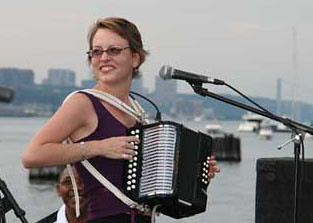
On Monday I actually attended my accordion lesson, after having missed it for several weeks in a row, then learned a new dominoes game. On Tuesday, I had to catch up on some work. Turned out I have to organize a press conference, of all things, in conjunction with this Folkways recording I’m producing here. And turned out that organizing a press conference here is a completely ridiculous undertaking, like throwing a wedding party or something. Invitations must be sent, follow-up phone calls must be made, refreshments and snacks must be served and, I’m told, even the tables must be decorated and flower arrangements purchased. I agreed to write up the invitations, and I secured a room at the Centro Leon for our location, but I’ve left the rest to La India who, I hope, knows far more about such things than I do.
That night we attended an opening at the Centro Leon, although since it was not a visiting show but simply the latest installment of the ongoing Dominican fine arts exhibit, there were not as many people (or as many speeches) as usual. Still, we got free beer, and also Nixon Roman (Rafaelito’s son) and El Prodigio’s saxophonist were there playing típico duets, something I don’t think anyone had ever conceived of before.
We kept our free-beer-drinking to a minimum, though: first, because I still had work to do afterwards, and second, in order to not jeopardize our plans for the morning. We had to get up early in order to get contracts Fed-Ex’d off to Washington and hit the road early if we wanted to get to Samana at a decent hour. It’s a long drive out there.
Our Dominican road trip took us first to San Francisco de Macoris, a town known mainly for its drug dealers. After a long stretch of bone-jolting road from which the pavement had been recently removed, we began to pass gigantic mansions, all glass and columns, some still under construction. Once we got into town, those gave way to the car dealerships with fleets of SUVs in front. “My leetle horse!” mom called them, reminded of the corny Colombian drug lord in “Romancing the Stone.” As we exited town on its eastern edge, we took advantage of the giant La Sirena branch to use its sparkling bathrooms, and to comment on how interesting it was that this country town’s department store had a better selection than Santiago’s.
Outside of San Francisco one sees a lot of rice fields, practically glowing in their emerald greenness, a couple of rice factories, and some tiny towns where colmados (corner stores) consist of a 5x5 shack with hinged shutter, supplied with an ancient scale and the most basic of provisions and canned goods. There’s not much else until you get to Nagua, a hot and dusty town located where the Nagua river meets the sea. It doesn’t seem to have much to recommend it, which makes it all the more astounding that it is this land that has produced more great típico accordionists than any other. Exiting the town to the southeast and following along the coast, things become more scenic. Thick groves of palm trees grow all the way down to the water’s edge. The sea here is always choppy, which perhaps explains why no tourism has developed here, but the view of mountainous Samana topped with an eternal ring of fluffy clouds is amazing. In this crook of the island’s arm, the only dwellings are the small shacks of a fishermen’s village, a half-completed hotel, and some kind of Buddhist retreat with a big “om” symbol painted on the wall facing the highway. Things are changing, however: a brand-spanking-new rest stop was nearing completion when we passed through – probably the only one in the country.
Samana was an island when Chris Colombus first came here. But soon after, it became a peninsula as the channel between it and mainland filled up with sediment. Still, it was long a haven for pirates and visitors can easily see why: the rugged landscape and numerous tiny, rocky islands surrounding it must have provided a limitless supply of hideouts. Even today, the province retains a bit of its piratey feel. As soon as you cross into it from Nagua and begin the ascent to Sanchez, you can feel a difference in the air. It is hard to put your finger on what it is. It is the air with its inviting breeze; the sun, which seems to make the green of the trees and the blue of the ocean that much more intense; the pace of life and of walking, which seems slower here than back on mainland Cibao. Even the houses are different. The traditional structures are wooden ones, as startlingly painted as those in other small Dominican towns, but they have different air vent decorations above the doorways and windows, in straight-lined geometric patterns rather than the curved carvings of Santiago.
We arrived in the city of Samana (technically Santa Barbara de Samana) after 3 ½ hours on the road, and definitely ready to eat. Pescado con coco, the classic Samanese dish of whole freshly-caught fish cooked in coconut milk, was clearly in order, and we thought we could use some fried plantains, too. So we made a stop at my usual restaurant, Bambu, which is right on the Malecon and affords a nice view of the Samana bay. This isn’t a beach town but rather a port, so the bay is always full of sailboats, and the motor boats that take tourists out to see whales or the keys leave from a dock right in front of the restaurant. An elevated walkway connects two tiny, rocky keys covered with palms right in the middle of the bay to the land and a fancy hotel. The whole effect is very scenic, and the malecon itself has been well-tended since the town became a cruise ship stopoff point two years ago, so it’s pleasant just to walk along the water on the brick path with crow’s nest lookout towers every block or so.
I still needed to talk to my new friend Virgilio, the town’s former mayor, in order to see if I could meet with any folkloric musicians during my quick visit. I called but since he hadn’t showed up by the time we finished lunch, I decided to just stop by his place. Virgilio and the whole family – wife, children, aunts, uncles – all live on the second story of an unfinished apartment building. The first floor is just cement and rebar, but the apartments upstairs are nice and have both a great view of the bay and a comfortable ocean breeze. The stray dog, Anita, who always follows Virgilio around was waiting in front of his door as I knew she would be. She barked at us at first but let us pass after we greeted her – I think she remembered me from last time (I gave her a cookie).
Virgilio welcomed us in and we ended up spending much longer than intended, although that’s usually to be expected in this country. We looked at family pictures, talked about Samana and music, and he gave me a Samanese carnival mask to take home – a bull-faced devil pained in pink, red, and white. A cruise ship would be arriving the next day, he told us, and to entertain the tourists he’d organized a small folklore show. It would be a good opportunity to see some Samanese traditions and talk to the folks, so we made plans to be back in town the next day at 2:00 sharp.
We still had at least 45 minutes on the road before we got to our day’s final destination, Las Galeras – a little town literally at the end of the road on the very tip of the peninsula. I’d never been beyond Samana before, so didn’t know what to expect of either the town or the road. I discovered that the road was not great but tolerable, and very scenic. We passed a town with a small dock where boats set out for Cayo Levantado, then an enormous resort where the road turned into a kind of secret passageway between overhanging trees, and then a long stretch of open road leading over a hill and down again. We passed occasional Samanese houses in pink and blue, a small cemetery with a chapel dedicated to the virgin, and a few men going to or from the fields wearing rubber work boots and carrying long machetes. There were also horses and burros loaded with wicker baskets or sacks of plastic burlap full of fruits and vegetables, usually driven by small boys perched on rag-rug saddle blankets, or very old men. I also found my all-time favorite barber shop. A 3x3 wooden shack with a shutter propped open revealed a shelf with combs, brushes, a spray bottle. The barber sat in front on a tiny cement patio of about the same size where the work was apparently done. It would have been hard to build anything smaller.
Eventually we got to the end of the road and Las Galeras. It consisted of: the end of the road, and one other road. One intersection, no stoplights, about four restaurants. Hotels were to either side on the second road, but two were closed down. A nonfunctional Jeep was parked in front of one; the other was being converted into pricey condos, we were told. Our lodging options were therefore limited, but there were several nice spots, mostly run by French. We ended up staying in the only one with a Dominican manager, “Hotel Todo Blanco.” It was an old rambling Victorian type of hotel which reminded Mom of some she’d stayed in in Africa, and appropriately enough, it was all white. It had a spacious, airy feel and was right on the beach, separated from the sand by a garden of tropical flowers and a lush lawn, the kind that grows here naturally with no investment required. There was no air conditioning, but once we threw open the doors to our second-floor balcony, the ocean breeze provided all the cooling necessary.
We had had two main worries on our long drive. First, the weather: the country had been experiencing torrential downpours and powerful winds that had destroyed roads, caused mudslides, and toppled trees and power lines all over the place. We were hoping not to experience such a thing on our drive. Second, the car: while the Falcon had undergone extensive repairs and my mechanic had assured me it was now fit to go to Puerto Rico if I so desired (though I hadn’t known that swim capabilities had been included in the work he’d done), since that time I’d also had to replace some wet spark plugs that were causing the motor to die at random intervals. We were hoping the car was indeed in optimal working condition now, but I remembered all too well that the last time I’d been on a long drive it was just at the point that I’d been thinking “the car is running great!” that everything had gone to hell in a handbasket. This time, I’d be careful to neither say nor think anything about the Falcon’s performance – at least, not where it could hear me.
In the end, we lucked out. Clouds gathered that night and things got breezy; when we woke up the Falcon was covererd in raindrops, but we stayed dry. The Falcon did die, but not until Las Galeras. It was not exactly traffic central and it started again right away, so it was no big deal. The next morning it seemed fine once again. Perhaps we’d simply jostled something loose on one of the many uncovered and uncommonly deep drainage ditches we’d had to cross since Samana.
We were relieved to have reached our destination intact, but it was already nearing sunset. It had been a long day. Clearly, it was time to drink tropical rum beverages and pig out once again. The fish shacks right on the beach at the end of the road looked inviting and were full of the local expats, but we’d had fish for lunch and didn’t want to repeat. Instead, we walked up the street to see what we could find. The Italian restaurant was closed (it was 9 already), so we had our choice of one vaguely French one and two sort of international ones with nearly identical menus of fish and pasta. We decided on two courses: first, beer and a spinach and cheese crepe at Chez Denise in the company of Germans, then spaghetti and beer at Gri-Gri in the company of aged American hippies. Gri-Gri (aka La Esquinita) was far more happening, though, and before we were have done with our pasta it began its conversion into what was apparently the town’s only disco. The regular energy-saving lights went out, a spinning colorful disco light took its place, and a selection of electronica, funk, and yes, disco, began to emit from the speakers. Both the Americans and the Dominicans loved this, especially one middle-aged Dominican in shorts (must have spent too much time with the ex-pats) who needed neither partner nor encouragement to do his own disco solo.
After they got to “Staying Alive,” however, we decided it was probably best to get going.
Back at the hotel, we were enjoying the ocean breezes and a round of our newly-learned dominoes game when the lights went out. This happens often in the DR, sure, but at a large hotel one would expect them to have a generator or inverter that would kick in after a minute. This didn’t happen. After seeing the level of hotel development and the number of French tourists and expats in the area, we’d begun to be suspicious of our guide book, which had told us that Las Galeras was a sort of undiscovered tourist Shangri-la. But now it seemed that maybe Las Galeras really was at the end of the earth. They hadn’t provided us with a lantern or even a candle, so all we had to see by was the half moon and the tiny light on my keychain. We finished our game by its minute beam, but by the end my thumb was worn out from holding down its button, so it seemed that it was time for bed.
In the morning, we were the only ones in the breezy breakfast patio by the sea. Fresh fruit and juice, eggs, coffee, toast and jam helped rouse us from our beachy stupor. Well, that, and the yowlings of the breakfast room’s resident cat, Tigre, demanding that we share. The other guests seemed to have breakfaster earlier, as a big group of them were out on the lawn doing Tai Chi exercises in the appropriate outfits, even. (How had they known there would be a Tai Chi master here? We certainly hadn’t known until we saw the flyer – in German – on a table yesterday.) It was a bit of an upstairs-downstairs moment, as while the Europeans practiced their Tai Chi on the lawn, three young Dominican men were down on the beach just below doing toe-touches and stretches.
Before we’d come out here, Virgilio had given us the names of two people we should look up. One was the mayor. The other was named “Wow” (though written as Guao in Spanish). I was frankly incredulous that this could be anyone’s name, and of course it was only his nickname, but still. Virgilio told me he was a big man so I surmised that when people saw him, they said “Wow! What a big guy!” The woman at our hotel knew him well (I suppose it would be hard not to in a place of this size) and said she would send for him, telling him to arrive at 8:30 or 9 the next morning. She also said that Las Galeras was full of so many odd names that Guao had begun to seem quite normal to her. She herself had apparently escaped this strange curse of Las Galeras – her name was Juliana.
Just as we were finishing breakfast, two Dominican men came in from the beach and we greeted them in the customary fashion. They disappeared and then reappeared a few minutes later, the bigger one saying, “was one of you looking for me?” “Guao!” I exclaimed happily. “Yes, I have been wanting to meet the famous Guao. I also have a message for you from my friend Virgilio,” I explained, handing him the business card on which the former mayor of Samana had scrawled a note telling Guao that we were his special friends and he should treat us as he would Virgilio himself.
Guao smiled and told me Virgilio was a good man. “I helped him out during his campaign, and when he was mayor, he helped me too.” Later I found out that this district is about 75% PRD, the left-leaning party to which both Virgilio and Guao belonged. Guao had long worked in local politics, helping to incorporate the Galeras municipal district which ran from some distance down the Samana road all the way up to the mountains of the Cabo Cabron peninsula, locally known as Loma Travesada. However, Guao lost in the latest elections to a hardware store owner who had given out free lumber on the day before the elections. Well, the guy might have had the goods, but I can’t imagine he could have had a catchier name.
What we wanted was a ride to Playa Rincon on Guao’s boat. Unfortunately, Virgilio’s note didn’t seem to change the price any. There was one going rate for two tourists going to el Rincon, and that was the rate we got. We took it anyway, since we were anxious to see the place before having to go back to Samana city. Our ride, a fiberglass hull of perhaps 18 feet with a few bench seats, a Yamaha motor, and a whale’s tail painted on the side, awaited us just a few feet down the beach. It was tied up to a palm tree that also served as lamp post. Guao proudly told us that the craft was one of the original 3 boats of that type in Las Galeras; all had been acquired in 1998. “How did people get to El Rincon before that?” I inquired. “Wooden boats,” he explained. That also explained all the abandoned-looking canoe-like craft moldering all over the beach. Modernity had arrived late in Las Galeras, but now that it was here, canoes served little purpose.
So Diosmare, Guao’s companion, pushed us off and we set across the waves in a northwesterly direction. The sea was choppy, especially at the rocky point we had to skirt to enter the bay of Playa Rincon. We were bouncing way off our seats, and it was a bit of a miracle that neither us nor our stuff bounced straight out into the sea. Still only 9:00, clouds hung over the mountains as they do every morning in Samana.
I had been studying the map of the peninsula earlier, and it had shown nothing for the mountainous area I was looking at now, a small peninsula jutting out of the main body of Samana to the northeast. Only Cabo Cabron, the cape at its tip, was marked, but only as a destination for scuba divers, not as a settlement. No towns, no roads, nothing else – could that really be possible? I had asked Diosmare what was over there and now asked Guao for confirmation. They confirmed that people lived in the mountains, growing ñame, plantains, yuca, “and kids,” Diosmare added. The place could be reached by boat to a small port at a dip in the mountains, and then by foot up a trail. I was intrigued – who knows what kind of music could be hiding in this remotest corner of the Dominican Republic? – and made plans to take a little field trip when I return next year. More locally, Guao, who helped to plan the town’s patron saint festivals each year, told me that Las Galeras had its own bachata, típico, and palos groups.
After only a 15 or 20-minute ride, Playa Rincon came into view. The beach was recently hailed by Conde Nast Traveler as one of the top 10 best beaches in the world, and it was easy to see why. The boat leaves you in the protected waters around the back of the rocky point, where you wade through clear, shallow, turquoise (or perhaps larimar) waters onto the beach, just at the point where a cold mountain stream flows into the bay. From there a long narrow strip of white sand sweeps a long arc around the bay and around a corner, where it ends perhaps a half-kilometer away against a cliff that forms the base of the Loma Travesá. Its entire length is backed by a thick stand of coconut palms, and a few of their fruit roll gently back and forth in the surf. There are few sounds to hear other than those of the waves, rough on the day we went because of recent storms, and birds calling out of the palm trees above, entirely unafraid of the people standing right below them. No one lives here, though locals come here to work each morning. It is remote and wild-looking, with the mountains rising steeply up on one side and the palms hiding the rest of the land from view. Mom and I comprised exactly half of the tourists on the beach that morning.
Nonetheless, Playa Rincon has been discovered. Our guide book praised it as being pristine and undeveloped, which is still mostly true because of the difficulty in reaching the place. Yet when we arrived, Mom pointed and exclaimed: “Development!” There were two restaurants on the landing end of the beach, one a cement-block structure right on the water’s edge, the other a typical thatch-roof rancho set back among the trees, both with all the fried fish and drinks you could want. Also, a few plastic tables and a line of white beach chairs were arranged at the landing point, in expectation of perhaps 20 tourists. And after we’d been there a while, we noticed some 4WD vehicles coming up the dirt track leading back to Las Galeras. A few strolling vendors even appeared, seemingly out of nowhere, one of them wearing a three-foot stack of palm-frond hats that completely covered his face, turning him into a sort of Dominican Cousin It.
The beach was long, though, still mostly empty, and nearly perfect. Let’s just hope they don’t build a better road any time soon.
We spent an idyllic two hours on Playa Rincon, bothered only by a couple of horseflies (my natural bug repellent took care of that, though) and a guy looking for change, in dollars, for a $50. Fat chance! The sea was choppy but still good for a swim in the warm water. But ever wary of check-out time, at about 11:30 we figured we should jump back in the boat. This time, we got a better look at some of the tiny, piratey islands just off the coast, including one perfectly flat one with a clump of palm trees right in the center that made it look like a fancy hat. Back at the hotel, we got in one more game of dominoes on our balcony with its fluttery white curtains, and then it was time to return to the Falcon.
On the road back to Samana, we tried to take our time and get some pictures of the interesting things we’d noted on our way out, but with only partial success. I missed my favorite barber shop. But Mom managed to get two enormous cruise ships sitting in the bay, in view just past a ramshackle dock from which Dominican boats left for Cayo Levantado. And we did get to town on time for the folklore show Virgilio had invited us to. They hadn’t started yet, but I found one of the musicians tinkering on an ancient accordion with a screwdriver back behind the bandstand.
This being a clue that nothing was going to happen very soon, Mom and I decided to take a look around the park, which had been filled with craft vendors in honor of the cruise ship tourists’ arrival. We bought a few items, doing our part to support the local economy, while listening in on the vendors laughing about the tourists’ cluelessness. One was particularly amused by the ugly black plastic sack one was carrying her purchases in, commenting that it “looked like she was carrying an old black cat.” “Why would any one give her that?” he wondered aloud in my general direction. “We have nice ones that say ‘thank you’ on them and everything.” He offered to change it for her and she refused indignantly. To a Dominican, always conscious of his appearance, this was very funny indeed.
Before long Virgilio returned – we could tell because we heard him start rapping on the microphone. He really was rapping: improvising rhymes about Samana and tourists to an electronic reggaeton beat. After this interlude, they moved on to the promised folklore show. Unfortunately, the tourists seemed more interested in shopping than in taking a look at the dancers and musicians. (You can bring a cow to water…) At least we were there to enjoy it. The local traditional musicians were there, playing tambora, palo, güira, and accordion, and a group of students in matching outfits of a blue tropical print fabric performed dances along with them. They did many of the classic Samanese numbers like the bamboula and chivo florete. They also did some palos dancing, and I saw that palos is played very differently in Samana: the one long drum was laid on the ground and the drummer sat on top to play it. Behind him, a guy with two sticks beat out ever-changing, improvised rhythms on the drum’s body. A third percussionist played on one head of an upright tambora held between his legs. Only the güira resembled the kind of palos I see and play in Santiago.
After the folkloric portion of the show was over, they moved on to popular music as provided by a guitar band playing both merengue and bachata. They wanted me to play a tune on the accordion, and I tried to oblige, but I couldn’t seem to get any sound out of the ancient instrument – air was escaping from so many holes in the bellows that before I’d played three notes, I’d reached its capacity. I had to beg off simply because I couldn’t figure out how I could get a whole phrase out of the thing. Afterwards, I spoke with the accordionist, a native Samanes of advanced years, so dark that in other parts of the country he’d surely be thought Haitian, and we laughed about the fact that no one but he could play his accordion. I’d been hoping to hear and see traditional merengue redondo at last, but it hadn’t been included in the day’s program. I asked him about it and he told me he was the only musician in town who played merengue redondo, and they usually only performed it out in the countryside on January 21, the day of the Virgen de la Altagracia. You can bet I’ll be back next year for this event.
We could have stayed around talking for quite some time, but there was still more on our agenda. Mom and I planned to stay that night in Las Terrenas, another town populated largely by French-speaking ex-pats, though on the north coast and with a larger hotel and restaurant selection. We had to cross the mountains again to get there so were anxious to set out; we were also hopeful that on the way, if we made good time, we could stop to see the famous waterfall, the Salto El Limon. Naturally, Virgilio had contacts in the tiny mountain town of El Limon, and we were told to look for (a) a Spaniard restaurant owner and waterfall excursion operator called Santi, and (b) a fantastic accordionist, the best in the peninsula, called Santos.
So far, we’d had enormous luck with the weather. Though it had looked ominous a couple of times, we’d had no more than a few drops of rain the whole trip, in spite of the fact that most of the rest of the country was experiencing dangerous amounts of tropical storm precipitation. By mutual agreement, we were not speaking of it, in an attempt not to jinx our trip – just as I would only discuss the Falcon’s performance out of its earshot. (I’d taken mom aside in the park to whisper, “don’t say anything, but I think the car is running pretty good.”) Yet as we reached the mountain’s summit just before El Limon, our luck appeared to run out and the rain started. So much for waterfall trips on horseback.
We looked sadly at all the paradas or roadhouses offering the tours as we passed through El Limon looking for Santi’s, but just as we got to the other side of town, the rain stop. Mom felt that all was not lost and urged me to go back. It was only 4:30, surely there was still time for a quick trip. We hadn’t yet found Santi but I turned back and we stopped at a likely-looking point. A guide met us at the gate and explained that they usually take the last tour at 5:00 but that they had closed early for the rain. If we came back tomorrow, he told us, he would take us for 250 pesos each, round-trip on horse. He also explained to us where the accordionist lived.
We turned around and made for Las Terrenas once again. This time I was looking for the landmark that would lead me to Santos, the accordionist. I didn’t find that, but we did find Santi’s. Looked like a good restaurant, but now it was time to find a hotel. Soon we were back on the coast on a very pleasant, well-paved, two-lane road that skirted the water behind a line of palm trees. We passed the tiny landing strip that serves as the El Portillo airport, from which a tiny propeller plane was just taking off, and then, before we knew it, we were in Las Terrenas.
You can tell you are in Las Terrenas because the road narrows and the traffic increases into a mass of motorbikes and 4WD vehicles, along with the occasional ATV. Then adorable bed-and-breakfasts start popping up in between the trees, most of them built in a kind of tropical plantation style, and most of them French or Dutch-run. It seemed that although the French had been kicked out of Haiti, here they had found another niche on the island. And so had the Haitians, it seemed – we soon noted that many of those who worked in the hotels and stores were indeed Haitians. Here, French was the language of tourism, not English. Even Spanish seemed to be in short supply!
All the hotels were equally adorable and most included breakfast, so we ended up staying at the first one we looked at. It was definitely an island-living type of place: wooden slatted windows rather than drapes or blinds, open woodwork above windows and doors, meaning fans rather than A/C. The roofs were of thatch and inside the ceilings were of wide-set wooden planking. The courtyard was full of tropical flowers, hammocks, and lounge chairs placed along a path where sand and grass mixed together. We loved it – well, except for the shower curtain that kept falling down – and you couldn’t beat the price, at $24 with breakfast for two.
By the time we got settled it wasn’t long til sunset, but we decided to hit the shops before dinner. Many of them had Haitian art and crafts, kinds not sold in Santiago; others had Dominican jewelry and the carved gourds that I’m pretty sure come not from here but from Salcedo. Everyone tried to speak French with us. They had little success.
Night fell, and hunger grew. I knew where to go, though, from my brief jaunt out here last year: El Pueblo de Los Pescadores, the so-called “fishermen’s village” at the river’s mouth, now converted entirely into tiny beachfront restaurants and bars. I hadn’t counted on mud, though. The recent rains made our walking difficult and messy in this town of dirt roads and no sidewalks. The wind off the ocean was kicking up, too, blowing palm fronds every which way. When we made it to the restaurant area, we were looking disheveled and ready to sit a while, but first we had to examine all our options. The restaurants run the gamut from Italian to French to Dominican to Spanish to Japanese, and two were new since last year. Since we’d enjoyed our two-course dinner last night, we decided to do it again in order to try more restaurants.
Our first stop was a brand new tapas bar with modern décor, all in red and black with a cut out of a metal bull above the bar and a nearly lifesize electric palm tree, white lights running up and down its length. We had sangria, Spanish tortilla, olives, and a tuna-potato salada type thing, and just as we were ready to leave the rain started in full force. The wind sounded like it was trying to rip off the tin roof, and water started pouring in through the heavy metal double door that stood open, down the (now muddy) tile steps and into the restaurant. The waiter closed them, then brought us a couple of trilingual newspapers to amuse ourselves with until the rain stopped. Luckily, it didn’t take long. By the time we’d looked at photos of Fefita La Grande’s recent performance in town, read our horoscopes in Spanish and a summary of international headlines in English, the coast was clear.
We crossed the street to our second course, wood-fired pizza at the Pizza Patio. It was too cold in the breeze to sit on their porch, even with their storm curtains tied down, so we took two stools at the bar where we could watch the pizza being made. The place was popular, evidently because you could order pizza for take-out or delivery, too. We ordered one with arugula, eliminating the need for a separate salad. Tasty. But because the wind was still threatening to start something again, there was no time to linger. Plus, we wanted ice cream. We walked as fast as we could through the muddy streets, across the bridge, back to our hotel, but not fast enough – the rain caught up with us at last, thoroughly soaking us, especially when a fellow American in an SUV stopped us to ask for directions to an internet café and then an inordinately long conversation considering that we were standing in the rain. Our little wood-plank room never looked so inviting.
There was some debate in the morning about where the day should take us. We could spend another night in Las Terrenas, giving us a whole day on the beach. Or we could pack up and move on to another town. We definitely wanted to get to the waterfall, and from there we could simply go back down to Samana and out through Nagua, perhaps heading up the coast to see what other beaches we could find. After a walk down the beach, a chat with the beach dogs, and a look at the kite-surfers, we opted for adventure and loaded the car.
It was really only a 15-minute drive back up to El Limon when we weren’t stopping to look at anything. Once in town we went to Santi’s restaurant for water, bathrooms, and an inquiry into road conditions. I already knew that the shortest route, the road from Las Terrenas to Sanchez, was extremely steep and dangerous, and had been subject to mudslides from the recent rains. The road to Samana took us quite a bit out of the way, however. Looking at my maps, I saw a branch that ran from El Limon down to Majagual, halfway to Sanchez, that would save us time if it was any good. The waitress’s advice was, “I wouldn’t recommend it.” Didn’t sound promising.
We drove on to the parada of the 250 peso rides. They confirmed that that road was no good. One woman said, “It’s really steep. I’m from here and it scares me.” Looked like the long way was the only way for us, but we still couldn’t pass up our chance to see the Salto. As we changed into our water shoes, the guides went to get our horses, already saddled up. In five minutes we were in the saddle and on the trail, heading over a grassy ridge.
Subscribe to:
Posts (Atom)