2/7/06
Something was in the air on Tuesday. It was clearly a day not meant to be. First, having discovered the night before that my headlights had burnt out, I had to hastily have those replaced, so I headed to the mechanic’s first thing. This ended up to be more of an ordeal than expected, since I went ahead and asked him about the blinker that had never worked and the dashboard display light that had mysteriously ceased to function a few weeks ago. All of that took until 2 PM, which was kind of bad since I had a meeting set up with La India Canela at 4 PM and a lot of work to do at the Centro Leon before then. Arriving at the Centro Leon at 2:30, I worked as quickly as I could, firing off as many emails as were humanly possible before 3:45, at which point I suddenly realized I’d eaten nothing and was starving. I shoved a cheese sandwich and bean soup down my throat and ran out the door again.
It was already 4:00, but La India lived nearby, so I wouldn’t be too late – in fact, I’d be positively early if we were working on Dominican time. (I’m never sure when we are and when we’re not, though, since some people expect me to function in “hora americana” and some don’t.) But like I say, something was in the air, and it was not meant to be.
First, I couldn’t find the turnoff to Llanos de Gurabo, which should have been only a few blocks east of the Centro Leon but I seemed to have passed it by. I stopped at a traffic light to figure out where I was, and also to figure out if the traffic light was actually working – in the sun, it kind of looked like the yellow had been lit when I pulled up, but looking at it again I wasn’t sure; perhaps it was not working. In that moment, a car behind me honked and I figured that in fact the light was out, so I started to go. But that car had, in the intervening half second, attempted to swerve around my right side where I couldn’t see him, and ended up sideswiping me!
I was swearing in my best Dominican style when I pulled over behind him to examine the damage. Well, the bumper was a little bit broken and scuffed up on that side, but it had been a little bit scratched and cracked before. It wasn’t worth making a big stink about, so after we finished yelling at one another for a minute or two in the accepted manner, I said it would be fine, explaining that the car had been ugly before and now was just a bit uglier, and he and his SUV with the Che Guevara sticker on the back window drove off again. Clearly, I wasn’t meant to get to this meeting at anything even remotely resembling on time.
I set off again, made a U-turn, then meandered through a hilly neighborhood until coming out on an avenue that would take me in the right direction, although it wasn’t the one I’d been searching for. A few blocks later, although there were no signs to tell me so, I got the feeling that I might be in the correct neighborhood and turned into it. None of the streets had the name I searched for, however, so I stopped two passersby for directions and ended up on what was apparently the right street, even though the posted street signs didn’t bother to state the fact. I checked my notes: Prolongacion 9, #3. According to the guy on the corner, this was Prolongacion 9, so I started looking for the house number.
5, 7, 9 – this didn’t seem to be the right direction, but there hadn’t been any #3 yet, so I kept going. 12, 14 – ah! there it was, right between 11 and 6. Of course! I sighed in exasperation at the sense of whimsy displayed by city planners. So I’d passed the first test, but I still wasn’t sure it was the right house. I’d been to La India’s once before, but that was two and a half years ago and I didn’t have a clear memory of what it looked like or where it was, but I really didn’t remember it being on the corner as this house was. Only one way to find out if I was at the right place, though, so I rang the bell.
A teenage girl answered, opening the iron gate for me. “Is La India here?” I asked. “Yes, yes, come on in,” she told me. She didn’t look familiar, but she could have been newly hired help, I reasoned. I inquired whether I could wash my hands, as the twenty-some minutes I’d already spent on the road in the hot sun had made me feel sweaty and dusty. She showed me to the kitchen sink and provided me with soap and a towel. That done, she showed me to a chair at the dining room table and sat down with me.
She looked at me expectantly. I smiled.
She continued to wait. Another girl, younger than the first, came in and sat down, too. I smiled at her.
I pulled out my notebook, attempting to look professional and ready for the meeting to which I’d arrived so late. Another minute passed.
They both looked expectantly at me. What were they waiting for? I wondered. I’d already asked for La India and no one looked like they were making any move to bring her.
“Umm… so, where exactly is La India?” I tried again.
“La India?” the first one said in a puzzled tone. “There’s no one by that name here.”
“What?! But that’s why I asked you when I got here!” I jumped out of my chair, startled that I was sitting in a strange house, with people that must have been off their rockers, to bring me in off the street. Then I sighed once more in exasperation. Getting lost was one thing, but being lost, suffering a traffic accident, and then being shown into a stranger’s house was really quite out of the ordinary, even for me. In fact, I was still lost, I remembered, and there didn’t seem to be any escape from the situation.
“Ah. You’re looking for La India Canela, aren’t you?” the younger girl guessed.
“Yes, I am! I got lost coming here, but my notes say Prologacion 9, #3 – isn’t this number three?”
“Yes, but there’s another three, around the corner,” she explained.
But of course. I should have known.
“Around the corner – but is it still the same street, then? Prolongacion 9?”
“Yes, yes. Just go around the corner and you’ll see the other number three. It’s two stories,” she elaborated.
“Well, thank you,” I said uncertainly, moving rapidly towards the door.
“But wait! Stay a while!” the first girl insisted.
I burst out laughing. This was too much. I hurriedly explained that I was late for a meeting and really had to be going, and hopped into my car as quick as I could.
The second number three turned out to have no one home. I gave up – neither my map nor my usually stellar navigation skills could possibly be of use here, especially if “here” was, as I was increasingly starting to believe, the Twilight Zone. I had to try the phone, the instrument of last resort.
La India’s housekeeper answered, expressed sympathy for my lostness, and then explained that the house was actually at #13, not #3.
“But WHICH thirteen?” I demanded, not wanting to get caught in the same trap twice.
“The one that’s just a couple of doors down from where you are. Keep going. Ah, you’re here now,” she said, and opened the door.
I told both her and La India the story of my misadventure. They both laughed heartily. “Well, that’s Dominicans for you,” La India said, shaking her head. “Although it is strange for people to open their doors in this neighborhood – they’re very careful of their homes,” the housekeeper added. Apparently a sweaty, disheveled American girl doesn’t count as a threat. Although, I could have been a missionary, and then they might never have gotten rid of me. Luckily, I was there on other business. Tipico business, to be exact.
The excitement over, we got down to work. We had set up this meeting in order to decide on a repertoire for the CD she would be recording for Folkways, and which I was here to produce. Over the next three hours, we listened to selections from my collections of historical típico recordings and discussed our favorite tunes. We ended up with a list of twelve that we though showed a good cross-section of rhythms, time periods, topics, and composers, but we’ll go over it again on Friday with Raul, Rafaelito’s son, who is going to help us with arrangements and rehearsals.
By the time we finished, it was already 7:30 – exactly the time that a show I’d been invited to was supposed to start. Luis, who served as our guide in the mountains last year on our trip to Valle del Tetero, had finally got back in town and told me about a free jazz concert scheduled to take place at the new UASD (Universidad Autonoma de Santo Domingo) campus that night. I still had to get back home, wash up, change clothes, and eat a bite before I could go anywhere, too. Luckily, Luis called and told me the event wasn’t going to start on time (should I really have been surprised?) since there wasn’t yet a big enough audience.
Eventually I did arrive, and although I was an hour late, the group was only in its third piece. The auditorium, far from empty, was nearly full. And it turned out that the event, sponsored by the US State Department, was a performance of a group from Jazz at Lincoln Center. They were good! It was a quartet consisting of organ, drum set, congas, and trumpet. The audience was really into it, responding either vocally or by clapping to all the solos. In fact, when the conguero did a solo during which he improvised some vocals, the audience decided it was time to chime in and sing the tunes back to him. The piece turned into a spontaneous call-and-response number, and you could tell the percussionist was terribly amused by it all. They should have expected that Dominicans wouldn’t be able to sit silently during a great performance.
Afterwards, I spoke with a couple of the musicians. I told them that it had been a welcome change to actually feel proud of being an American for a few moments. The rest of the time, when you live abroad these days, it’s pretty much just an embarrassment. Let’s hope that some time in the not-too-distant future, we’ll all be able to enjoy a few more of those moments.
On Thursday, I decided to do something completely different and join Luis on a day trip up to the mountains. He goes frequently to an environmental preserve, la Reserva Cientifica Ebano Verde, on the way to Constanza, a place legendary in these parts for its beauty, cool temperatures, and fresh flowers and produce. I’d never been, and I could use both some nature and some exercise, so I decided to tag along.
This reserve was founded about ten years ago by Fundacion Progressio, a local NGO in order to protect the Ebano Verde, or green ebony tree, which was quickly becoming depleted. It is an endemic species only found in this particular part of the island. The local population was subsisting on cutting down these trees and other hardwoods in demand for furniture and art. The tree can grow to over 20 feet in height but the only old-growth stands left are deep in the reserve. It is difficult to grow, but the Fundacion employs technicians who work on germination projects in order to help reseed the area.
Luis and I set off from Santiago in the late morning, about an hour or so after we’d originally planned to hit the road (naturally). Heading south on the Autopista Duarte past La Vega, we passed all the usual roadside artifacts: the ceramics, the hammocks, the wooden dishes and utensils, and finally the piles of chicharron, or pork rinds. That was the indication that our turnoff, just before Bonao, was approaching. From there, we headed through the town of El Abanico up a steep and often frightening road into the Cordillera Central.
This was definitely the backwoods, but that didn’t mean there wasn’t plenty going on. Along the way we passed two barefoot children carrying ñame they’d just dug out of the jungle somewhere. Next to one house, someone had constructed a basketball hoop using an old motorcycle tire. Higher up, another young boy attempted to repair a foot-pedal Singer sewing machine sitting in front of a clapboard house whose owners hadn’t been able to afford paint in quite some time. The Singer was in surprisingly good shape, as shiny as if it had been bought yesterday.
Then we were monte adentro, deep into the mountain forest. I began to be able to recognize the piñon cubano with its pink tissue-paper flowers, the great amapola, and the yagrumo with its enormous fan-shape leaves that shine silver at night. Other plants surprised me with their familiarity: the fragrant eucalyptus, graceful stands of bamboo. Higher still, the temperature dropping to a pleasant degree, we found manacles palms, indicating that water was near the surface, mixed with the first pine trees. There was even an occasional early-blooming flamboyan, the most beloved of Dominican trees, whose flaming orange blooms are so favored by painters. The steep slopes, Alpen in everything but vegetation, were good for more than just trees, we found as we passed a group of paragliders throwing themselves off the mountain and floating gracefully down to the Cibao valley floor.
Now there were cafetales, coffee plantations; the palo de viento which quakes like an aspen in the breeze; and stands of elencho ferns covering entire slopes. Nearly fluorescent green in color, Luis explained that the plants were all females. The males, alone in the midst of their harems, resembled tiny palms with fronds drooping down to reach their mates.
Then we turned a corner, and found ourselves at the highest point on our route, at about 1200 meters. The site was marked with a small chapel dedicated to La Virgen de Altagracia. The irregularly-shaped mud walls resembled the mountain slopes around us and also looked invitingly cool, so we stopped to enter. Two women caretakers welcomed us inside, explaining that it had just been built in the year 2000 and that candles were for sale, if we wished to make a devotion. Images of the virgin were on display behind a decorative iron rejilla and rays of light came down through glass bricks that had been laid in the form of a cross into the ceiling. It was cool, quiet, and contemplative, and while we enjoyed the silence for a moment, a produce truck driver on his way home to Constanza stopped in to do the same.
A short while later, we reached the town of El Arroyazo, at the turnoff to the preserve’s interpretive center. Luis seemed to know every resident of this town, and therefore we had to stop about once every minute to inquire after someone’s health. One woman told us the mass marking the one-year anniversary of her mother’s death would be held later today. A teenage boy in rubber work boots worked to bundle tiny white and yellow flowers on long stalks into manageable bundles for market. Vast fields of roses alternated with lettuce and white-roofed greenhouses where tomatoes grew. Many Haitians were on their way to and from the fields, having immigrated in search of profitable work. One house featured a veve design rendered in wood, a reminder of the vodou religion the inhabitants practiced.
A couple more kilometers, past a few attractive cabins and one misplaced A-frame, and we reached our destination. The first thing to see was the public swimming hole, a gorgeous spot with green mountain water so clear you could easily see the rocks on the bottom far below. It looked a little cold for me, though, so I contented myself with scaling the rocks along the river’s edge to get a few pictures. Luis told me the water was populated with few fish but many jaibas, or river crabs, which make for good eating.
I still wanted to get some exercise, however, so headedup the trail for a lovely 4km walk past 2 small, creaky footbridges. It was easy to see why this mountain range is known as “la madre de las aguas,” the mother of waters. We’d passed a number of streams tumbling down the steep slopes on our way up, and here was where they began, in hundreds of little springs. At various points along the trail I could hear the water rushing below. Otherwise, all was silent save for the occasional buzz of a cicada, the chirp of the ciguita, a tiny, cheerful brown bird, the squelch of my shoes in patches of mud, or the crunch of a silvery yagrumo leaf underfoot. It was quite a change from the constant noise of Santiago.
Heading first up and then back down to the stream, I reached the second bridge and the abandoned encampment just beyond it. I paused to eat my sandwich and headed back, making a stop at the education center to see what I could learn. Park guides Christian and Luis showed me around the displays, which included illustrations of local birds, plants, and insects, and topographical models of the park territory. They estimated that there were about 90 species of birds in the park, 15% endemic, in addition to its seven endemic plants including the ebano verde. The highest point is Loma La Sal, at 1400 meters and a day’s hike away, where the tallest ebony trees are found along with several waterfalls.
Christian then showed me the young ebonies that demonstrated their successful germination experiments: eight and ten-year-old saplings, ten feet tall but only a couple of inches in diameter. As we examined the results, I got bit by an evil malle (sand fly), the bane of my existence. Luckily, they had garlic and salt on hand, which, if rubbed on the bite quickly, can abate some of the unbearable itch. And if anyone thinks that locals don’t get bit, think again: Luis the guide showed me dozens of scabbed-over welts up and down his arms where they’d gotten him in the last week, and he’s lived in the mountains all his life. We discussed insects for a while longer, but it was getting late and I had a meeting to get to, so Luis (Santiago Luis, not the other one) and I began to head back down the mountain.
We didn’t make very fast progress, however. We had to stop to talk to everyone once more, give a woman and her baby a ride to the mass, pick up a couple of squash, and shoot the breeze with an elderly couple who reported they had been married over sixty years, and the woman was turning 87 that very day. We gave them each a banana as an anniversary present.
We also had to stop once more at the home of that teenager who we’d earlier seen buried in piles of flowers. The flowers were still there, on the porch of their roughly made wooden house backed by a grove of banana trees, but they were now all neatly tied up in bundles and placed into buckets of water, ready for the market in Constanza. Also, the radio was plugged in now and blasting “It’s my life,” a snappy little bit of American techno music. The boy Carlos welcomed us back, telling us to get out and offering to cut some flowers for me, fresh out of the field. How could I say no?
Emerging from under the shady canopy of the banana grove, which also served as the family’s trash heap (the bananas didn’t seem to mind), we came out into a spacious field, where the family’s cash crop of flowers was surrounded by bananas, papaya trees, a few stalks of corn, a bit of sugar cane, and one lone orange tree right in the middle. Carlos took his clippers and cut me an enormous heap of tiny yellow salidagos and white, daisy-like montecasinos. The silence, the flowers waving in the pleasantly cool mountain breeze, the fruit falling off the trees, ready to eat, the blue-green peaks in the distance – I felt I had never been part of such an idyllic scene. I could see why Dominicans speak of pre-industrial times in such Edenic terms.
Before we left, Luis insisted upon gathering an enormous heap of bananas, both green one from the trees and ripe yellow ones from the ground, which then went into a plastic burlap rice sack. He also needed a few stalks of sugar cane, which Carlos peeled for us with his machete. Then we were on the road again, gnawing on our sweet acquisitions.
This time, as I gripped the door for dear life around the perilous curves, I also got a good look at the Cibao valley as it was laid out below us, with its patchwork of fields in different shades of green and the blue waters of the reservoir lake spilling out from between two mountains. Up where we were, someone had tacked signs to two trees, wooden ones with blue letters spelling: “I love the trees because they are dressed in silence.”
Unforunately, things weren’t so silent when we got back. I didn’t get home until 6:30 and I had an event to attend at the Centro Leon at 7. I barely had time to hurriedly sponge myself off, change clothes, and stuff some food down my throat before I ran out the door again – so much for the tranquility I’d absorbed in the mountains. Then, when I pulled my car out of the driveway, it started honking for no apparent reason. And it kept on honking, and honking, and honking. The neighbors looked quizzically at me as I raised my hands in exasperation, then pulled over again to assess the situation. Definitely, the problem was with the wiring in the steering wheel: something bad had happened two days ago when they had taken it apart to repair the blinkers. I called El Negro and hailed a passerby to see if he could disconnect the horn for me. The poor guy ended up having to spend 45 minutes on it – as we discovered, there were actually two horns on my car, one above the other. The first apparently was just to fake you out, as it didn’t work at all; the real one was hidden underneath. Needless to say, I was a wee bit late to my event. But it all turned out alright, since the speakers had gotten a late start, too.
Sunday, February 11, 2007


Tuesday, February 06, 2007
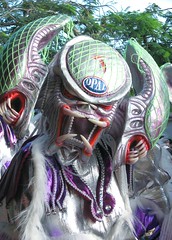
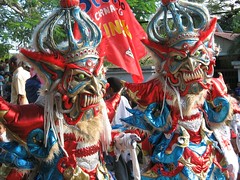
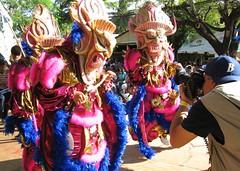
Hombre/muñeco
another traditional carnival costume in the DR - the man being carried by a mannequin, or in this case, a doll. He is accompanied by a tamborero when he dances.


giant accordion
Orange, a cell phone company here in the DR, elected to decorate their tent at the carnival in La Vega with giant tipico musicians.

Las Fieras
La Vega carnival: I liked this group's cueva (HQ) for their creative and Magritte-esque shading option

Los Yankees cueva
At the carnival in La Vega, DR: Artwork on the cueva, or HQ, of a group of diablos hailing from New York

Carnival, part 1: La Vega
2/5/07
Things quieted down for a few days after my Batey visit. I spent Thursday at the Centro Leon, writing things up and getting organized. On Friday, I visited Chiqui’s mom in the hospital once again, and then had several things fixed on my car: the hatch back, which wouldn’t close; a back door, which wouldn’t open; a new gas filter; a field trip to various auto parts stores in search of a new oil cap. On Saturday, I paid some more visits, first to Tonito, from my carnival group, and then to Hector and Denio, of my palos group.
Sunday was far more action-packed. Being the first Sunday of February, it was also the official start of the carnival season. And since this year I am trying to visit some different carnivals, a friend from the Centro Leon had set up a meeting for me with a member of the carnival planning committee in La Vega.
If you read my blog last year, you might remember something about the Vegan carnival, the biggest and best-funded in the land. (If you don’t remember, you can always go back and look at the February 2006 archives.) Most Dominicans seem to thing that it is a model event, one that could serve as an example to other cities’ carnivals, but I had some concerns about commercialism and participation. It seemed to me that with all the rules the carnival committee placed on participants, and with the rising costs of costumes and masks that necessitated ever more attention paid to fundraising, the Vegan carnival didn’t allow for the kind of popular participation and freedom of expression that Santiago’s did. I wanted to see for myself how the thing worked.
I arrived at the Parque Duarte, the main square in the old part of La Vega, just before noon. Although I’d been to the national park at the ruins of Old La Vega, and to Santo Cerro, a pilgrimage site just out of town, I’d never had an opportunity to look around La Vega itself. On the south side of this square I could see the Concepcion cathedral, an odd-looking modernist structure that seemed half-finished, but was actually complete. On the east side was the Ayuntamiento, or City Hall, and on the north was the Centro de la Cultura, on whose porch I decided to stand. A stall selling crafts had been set up there, and bags with wooden and bamboo beadwork, painted gourds, coconut-shell jewelry, and satchels painted with carnival devils were for sale.
A few minutes later my guide, William Gil, arrived, and we began our tour. The “carnival zone” was to the east of us, so we left my car parked on the square and headed in that direction. The sounds of carpentry were everywhere, since all the carnival groups were still busy constructing their “cuevas,” or headquarters and staging areas.
William confirmed that there had been no groups of devils before the 1980s, when “Los Siete” first formed. Today there are, he estimates, somewhere in the neighborhood of 130 groups, including Los Broncos, a group that grew out of Los Siete. Some of the groups belong to different parts of town, as in Santiago; others, like Los Magoyos, are family affairs. One, called “Los Yankees,” is made up entirely of Veganos in New York, and it was to this cueva that we went first.
The name “cave” is somewhat misleading as applied to these structures. They were really more of a patio, I commented, since they are made up of raised seating areas, a bar or refreshment stand, and some kind of shading device, all decorated with some sort of devilish theme related to the group’s costume, but mostly covered in the logos of the group’s sponsor. Each group receives not only their costumes and masks from the sponsor, but also drinks, the cueva, and even payment for their performance. Quite a contrast to what we deal with in Santiago!
In spite of the rampant commercialism, there is still a lot of creativity in display. Instead of simply putting up a tent-like shelter from the sun, like the others, one group had strung up a net and festooned it with white umbrellas. They also had a giant tower, about 30 feet high, featuring the tiger head that is the emblem of Las Fieras (The Furies). One had made a castle with a devil’s head about the gate and two costumed dancing figures. But I particularly liked the Yankees, who had painted a mural of the Statue of Liberty and the Manhattan skyline (post-September 11), and whose emblem was a skull wearing red, white, and blue glasses, Grateful Dead style.
We stopped to talk with a couple of members of Los Nietos. This group belonged to Soto, a semi-rural area west of town, and had chosen their name – “The Grandsons” – because they were all young boys when they started. They reported that their costumes this year had cost about 16,000 pesos ($500) and weighed about 9 pounds, without the mask.
The carnival zone covers an area of about ten blocks, packed with cuevas, stages belonging to various sponsors (I saw one for Orange wireless) and official organizations (including radio, TV, and the Ayuntamiento), food stands, and wandering vendors selling tiny versions of devils’ masks, vejigas wrapped in colorful fabrics for you to whack your friends with, whistles, drinks, and snacks. Since, William told me, things usually get going around 2 PM we thought we had better get to our seats before then if we wanted to avoid the vejigazos.
One of the things for which La Vega is most famous is the violence of its vejigazos, or whacks with an inflated pig bladder. We dole these out in Santiago as well, but in La Vega they have made several adjustments to their equipment in order to give a more painful experience. First, they put several bladders one inside of the other to make them stronger and harder. These are wrapped in fabric to make them match the costumes, and the whole thing is then attached to a rubber rod to allow for greater precision and speed. The pain they could inflict was legendary, and to be quite honest, I was scared. I wanted to enjoy carnival, but I didn’t want to suffer for it for the whole week after, and I was assured that that was how long the bruises would last.
In order to avoid this sorry fate, William made sure I was well out of the line of fire, but I discussed the problem with him.
“But why do they want to hit so hard? I don’t see what’s fun about that,” I said.
“Well, it’s a peculiarity of the veganos. It’s how we enjoy our carnival. The vejigazos make us feel happy.”
“Happy?! Why, are veganos masochists? I don’t see how pain translates into joy.”
“They say that the devils hit us in order to get rid of all the evil we’ve accumulated during the year. That’s how the vejigazos got started, centuries ago.”
“Sure, but carnival doesn’t seem particularly religious these days.”
“No, definitely not. But that’s the tradition.”
I was still confused about how a vejigazo could bring joy – until I saw my first one. There was a raised ramp in front of the Ayuntamiento stage on which we were seated, and every so often, devils would parade down it. One onlooker was standing on it talking to a friend, unaware that a devil was coming up behind him. Noticing his distraction, the devil got a running start, wound up, and WHAM! The vejiga slammed into his back with a resounding crack. The man jumped and turned around, shouting expletives at the devil as the devil danced around him. Everyone around laughed, both in amusement at his misfortune and relief that we had escaped it. It was pretty funny. “Ah, what joy!” I exclaimed. “Aha! Now you understand,” William laughed.
Still, I wasn’t eager to experience the pain myself. I’d recommend to anyone attending carnival in La Vega to keep well out of the way. There appear to be two ways to do this: either arrive early, around 1:00. and find yourself a seat on the bleachers, or pay to enjoy the VIP seating provided for a cost of from fifty to three hundred pesos ($1.50-$9) in the cuevas. There, you can enjoy beverage service, too.
Since it was only the first day of carnival, just a fraction of the groups turned out in costume, and it took them quite a while to do so. We were waiting until after three, so I took advantage of the time to ask William a few more questions. For example, I had already seen several women in devil garb; when had they started dressing up? William explained that a group called “Las Amazonas” formed entirely of women had come out in the 1990s. No one believed that they were women at first, since it had never been seen before – it was practically a taboo. After they had made the circuit of the parade route, people did believe, because they moved differently than the men and tired faster in the heavy costumes. But now that the younger generation has grown up with female devils and the women have become accustomed to the job, there is virtually no difference, and women belong to many different groups today.
I also wanted to know about the comparsas, or semi-theatrical groups who go out at carnival time dressed as things other than devils. He told me that the number of comparsas had been dramatically reduced in the past two decades. Now he estimated that there were only five, compared to 130 grupos de diablos, whereas formerly, the former had outnumbered the latter.
What had caused this dramatic reduction? I wanted to know. “Money,” he told me frankly. “Since the creation of UCAVE, the Union Carnavalesca Vegana, carnival has become a business.” With the formation of this association of groups came more money from corporate sponsors, and what they wanted were colorful, impressive, expensive-looking costumes. They wanted devils, not Indians in loincloths, or Africans with body paint, or people dressed up to look like the President – all comparsas commonly found throughout the country. What’s more, comparsas generally belong to the poor, and there was little room for them in the new scheme of things.
“So the costumes became more impressive, but the comparsas died out. You gained something only to lose something else,” I suggested. He agreed. While UCAVE didn’t discourage comparsas to participate, they didn’t exactly encourage them either, since there was no money there. Back in Santiago, I asked a friend who had studied such things who it was, exactly, who participated in the Vegan carnival these days. “The children of the rich,” he told me. So the rich become richer, and the poor poorer. Sounds familiar.
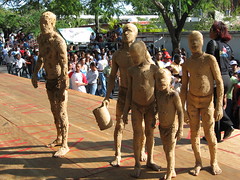
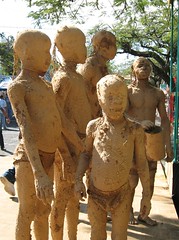
Nonetheless, there were some distinctive comparsas on display on Sunday. There were the mudmen, a bunch of barefoot kids, actually, who had covered their entire bodies with yellowish mud, including their faces, which had first been obscured by a pantyhose mask. They stalked about zombie-style, and just generally looked creepy. There was also a seven-foot-tall headless priest, and the pope riding about in a chariot pulled by a white horse: a Dominican popemobile. There were even a couple of africanos, nearly naked but slicked down with engine grease and body paint, another low-budget costume. I also saw the man riding the doll, another old standby, and a troupe of Robalagallinas, the traditional transvestive character with huge buttocks and a tattered umbrella.
The rest were devils. And having said what I needed to say about them already, now I must state that they are undeniably beautiful and impressive. They come in every possible color combination, but all have voluminous costumes made of layers upon layers of artfully cut satins, lames, and sequined fabrics studded with just a few bells – not enough to make them as heavy as ours in Santiago. The masks have grown to monstrous proportions, at least two feet tall each, molded in acrylic and painted in fluorescent and metallic colors. Most depict a grimacing devil with angry brows and fearsome fangs, sprouting horns, sculpted hair and beard, and sometimes ostrich feathers out of its head.
There are a few variations on this traditional devil face, however: some with bug eyes look like extraterrestrials borrowed from “Alien Autopsy,” occasionally with pink brains on view. One group, called “Los Zorros,” had their devils wearing a flat-topped Spanish hat. And there were a dozen King Tuts sculpted in gold and lapis colors. With between ten and fifty in each group jumping and running about, the devils make quite an impression. Yet instead of the colorful, custom-made shoes we use in Santiago, they have matching, store-bought tennis shoes, usually in colors to match the costume. They may not be as creative, but they did look comfortable.
Each group is preceded by a bevy of flag-wavers bearing their standard, and many have their own theme-songs, another benefit of sponsorship. I was a little surprised, however, to find that just like in Santiago, Veganos have no concept of traditional carnival music. William didn’t remember anything about music before the formation of devil groups in the 1980s, just as I had found with the lechones in Santiago. The groups’ official songs are likely to be electronic dance music overlaid with vocals exhorting the group, “Dame un vejigazo.” I found this particularly interesting since the Vegan politicians I’d seen talking about their carnival at the Centro Leon last year had made a big deal over the fact that they don’t allow any disco lites, the pickups mounted with speakers we use to provide music in the Santiago carnival. While I had thought their beef was with the popular music they play, apparently, it was only with the look of the thing.
So it seems that the Vegan concept of “tradition” relies solely on visuals, not on sound – and even then, significant allowances are made. Twenty-plus years ago, masks were about the same size as one’s normal face, costumes were far simpler, and one imagines, sneakers were not in evidence. And while the officials had said they were proud not to have t-shirts and baseball caps on their carnival groups, at least on this first Sunday of February, that is exactly what I saw. Many were on hand in the shirts they’d designed to represent their groups of devils this year, and in the cuevas, you could even buy one for yourself.
In conclusion, the Carnaval de la Vega is well worth seeing. The costumes are beautiful, the cuevas creative, and the audience is into it. William also tells me that it is the carnival with the most popular support, never dying out over the centuries it has been practiced, even during the repressive years of Trujillo and Balaguer. But for a folklorist, it’s a mixed bag. Every carnival in the country is different now than it was fifty or a hundred years ago, naturally. People’s creativity is everywhere in evidence in the changing costumes, masks, and, particularly, musical choices. Yet in La Vega, the conflict between the maintenance of tradition and the drive to commercialize and cater to tourism is particularly in evidence. So go and see La Vega, but try to catch another as well – Cotui, Salcedo, or good old Santiago – in order to see what happens when regular folks are able to make their own decisions about carnival.
Things quieted down for a few days after my Batey visit. I spent Thursday at the Centro Leon, writing things up and getting organized. On Friday, I visited Chiqui’s mom in the hospital once again, and then had several things fixed on my car: the hatch back, which wouldn’t close; a back door, which wouldn’t open; a new gas filter; a field trip to various auto parts stores in search of a new oil cap. On Saturday, I paid some more visits, first to Tonito, from my carnival group, and then to Hector and Denio, of my palos group.
Sunday was far more action-packed. Being the first Sunday of February, it was also the official start of the carnival season. And since this year I am trying to visit some different carnivals, a friend from the Centro Leon had set up a meeting for me with a member of the carnival planning committee in La Vega.
If you read my blog last year, you might remember something about the Vegan carnival, the biggest and best-funded in the land. (If you don’t remember, you can always go back and look at the February 2006 archives.) Most Dominicans seem to thing that it is a model event, one that could serve as an example to other cities’ carnivals, but I had some concerns about commercialism and participation. It seemed to me that with all the rules the carnival committee placed on participants, and with the rising costs of costumes and masks that necessitated ever more attention paid to fundraising, the Vegan carnival didn’t allow for the kind of popular participation and freedom of expression that Santiago’s did. I wanted to see for myself how the thing worked.
I arrived at the Parque Duarte, the main square in the old part of La Vega, just before noon. Although I’d been to the national park at the ruins of Old La Vega, and to Santo Cerro, a pilgrimage site just out of town, I’d never had an opportunity to look around La Vega itself. On the south side of this square I could see the Concepcion cathedral, an odd-looking modernist structure that seemed half-finished, but was actually complete. On the east side was the Ayuntamiento, or City Hall, and on the north was the Centro de la Cultura, on whose porch I decided to stand. A stall selling crafts had been set up there, and bags with wooden and bamboo beadwork, painted gourds, coconut-shell jewelry, and satchels painted with carnival devils were for sale.
A few minutes later my guide, William Gil, arrived, and we began our tour. The “carnival zone” was to the east of us, so we left my car parked on the square and headed in that direction. The sounds of carpentry were everywhere, since all the carnival groups were still busy constructing their “cuevas,” or headquarters and staging areas.
William confirmed that there had been no groups of devils before the 1980s, when “Los Siete” first formed. Today there are, he estimates, somewhere in the neighborhood of 130 groups, including Los Broncos, a group that grew out of Los Siete. Some of the groups belong to different parts of town, as in Santiago; others, like Los Magoyos, are family affairs. One, called “Los Yankees,” is made up entirely of Veganos in New York, and it was to this cueva that we went first.
The name “cave” is somewhat misleading as applied to these structures. They were really more of a patio, I commented, since they are made up of raised seating areas, a bar or refreshment stand, and some kind of shading device, all decorated with some sort of devilish theme related to the group’s costume, but mostly covered in the logos of the group’s sponsor. Each group receives not only their costumes and masks from the sponsor, but also drinks, the cueva, and even payment for their performance. Quite a contrast to what we deal with in Santiago!
In spite of the rampant commercialism, there is still a lot of creativity in display. Instead of simply putting up a tent-like shelter from the sun, like the others, one group had strung up a net and festooned it with white umbrellas. They also had a giant tower, about 30 feet high, featuring the tiger head that is the emblem of Las Fieras (The Furies). One had made a castle with a devil’s head about the gate and two costumed dancing figures. But I particularly liked the Yankees, who had painted a mural of the Statue of Liberty and the Manhattan skyline (post-September 11), and whose emblem was a skull wearing red, white, and blue glasses, Grateful Dead style.
We stopped to talk with a couple of members of Los Nietos. This group belonged to Soto, a semi-rural area west of town, and had chosen their name – “The Grandsons” – because they were all young boys when they started. They reported that their costumes this year had cost about 16,000 pesos ($500) and weighed about 9 pounds, without the mask.
The carnival zone covers an area of about ten blocks, packed with cuevas, stages belonging to various sponsors (I saw one for Orange wireless) and official organizations (including radio, TV, and the Ayuntamiento), food stands, and wandering vendors selling tiny versions of devils’ masks, vejigas wrapped in colorful fabrics for you to whack your friends with, whistles, drinks, and snacks. Since, William told me, things usually get going around 2 PM we thought we had better get to our seats before then if we wanted to avoid the vejigazos.
One of the things for which La Vega is most famous is the violence of its vejigazos, or whacks with an inflated pig bladder. We dole these out in Santiago as well, but in La Vega they have made several adjustments to their equipment in order to give a more painful experience. First, they put several bladders one inside of the other to make them stronger and harder. These are wrapped in fabric to make them match the costumes, and the whole thing is then attached to a rubber rod to allow for greater precision and speed. The pain they could inflict was legendary, and to be quite honest, I was scared. I wanted to enjoy carnival, but I didn’t want to suffer for it for the whole week after, and I was assured that that was how long the bruises would last.
In order to avoid this sorry fate, William made sure I was well out of the line of fire, but I discussed the problem with him.
“But why do they want to hit so hard? I don’t see what’s fun about that,” I said.
“Well, it’s a peculiarity of the veganos. It’s how we enjoy our carnival. The vejigazos make us feel happy.”
“Happy?! Why, are veganos masochists? I don’t see how pain translates into joy.”
“They say that the devils hit us in order to get rid of all the evil we’ve accumulated during the year. That’s how the vejigazos got started, centuries ago.”
“Sure, but carnival doesn’t seem particularly religious these days.”
“No, definitely not. But that’s the tradition.”
I was still confused about how a vejigazo could bring joy – until I saw my first one. There was a raised ramp in front of the Ayuntamiento stage on which we were seated, and every so often, devils would parade down it. One onlooker was standing on it talking to a friend, unaware that a devil was coming up behind him. Noticing his distraction, the devil got a running start, wound up, and WHAM! The vejiga slammed into his back with a resounding crack. The man jumped and turned around, shouting expletives at the devil as the devil danced around him. Everyone around laughed, both in amusement at his misfortune and relief that we had escaped it. It was pretty funny. “Ah, what joy!” I exclaimed. “Aha! Now you understand,” William laughed.
Still, I wasn’t eager to experience the pain myself. I’d recommend to anyone attending carnival in La Vega to keep well out of the way. There appear to be two ways to do this: either arrive early, around 1:00. and find yourself a seat on the bleachers, or pay to enjoy the VIP seating provided for a cost of from fifty to three hundred pesos ($1.50-$9) in the cuevas. There, you can enjoy beverage service, too.
Since it was only the first day of carnival, just a fraction of the groups turned out in costume, and it took them quite a while to do so. We were waiting until after three, so I took advantage of the time to ask William a few more questions. For example, I had already seen several women in devil garb; when had they started dressing up? William explained that a group called “Las Amazonas” formed entirely of women had come out in the 1990s. No one believed that they were women at first, since it had never been seen before – it was practically a taboo. After they had made the circuit of the parade route, people did believe, because they moved differently than the men and tired faster in the heavy costumes. But now that the younger generation has grown up with female devils and the women have become accustomed to the job, there is virtually no difference, and women belong to many different groups today.
I also wanted to know about the comparsas, or semi-theatrical groups who go out at carnival time dressed as things other than devils. He told me that the number of comparsas had been dramatically reduced in the past two decades. Now he estimated that there were only five, compared to 130 grupos de diablos, whereas formerly, the former had outnumbered the latter.
What had caused this dramatic reduction? I wanted to know. “Money,” he told me frankly. “Since the creation of UCAVE, the Union Carnavalesca Vegana, carnival has become a business.” With the formation of this association of groups came more money from corporate sponsors, and what they wanted were colorful, impressive, expensive-looking costumes. They wanted devils, not Indians in loincloths, or Africans with body paint, or people dressed up to look like the President – all comparsas commonly found throughout the country. What’s more, comparsas generally belong to the poor, and there was little room for them in the new scheme of things.
“So the costumes became more impressive, but the comparsas died out. You gained something only to lose something else,” I suggested. He agreed. While UCAVE didn’t discourage comparsas to participate, they didn’t exactly encourage them either, since there was no money there. Back in Santiago, I asked a friend who had studied such things who it was, exactly, who participated in the Vegan carnival these days. “The children of the rich,” he told me. So the rich become richer, and the poor poorer. Sounds familiar.
Nonetheless, there were some distinctive comparsas on display on Sunday. There were the mudmen, a bunch of barefoot kids, actually, who had covered their entire bodies with yellowish mud, including their faces, which had first been obscured by a pantyhose mask. They stalked about zombie-style, and just generally looked creepy. There was also a seven-foot-tall headless priest, and the pope riding about in a chariot pulled by a white horse: a Dominican popemobile. There were even a couple of africanos, nearly naked but slicked down with engine grease and body paint, another low-budget costume. I also saw the man riding the doll, another old standby, and a troupe of Robalagallinas, the traditional transvestive character with huge buttocks and a tattered umbrella.
The rest were devils. And having said what I needed to say about them already, now I must state that they are undeniably beautiful and impressive. They come in every possible color combination, but all have voluminous costumes made of layers upon layers of artfully cut satins, lames, and sequined fabrics studded with just a few bells – not enough to make them as heavy as ours in Santiago. The masks have grown to monstrous proportions, at least two feet tall each, molded in acrylic and painted in fluorescent and metallic colors. Most depict a grimacing devil with angry brows and fearsome fangs, sprouting horns, sculpted hair and beard, and sometimes ostrich feathers out of its head.
There are a few variations on this traditional devil face, however: some with bug eyes look like extraterrestrials borrowed from “Alien Autopsy,” occasionally with pink brains on view. One group, called “Los Zorros,” had their devils wearing a flat-topped Spanish hat. And there were a dozen King Tuts sculpted in gold and lapis colors. With between ten and fifty in each group jumping and running about, the devils make quite an impression. Yet instead of the colorful, custom-made shoes we use in Santiago, they have matching, store-bought tennis shoes, usually in colors to match the costume. They may not be as creative, but they did look comfortable.
Each group is preceded by a bevy of flag-wavers bearing their standard, and many have their own theme-songs, another benefit of sponsorship. I was a little surprised, however, to find that just like in Santiago, Veganos have no concept of traditional carnival music. William didn’t remember anything about music before the formation of devil groups in the 1980s, just as I had found with the lechones in Santiago. The groups’ official songs are likely to be electronic dance music overlaid with vocals exhorting the group, “Dame un vejigazo.” I found this particularly interesting since the Vegan politicians I’d seen talking about their carnival at the Centro Leon last year had made a big deal over the fact that they don’t allow any disco lites, the pickups mounted with speakers we use to provide music in the Santiago carnival. While I had thought their beef was with the popular music they play, apparently, it was only with the look of the thing.
So it seems that the Vegan concept of “tradition” relies solely on visuals, not on sound – and even then, significant allowances are made. Twenty-plus years ago, masks were about the same size as one’s normal face, costumes were far simpler, and one imagines, sneakers were not in evidence. And while the officials had said they were proud not to have t-shirts and baseball caps on their carnival groups, at least on this first Sunday of February, that is exactly what I saw. Many were on hand in the shirts they’d designed to represent their groups of devils this year, and in the cuevas, you could even buy one for yourself.
In conclusion, the Carnaval de la Vega is well worth seeing. The costumes are beautiful, the cuevas creative, and the audience is into it. William also tells me that it is the carnival with the most popular support, never dying out over the centuries it has been practiced, even during the repressive years of Trujillo and Balaguer. But for a folklorist, it’s a mixed bag. Every carnival in the country is different now than it was fifty or a hundred years ago, naturally. People’s creativity is everywhere in evidence in the changing costumes, masks, and, particularly, musical choices. Yet in La Vega, the conflict between the maintenance of tradition and the drive to commercialize and cater to tourism is particularly in evidence. So go and see La Vega, but try to catch another as well – Cotui, Salcedo, or good old Santiago – in order to see what happens when regular folks are able to make their own decisions about carnival.

Kids
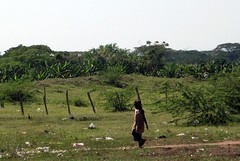
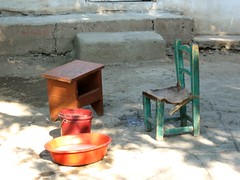
These kids who live on Batey Libertad badly wanted their picture taken. Digital cameras are great!

Thursday, February 01, 2007
Back in action!
Once again, I chose the appropriate moment to make a grand entrance back into Santiago life. As the plane made its final approach last Friday, I saw the monument was all dressed up in a new set of patriotic red, blue, and white lights; I also noticed that the Estadio Cibao was all lit up, so a baseball game must have been going on.
Jon, the visiting professor from the University of Vermont to whom I’d loaned my car, picked me up in my own vehicle. His son had renamed it “The Millenium Falcon” in my absence, and I thoroughly approved of the name. I dropped him off at home and met the rest of the family, then hurried back to my old abode, since it was already past 10 PM. On the way home, I noticed that all those buzzy plastic horns I’d become so familiar with last baseball season were back in full force. Same car, same apartment, same ruckus – it was almost like I never left.
Almost, but not quite: Doña Ana met me at my car and showed me around the apartment again. The mosquito escape route was still operational, but she told me the old green-light water system was no longer needed, new ruffled toilet-seat covers had been sewn, and also the furniture had been rearranged. More importantly, I found out that the final game of the playoffs was what I’d seen in progress at the baseball stadium, and the Aguilas, the local Santiago team, was going to win: it was the seventh inning and they were ahead 10-1 over their archrivals, Los Tigres de Licey. Last year, I’d seen the Tigres beat the Aguilas on their way to winning the 2006 title, but like I say, things are different around here this year.
Don Rafael informed me that the impending Aguilas win meant that, very shortly, all kinds of inclement noises would occur, and no one would get much sleep. Sure enough, as I lay on my bed with my hand in the air, applying pressure to the thumb I’d just sliced open while trying to cut open a box of juice, fireworks started going off and shots were fired into the air, music played, and horns honked. But after a 4:30 AM wake-up call, three flights, twelve hours of travel, and completely jacked up on decongestants, I felt like I could sleep through anything, and I pretty much did.
Since then, it’s been mostly what you would expect: paying visits to friends, and getting back into this other way of life. The slower pace, the frightening traffic, the heat. The replacement of handicapped parking spaces with “I’m Going to be a Mother” spaces. A few things have changed besides the arrangement of my furniture: parties start and end earlier because of new cabaret laws. There are parking meters downtown where once there was only chaos. They put up a bunch of signs in a probably vain attempt to keep people from driving the wrong way on the one-way streets in my neighborhood.
Here’s what happens when you’ve been away from here for seven months and then you come back for a three-month stay. 1) Everyone says, “Why so short?” 2) Everyone says, “You look fatter!” (I haven’t changed in weight at all, but I realize that it’s supposed to be a compliment. Flesh is valued here.)
So far, I’ve visited the Taveras family (Chiqui, Laura, and all), the Roman family (Rafaelito, Carmen, and all), and my friends at the Centro Leon. Everyone says, “nothing’s new here,” but it’s not precisely true. Besides what I’ve mentioned, Chiqui went to New York for the first time and returned just two weeks before I arrived. He came back with a few more words of English and a picture of himself with a very lifelike wax statue of Morgan Freeman. His mother had a stroke and was brought to a hospital here in Santiago where we all went to see her. Rafaelito has more students than ever, and Carmen lost a lot of weight. At the Centro Leon, Angela went back to New York, Zoraya has nearly finished her Master’s, and everyone is hard at work on the upcoming conference.
I still have many more visits to make, but first, I had to make some arrangements. My agenda for this trip is different from those past. I’ve already got more interviews for my dissertation than I know what to do with, or am able to transcribe, so I’m going to (a) hire a transcriber and (b) take a vacation from interviews. Instead, I’m going to try to get some comparative information as well as experience some different parts of the country.
First, since this is carnival month, I’m planning on visiting some of the different carnivals in various Cibaeno towns. Last year, when I was busy participating in carnival with my group of lechones, I was only able to see the event here in Santiago and I didn’t have much opportunity to document the experience with photographs or video. This year, while I still want to hit the streets with Los Confraternos, I also want to see the better-known carnival in La Vega as well as some others with unique costumes and practices, such as perhaps Cotui, Salcedo, or Puerto Plata.
Second, I want to get a little bit more activist and spend some time on the bateyes. A batey is a government settlement for agricultural workers, usually those who undertake the difficult sugar cane harvest. Many batey-dwellers are Dominico-Haitians or even Haitian immigrants (many illegal), and they form the poorest segment of the population here. Last year, I visited a batey in Barahona during holy week in order to hear some ga-ga music (you can see it on this blog under April 2006). Now, I want to see how conditions are on bateyes here in the north, see what kind of musical activity goes on there, and perhaps lend a helping hand with some projects.
That’s why I got in touch with Jon of the University of Vermont, who along with his wife Pat is running a program on Batey Libertad northwest of Santiago. Run through GrassRoots Soccer, a group that works mostly in Africa, the program combines soccer training with HIV/AIDS education. The batey’s team competes with others in the region in order to create opportunities for the batey residents to interact positively with other Dominicans and help eliminate racism. The project has also built a multi-purpose room where classes are held and a medical clinic on the batey.
On Wednesday I got my first opportunity to accompany Jon out to Batey Libertad. I met him and two young men who work with the soccer program, Yanlico and Rafo, at the house he is renting in La Zurza (near where I lived my first year here). He had been sad to see the Falcon go, but luckily had been able to purchase his own bucket of bolts, temporarily named “Red-riguez,” from El Negro just a day before I arrived. A little nicer than the Falcon but without quite so much character, it nevertheless did a fine job of carting the four of us out of town, past Navarrete, Esperanza, and the middle-of-nowhere settlement simply called “Km. 10” to the batey.
Batey Libertad is much smaller than the one I’d seen in the south, but still has a population of nearly 2000. It was originally constructed during the Trujillo era to house sugar cane workers, but the cane is now gone: today, these people work in the rice fields that line the highway along here. They are beautiful and impossibly green, but full of pests and fungi that spread nasty parasites, skin diseases, and respiratory infections among the workers. The work is hot and can be painful, but it is still a draw for many Haitians who have no work at all.
The settlement itself consists of clusters of houses made of materials ranging from rusted-out corrugated tin to newly plastered and painted cinder block, so close together that cars can’t pass through most of its dusty roads. There are two round shelters with thatched roofs and concrete floors that can be used for gaming, and five small concrete water towers on stilts, all empty. Rafo tells me that a community upstream from them has usurped their water supply, and now they have to cross the highway to fetch it from the rice plant. When the plant is closed and locked, they take it out of the drainage ditch that catches the pesticide-filled runoff from the fields. For sanitation, there are a handful of outhouses all in a row: Rafo calls it the Barrio de las Letrinas. One of the stalls used to hold a communal shower, but now, of course, it’s out of order.
There are a few more landmarks to see here: two Trujillo-era buildings still stand, long, low concrete buildings divided into separate apartments, where workers used to sleep twenty to a room in hammocks. A concrete slab with a basketless hoop at one end provides some entertainment, though perhaps not as much as the dirt soccer field that lies just outside the settlement. There is an internet center (one of Jon’s endeavors), denoted by a nicely-painted desktop computer on its yellow wall. Tobacco dries in two places: the green leaves hang outside under a shelter, those farther along in the aging process dry inside a wooden house, its shutters open to reveal the somewhat surreal scene inside. Sheep, cows, and chickens stroll the open area between Latrine town and the soccer field.
Then there is the lair of Casco Pelao (bald head), the local voodoo doctor. His consulting office is decorated with a painting of San Miguel in angel form floating over the doorway, accompanied by a legend informing would-be patients that their search ends here, for the low low price of 57 pesos and a bottle of rum. Next door is the peristyle, a building designed for voodoo ceremonies, with its all-important centerpost and colorful paper and plastic flags hanging from the ceiling. On the other side of the batey is his home, painted with the full-size image of a hatted man with crosses in his eyes and a bone necklace; here, the deity Guede guards the doorway. Casco Pelao’s home actually takes up only half the building, the other half is a dormitory where his patients may sleep peacefully, free from evil influences. Besides medicine, Casco Pelao also provides entertainment. On weekends, he converts the peristyle into a disco for the benefit of local youth (and a small entrance fee).
Casco Pelao was not around at the moment. Instead, we met with Papito, who serves as mayor of the batey and the head of a very accomplished family: his sons are now studying medicine and law at the technical university in Santiago. We pulled up a couple of chairs in the shade between the houses to chat, and were soon swamped by children. Some were playing a version of hopscotch they’d drawn using coal scavenged from cooking fires. Some were getting their hair combed, another was taking a bath in a washtub – the school around the corner, which goes up to fifth grade, had just broken for lunch. Before long, we got our own, prepared by Papito’s wife in the communal kitchen: rice, spaghetti, fried chicken (for those who eat such things), and a bottle of Red Rock, the soda that tastes like red.
Chatting with Milanda, one of the soccer trainers, I found out that Batey Libertad had once had a ga-ga but its leader had moved away; a típico musician used to live here, too, but now he lived and worked in Santiago. These days, most musical activity around here was recorded. Indeed, today there was electricity, and people were taking advantage of it to listen to típico, reggaeton, and bachata. On the weekends, when the power supply permits, the kids have dances where Haitian konpa and Dominican bachata are the favored sounds. But there are plenty of drummers here who provide Casco Pelao with necessary ceremonial music. November and December are the big months for voodoo ceremonies here, I’m told, but those who wish for one to be performed especially for them can pay to obtain this service, and Jon will be doing so in March when his student group comes down. Most interestingly, Milanda told me that just this past weekend, a ga-ga group appeared in the batey to play for tips. They had come down from “la loma,” the hills, an indefinite spot to be sure, but likely to refer to one of the coffee plantations in the mountains that separate Navarrete from the coast. This could be something to investigate.
After lunch, we headed to the recently-constructed community building, where Yanlico was in the midst of leading an education session with this year’s Grassroots Soccer trainees. It was the first time this part of the curriculum had been tried out here, recently translated from English to Spanish, and results were mixed. Today’s activity was a game called, “where do I stand?” and it was a means of getting the kids to talk about their beliefs and opinions about sex. Yanlico would read a statement from the book, and the students would decide where they stood on it by going to either the “agree” side of the room or the “disagree” side, or staying somewhere in between. We soon realized there was a problem with understanding double negatives – i.e. those who disagreed with a negative statement often stood on the “agree” side, as they were thinking that made it a positive statement. In spite of the confusion, though, the goal of talking about their opinions was reached. The second game was a game of limbo, where the pole with a sign marked “sex” hanging from it was progressively lowered as a symbol of the increased peer pressure one can expect at increasing ages. This game was particularly popular and amusing, although as Jon remarked, it was a bit fatalistic: sooner or later, the sex was going to hit you. The meeting concluded with a snack (a way to ensure attendance as well as provide needed calories) and we returned to Papito’s.
The short time remaining in the afternoon was occupied by (a) playing with the community dog, Rey, and (b), much less fun, accomplishing the errand of making photocopies of a poster inviting batey residents to the Grassroots graduation ceremony this weekend. This took about two hours of running around the congested and polluted streets of Esperanza, since we had to try two different Internet centers and three copy stores before we found functional printers and copiers. After that, it was back to Santiago as the bright red sun set behind the emerald rice paddies while men on horses and pedestrians with machetes headed for home.
Jon, the visiting professor from the University of Vermont to whom I’d loaned my car, picked me up in my own vehicle. His son had renamed it “The Millenium Falcon” in my absence, and I thoroughly approved of the name. I dropped him off at home and met the rest of the family, then hurried back to my old abode, since it was already past 10 PM. On the way home, I noticed that all those buzzy plastic horns I’d become so familiar with last baseball season were back in full force. Same car, same apartment, same ruckus – it was almost like I never left.
Almost, but not quite: Doña Ana met me at my car and showed me around the apartment again. The mosquito escape route was still operational, but she told me the old green-light water system was no longer needed, new ruffled toilet-seat covers had been sewn, and also the furniture had been rearranged. More importantly, I found out that the final game of the playoffs was what I’d seen in progress at the baseball stadium, and the Aguilas, the local Santiago team, was going to win: it was the seventh inning and they were ahead 10-1 over their archrivals, Los Tigres de Licey. Last year, I’d seen the Tigres beat the Aguilas on their way to winning the 2006 title, but like I say, things are different around here this year.
Don Rafael informed me that the impending Aguilas win meant that, very shortly, all kinds of inclement noises would occur, and no one would get much sleep. Sure enough, as I lay on my bed with my hand in the air, applying pressure to the thumb I’d just sliced open while trying to cut open a box of juice, fireworks started going off and shots were fired into the air, music played, and horns honked. But after a 4:30 AM wake-up call, three flights, twelve hours of travel, and completely jacked up on decongestants, I felt like I could sleep through anything, and I pretty much did.
Since then, it’s been mostly what you would expect: paying visits to friends, and getting back into this other way of life. The slower pace, the frightening traffic, the heat. The replacement of handicapped parking spaces with “I’m Going to be a Mother” spaces. A few things have changed besides the arrangement of my furniture: parties start and end earlier because of new cabaret laws. There are parking meters downtown where once there was only chaos. They put up a bunch of signs in a probably vain attempt to keep people from driving the wrong way on the one-way streets in my neighborhood.
Here’s what happens when you’ve been away from here for seven months and then you come back for a three-month stay. 1) Everyone says, “Why so short?” 2) Everyone says, “You look fatter!” (I haven’t changed in weight at all, but I realize that it’s supposed to be a compliment. Flesh is valued here.)
So far, I’ve visited the Taveras family (Chiqui, Laura, and all), the Roman family (Rafaelito, Carmen, and all), and my friends at the Centro Leon. Everyone says, “nothing’s new here,” but it’s not precisely true. Besides what I’ve mentioned, Chiqui went to New York for the first time and returned just two weeks before I arrived. He came back with a few more words of English and a picture of himself with a very lifelike wax statue of Morgan Freeman. His mother had a stroke and was brought to a hospital here in Santiago where we all went to see her. Rafaelito has more students than ever, and Carmen lost a lot of weight. At the Centro Leon, Angela went back to New York, Zoraya has nearly finished her Master’s, and everyone is hard at work on the upcoming conference.
I still have many more visits to make, but first, I had to make some arrangements. My agenda for this trip is different from those past. I’ve already got more interviews for my dissertation than I know what to do with, or am able to transcribe, so I’m going to (a) hire a transcriber and (b) take a vacation from interviews. Instead, I’m going to try to get some comparative information as well as experience some different parts of the country.
First, since this is carnival month, I’m planning on visiting some of the different carnivals in various Cibaeno towns. Last year, when I was busy participating in carnival with my group of lechones, I was only able to see the event here in Santiago and I didn’t have much opportunity to document the experience with photographs or video. This year, while I still want to hit the streets with Los Confraternos, I also want to see the better-known carnival in La Vega as well as some others with unique costumes and practices, such as perhaps Cotui, Salcedo, or Puerto Plata.
Second, I want to get a little bit more activist and spend some time on the bateyes. A batey is a government settlement for agricultural workers, usually those who undertake the difficult sugar cane harvest. Many batey-dwellers are Dominico-Haitians or even Haitian immigrants (many illegal), and they form the poorest segment of the population here. Last year, I visited a batey in Barahona during holy week in order to hear some ga-ga music (you can see it on this blog under April 2006). Now, I want to see how conditions are on bateyes here in the north, see what kind of musical activity goes on there, and perhaps lend a helping hand with some projects.
That’s why I got in touch with Jon of the University of Vermont, who along with his wife Pat is running a program on Batey Libertad northwest of Santiago. Run through GrassRoots Soccer, a group that works mostly in Africa, the program combines soccer training with HIV/AIDS education. The batey’s team competes with others in the region in order to create opportunities for the batey residents to interact positively with other Dominicans and help eliminate racism. The project has also built a multi-purpose room where classes are held and a medical clinic on the batey.
On Wednesday I got my first opportunity to accompany Jon out to Batey Libertad. I met him and two young men who work with the soccer program, Yanlico and Rafo, at the house he is renting in La Zurza (near where I lived my first year here). He had been sad to see the Falcon go, but luckily had been able to purchase his own bucket of bolts, temporarily named “Red-riguez,” from El Negro just a day before I arrived. A little nicer than the Falcon but without quite so much character, it nevertheless did a fine job of carting the four of us out of town, past Navarrete, Esperanza, and the middle-of-nowhere settlement simply called “Km. 10” to the batey.
Batey Libertad is much smaller than the one I’d seen in the south, but still has a population of nearly 2000. It was originally constructed during the Trujillo era to house sugar cane workers, but the cane is now gone: today, these people work in the rice fields that line the highway along here. They are beautiful and impossibly green, but full of pests and fungi that spread nasty parasites, skin diseases, and respiratory infections among the workers. The work is hot and can be painful, but it is still a draw for many Haitians who have no work at all.
The settlement itself consists of clusters of houses made of materials ranging from rusted-out corrugated tin to newly plastered and painted cinder block, so close together that cars can’t pass through most of its dusty roads. There are two round shelters with thatched roofs and concrete floors that can be used for gaming, and five small concrete water towers on stilts, all empty. Rafo tells me that a community upstream from them has usurped their water supply, and now they have to cross the highway to fetch it from the rice plant. When the plant is closed and locked, they take it out of the drainage ditch that catches the pesticide-filled runoff from the fields. For sanitation, there are a handful of outhouses all in a row: Rafo calls it the Barrio de las Letrinas. One of the stalls used to hold a communal shower, but now, of course, it’s out of order.
There are a few more landmarks to see here: two Trujillo-era buildings still stand, long, low concrete buildings divided into separate apartments, where workers used to sleep twenty to a room in hammocks. A concrete slab with a basketless hoop at one end provides some entertainment, though perhaps not as much as the dirt soccer field that lies just outside the settlement. There is an internet center (one of Jon’s endeavors), denoted by a nicely-painted desktop computer on its yellow wall. Tobacco dries in two places: the green leaves hang outside under a shelter, those farther along in the aging process dry inside a wooden house, its shutters open to reveal the somewhat surreal scene inside. Sheep, cows, and chickens stroll the open area between Latrine town and the soccer field.
Then there is the lair of Casco Pelao (bald head), the local voodoo doctor. His consulting office is decorated with a painting of San Miguel in angel form floating over the doorway, accompanied by a legend informing would-be patients that their search ends here, for the low low price of 57 pesos and a bottle of rum. Next door is the peristyle, a building designed for voodoo ceremonies, with its all-important centerpost and colorful paper and plastic flags hanging from the ceiling. On the other side of the batey is his home, painted with the full-size image of a hatted man with crosses in his eyes and a bone necklace; here, the deity Guede guards the doorway. Casco Pelao’s home actually takes up only half the building, the other half is a dormitory where his patients may sleep peacefully, free from evil influences. Besides medicine, Casco Pelao also provides entertainment. On weekends, he converts the peristyle into a disco for the benefit of local youth (and a small entrance fee).
Casco Pelao was not around at the moment. Instead, we met with Papito, who serves as mayor of the batey and the head of a very accomplished family: his sons are now studying medicine and law at the technical university in Santiago. We pulled up a couple of chairs in the shade between the houses to chat, and were soon swamped by children. Some were playing a version of hopscotch they’d drawn using coal scavenged from cooking fires. Some were getting their hair combed, another was taking a bath in a washtub – the school around the corner, which goes up to fifth grade, had just broken for lunch. Before long, we got our own, prepared by Papito’s wife in the communal kitchen: rice, spaghetti, fried chicken (for those who eat such things), and a bottle of Red Rock, the soda that tastes like red.
Chatting with Milanda, one of the soccer trainers, I found out that Batey Libertad had once had a ga-ga but its leader had moved away; a típico musician used to live here, too, but now he lived and worked in Santiago. These days, most musical activity around here was recorded. Indeed, today there was electricity, and people were taking advantage of it to listen to típico, reggaeton, and bachata. On the weekends, when the power supply permits, the kids have dances where Haitian konpa and Dominican bachata are the favored sounds. But there are plenty of drummers here who provide Casco Pelao with necessary ceremonial music. November and December are the big months for voodoo ceremonies here, I’m told, but those who wish for one to be performed especially for them can pay to obtain this service, and Jon will be doing so in March when his student group comes down. Most interestingly, Milanda told me that just this past weekend, a ga-ga group appeared in the batey to play for tips. They had come down from “la loma,” the hills, an indefinite spot to be sure, but likely to refer to one of the coffee plantations in the mountains that separate Navarrete from the coast. This could be something to investigate.
After lunch, we headed to the recently-constructed community building, where Yanlico was in the midst of leading an education session with this year’s Grassroots Soccer trainees. It was the first time this part of the curriculum had been tried out here, recently translated from English to Spanish, and results were mixed. Today’s activity was a game called, “where do I stand?” and it was a means of getting the kids to talk about their beliefs and opinions about sex. Yanlico would read a statement from the book, and the students would decide where they stood on it by going to either the “agree” side of the room or the “disagree” side, or staying somewhere in between. We soon realized there was a problem with understanding double negatives – i.e. those who disagreed with a negative statement often stood on the “agree” side, as they were thinking that made it a positive statement. In spite of the confusion, though, the goal of talking about their opinions was reached. The second game was a game of limbo, where the pole with a sign marked “sex” hanging from it was progressively lowered as a symbol of the increased peer pressure one can expect at increasing ages. This game was particularly popular and amusing, although as Jon remarked, it was a bit fatalistic: sooner or later, the sex was going to hit you. The meeting concluded with a snack (a way to ensure attendance as well as provide needed calories) and we returned to Papito’s.
The short time remaining in the afternoon was occupied by (a) playing with the community dog, Rey, and (b), much less fun, accomplishing the errand of making photocopies of a poster inviting batey residents to the Grassroots graduation ceremony this weekend. This took about two hours of running around the congested and polluted streets of Esperanza, since we had to try two different Internet centers and three copy stores before we found functional printers and copiers. After that, it was back to Santiago as the bright red sun set behind the emerald rice paddies while men on horses and pedestrians with machetes headed for home.
Friday, January 12, 2007
El Prodigio y yo
Picture taken by Jose Enrique Tavarez at the Centro Leon last year, and just dug up by me.
Back in Action
Hey, you don't have to tell ME it's been a while! Where have I been? well, I went to California to see the grandparents for Thanksgiving, I went to Puerto Peñasco, Mexico, for a few days after Christmas. Between trips, I was working on the old dissertation (nearly three chapters done now), in part while in residence at a local writer's colony, Casa Libre en la Solana. They are awesome!! Send them your money!!
Since the holidays, things have been decidedly less interesting. I've been spending rather an inordinate amount of time working on the index for my forthcoming book
(take a look here: http://www.uapress.arizona.edu/BOOKS/bid1801.htm). And an even more ridiculous amount of time preparing for my upcoming trip. Yes, I'm heading back to Santiago for more carnival, more accordion, and more Brugal in just two weeks.
BUT WHAT DOES THAT MEAN FOR ME?? you may be asking yourself. Good question. If you are my friend, perhaps it means you should be checking plane fare to the DR in order to pay me a visit. Don't forget: carnival season runs through February, and whale season ends March 15. If you are a blog reader who is not yet my friend, perhaps it means you should subscribe to my feed so you don't miss a single exciting installment of my adventures in The Republic, as my nephew has been known to call it. Either way, keep in mind that I will arrive in La Ciudad Corazon on January 26 and will be blogging away shortly thereafter.
To tide you over in the meantime, here's a photo I just dug up of me and El Prodigio, taken by Jose Enrique Tavarez at the Centro Leon.
Since the holidays, things have been decidedly less interesting. I've been spending rather an inordinate amount of time working on the index for my forthcoming book
(take a look here: http://www.uapress.arizona.edu/BOOKS/bid1801.htm). And an even more ridiculous amount of time preparing for my upcoming trip. Yes, I'm heading back to Santiago for more carnival, more accordion, and more Brugal in just two weeks.
BUT WHAT DOES THAT MEAN FOR ME?? you may be asking yourself. Good question. If you are my friend, perhaps it means you should be checking plane fare to the DR in order to pay me a visit. Don't forget: carnival season runs through February, and whale season ends March 15. If you are a blog reader who is not yet my friend, perhaps it means you should subscribe to my feed so you don't miss a single exciting installment of my adventures in The Republic, as my nephew has been known to call it. Either way, keep in mind that I will arrive in La Ciudad Corazon on January 26 and will be blogging away shortly thereafter.
To tide you over in the meantime, here's a photo I just dug up of me and El Prodigio, taken by Jose Enrique Tavarez at the Centro Leon.
Friday, December 01, 2006
Talking tiguere
Recently, I’ve been traveling again. I was at a conference in Phoenix, I had Thanksgiving with family in Riverside, California, and most excitingly, I was in Hawaii. It was also for a conference but I was, sadly, forced to ditch some of the proceedings to hang out on the beach instead. I’ve put a couple of pictures from that trip below for you to enjoy.
At the moment, I’m temporarily residing in a writers’ colony right here in called Casa Libre en la Solana (http://www.casalibre.org/). It’s a great place and I’m getting a lot done. I’m going to be very sad when I have to leave my cute little apartment here next week! Anyway, lately I’ve been writing about gender roles in the DR, particularly that of the tíguere. So here, for you, readers, is a moment of diversion with the tíguere.
Literally, tíguere is simply the peculiarly Dominican pronunciation of the word for “tiger.” But it also refers to a type of man in the DR – a hustler, a master of the street, a sharp dresser, and a tough guy. The tíguere arose along with the urbanization of the country, having first emerged in Santo Domingo around the 1920s. Porfirio Rubirosa, the famous 1950s playboy, and even Trujillo himself are classic tígueres. Today, tigueraje (the behavior or the domain of the tíguere) is a homegrown Dominican youth culture with its own style of dress, music (these days, usually reggaetón and/or “merengues de la calle”), and language.
I came across a recent article in Hoy newspaper that spoke about how the vocabulary of tigueraje is showing up everywhere now, even in the upper classes, among educated people, and high-ranking politicians. The article also gives a list of current expressions. Here are some of them, translated into both idiomatic and literal English. (I changed some of the definitions from the article that were incorrect.)
Tumba eso = forget it (lit. knock it over)
Ponte cloro = be clear (lit. “light”); tell the truth (lit. put bleach on yourself)
¿Quién te cotiza? = Who puts up with your craziness? (Who pays you?)
Te guayaste = You messed up (you grated yourself)
Te subí “lo vidrio” = I’m not listening to you (I rolled up the windows on you)
Te la comiste = You messed up – or were awesome, depending on tone (You ate it)
Ta’ to’ = OK (it’s all there)
Hazme coro = pay attention to me; do what I’m doing (Sing back-up to me)
Muela = a made-up store intended to convince someone (molar)
¿Me copiaste? = Did you understand me? (Did you copy me?)
En olla = broke (in the pot)
A millón = with a lot of energy (to the million)
¿Quién lo patrocina? = who’s paying you to act so dumb? (Who’s sponsoring that?)
Bulto = story (bag)
Emperrao = in love (dogged)
Pecao = ugly person (sin)
Ecole cuá = Exactly, agreed. (I have NO IDEA where this one came from! Any ideas?)
Ella tiene todo el dinero ma’ 20 peso = She’s rich (She has all the money plus 20 pesos)
Grillo = unattractive but easy woman (cricket)
Juquiao = crazy or drunk (hooked, from English)
Suave, que es bolero = calm down (easy, it’s a bolero [slow song])
Ta’ jevi = Great! (It’s heavy, from English)
Tú ta’ happy = you’re kind of drunk (you’re happy, from English)
Te paniqueate = you freaked out (from English panicked)
Vacanyol = Someone who tries to seem cool by using expressions, clothing, etc borrowed from New York (combination of vacán, cool, with yol, from Dominican pronunciation of New York)
Incidentally, I recently found that vacán or vacana comes from the Portuguese bacana, meaning fantastic. I wonder how long it’s been in use and how it got into Dominican Spanish?
Anyway, when in office ex-president Hipólito Mejía was particularly famous for using the vocabulary of tigueraje. The article mentioned quotes him as having told (current, but ex at the time of the incident) president Leonel Fernández, “te sub[i los vidrios” – or “I rolled the window up on you” – in order to say “I’m not listening to what you’re saying.” It’s roughly the equivalent of George Bush telling Bill Clinton, “Talk to the hand.”
At the moment, I’m temporarily residing in a writers’ colony right here in called Casa Libre en la Solana (http://www.casalibre.org/). It’s a great place and I’m getting a lot done. I’m going to be very sad when I have to leave my cute little apartment here next week! Anyway, lately I’ve been writing about gender roles in the DR, particularly that of the tíguere. So here, for you, readers, is a moment of diversion with the tíguere.
Literally, tíguere is simply the peculiarly Dominican pronunciation of the word for “tiger.” But it also refers to a type of man in the DR – a hustler, a master of the street, a sharp dresser, and a tough guy. The tíguere arose along with the urbanization of the country, having first emerged in Santo Domingo around the 1920s. Porfirio Rubirosa, the famous 1950s playboy, and even Trujillo himself are classic tígueres. Today, tigueraje (the behavior or the domain of the tíguere) is a homegrown Dominican youth culture with its own style of dress, music (these days, usually reggaetón and/or “merengues de la calle”), and language.
I came across a recent article in Hoy newspaper that spoke about how the vocabulary of tigueraje is showing up everywhere now, even in the upper classes, among educated people, and high-ranking politicians. The article also gives a list of current expressions. Here are some of them, translated into both idiomatic and literal English. (I changed some of the definitions from the article that were incorrect.)
Tumba eso = forget it (lit. knock it over)
Ponte cloro = be clear (lit. “light”); tell the truth (lit. put bleach on yourself)
¿Quién te cotiza? = Who puts up with your craziness? (Who pays you?)
Te guayaste = You messed up (you grated yourself)
Te subí “lo vidrio” = I’m not listening to you (I rolled up the windows on you)
Te la comiste = You messed up – or were awesome, depending on tone (You ate it)
Ta’ to’ = OK (it’s all there)
Hazme coro = pay attention to me; do what I’m doing (Sing back-up to me)
Muela = a made-up store intended to convince someone (molar)
¿Me copiaste? = Did you understand me? (Did you copy me?)
En olla = broke (in the pot)
A millón = with a lot of energy (to the million)
¿Quién lo patrocina? = who’s paying you to act so dumb? (Who’s sponsoring that?)
Bulto = story (bag)
Emperrao = in love (dogged)
Pecao = ugly person (sin)
Ecole cuá = Exactly, agreed. (I have NO IDEA where this one came from! Any ideas?)
Ella tiene todo el dinero ma’ 20 peso = She’s rich (She has all the money plus 20 pesos)
Grillo = unattractive but easy woman (cricket)
Juquiao = crazy or drunk (hooked, from English)
Suave, que es bolero = calm down (easy, it’s a bolero [slow song])
Ta’ jevi = Great! (It’s heavy, from English)
Tú ta’ happy = you’re kind of drunk (you’re happy, from English)
Te paniqueate = you freaked out (from English panicked)
Vacanyol = Someone who tries to seem cool by using expressions, clothing, etc borrowed from New York (combination of vacán, cool, with yol, from Dominican pronunciation of New York)
Incidentally, I recently found that vacán or vacana comes from the Portuguese bacana, meaning fantastic. I wonder how long it’s been in use and how it got into Dominican Spanish?
Anyway, when in office ex-president Hipólito Mejía was particularly famous for using the vocabulary of tigueraje. The article mentioned quotes him as having told (current, but ex at the time of the incident) president Leonel Fernández, “te sub[i los vidrios” – or “I rolled the window up on you” – in order to say “I’m not listening to what you’re saying.” It’s roughly the equivalent of George Bush telling Bill Clinton, “Talk to the hand.”
Wednesday, November 08, 2006
Update & Interview with El Flaco
You haven’t heard from me for a while, so perhaps you’re wondering where I’ve been since my last posting. Since returning to Tucson from New York, I’ve mostly just been writing and transcribing. I also took a little jaunt to California to visit my elderly grandparents and to Tempe to attend a conference on dance. None of this has much to do with the Dominican Republic, merengue típico, or accordions, so I didn’t post any of it. However, I have seen a few scenic sights.
As for all things tipico, I've decided, in the absence of new accordion experiences, to post excerpts from interviews and other fieldwork-related materials. So here's the first installment: Flaco's story! This is excerpted from an interview I did with the great tamborero back in 2002, where he talks about playing with Tatico and how tipico has changed since then. The interview was conducted in a barbershop in Queens.
DOMINGO "FLACO" PEÑA
Born in the town of Maimón de Bonao, Flaco started playing with his accordionist father at age 9, mostly on tambora, but also güira and conga. Although merengue típico was his first choice, he also played for a while in a Bonao-based orquesta led by Jesus García, called Combo Bonao.
“I learned how to play on my own. Or rather, no one told me, play like this. Because the percussion instruments, tambora, güira – that’s born in you. People say, ‘Teach me to play tambora.’ No. It’s born in you. Whoever isn’t born with the feeling of playing won’t learn it.”
Around 1964 or 1965, Flaco moved to the capital where he met many of the era’s top musicians, including Tatico. This was the time of the April Revolution, however, and he soon left for three months in Nagua at the behest of Juan Prieto, an accordionist and accordion tuner, and then joined Combo Candela. But Tatico didn’t forget El Flaco’s playing and eventually he brought the tamborero to Santiago. In 1972, they began to perform together:
“I met him in the capital because I played a gig with him. He was very young still, new. After that we didn’t see each other because I came here [to New York] and he went to the capital because they put him on Dominican TV. I was in the campo. Later he was taken off TV, the war and all that broke out, and that’s when he came to look for me.
“Tatico was the maximum. The maximum as an accordionist, as a person, however. He was very good to us, the musicians. Everyone liked him, even children. Tatico was so loved that he’d sit down to play dominoes and the people would accumulate thinking he was going to play music…. He was famous from the beginning.”
When Flaco played with Tatico, they played a variety of rhythms, some of which are no longer in use. The paseo, for example, “used to be obligatory” in a merengue derecho. They also played mangulinas, which are now generally heard only in folkloric groups. “If they request it, it’ll be played. But people used to request it a lot, and now they almost never request it. It has to be a person who remembers it.” He even recorded a bolero with Tatico, making them perhaps the first and the last típico group to do so.
Tambora playing has changed, he says, in that it is faster today and there is little opportunity for playing mangulina or paseo. The instrument itself is also different, since many people now use the ones made by LP which have metal rims and screw tighteners rather than wood rims and ropes. The dance style is also different. “Before, dancing a merengue was almost like dancing a danza. The merengue wasn’t so fast as it is now. It was a smooth merengue, danzeado. Now whoever dances merengue goes home all worn out!”
Mostly, he remembers that dance parties in the Cibao were far different in those days. They were held in outdoor shelters with cement floors that were normally used for drying tobacco or rice but were cleaned out for the occasion. Sometimes there were theme parties, like one time when everyone had to make their dresses out of paper. “And that whole party, everything sounded like, ‘sh, sh, sh.’”
In the capital, however, things were more like they are today. There were bars a trio could go to and play a couple of merengues and earn from 10 to 25 pesos. For a full party they might earn 50 or 60. In the camp they were lucky to get 7 pesos each. “Y tocando hasta las siete de la mañana. Las fiestas amanecían de verdad.”
Flaco has really lived tipico history. He was even present for some of the events that inspired some of the most popular merengues. For example, the lyrics to “El Puente Seco” refers to Isaias “Saco” Henriquez, Tatico’s brother, who had killed himself on a particular overpass on the highway between Santiago and Navarrete. One verse states:
En el puente seco
se me acercó un guapo
Y tuvo al matarme
donde cayó Saco
(On the dry bridge
A tough guy approached me
And he tried to kill me
Where Saco fell.)
Flaco recalls that Diogenes Jimenez composed that song when, “we were walking along there alter a gig and he was flirting with a pretty girl who was there. Then another guy who was practically her husband snuck up on him with a knife.” While lyrics like those are true representations of Cibao life, he believes that in merengue today, “none of [the lyrics] are worth the trouble. Honestly. They don’t make sense.”
When one thinks of "Culiquitaca," it's kind of hard to argue with the guy.
As for all things tipico, I've decided, in the absence of new accordion experiences, to post excerpts from interviews and other fieldwork-related materials. So here's the first installment: Flaco's story! This is excerpted from an interview I did with the great tamborero back in 2002, where he talks about playing with Tatico and how tipico has changed since then. The interview was conducted in a barbershop in Queens.
DOMINGO "FLACO" PEÑA
Born in the town of Maimón de Bonao, Flaco started playing with his accordionist father at age 9, mostly on tambora, but also güira and conga. Although merengue típico was his first choice, he also played for a while in a Bonao-based orquesta led by Jesus García, called Combo Bonao.
“I learned how to play on my own. Or rather, no one told me, play like this. Because the percussion instruments, tambora, güira – that’s born in you. People say, ‘Teach me to play tambora.’ No. It’s born in you. Whoever isn’t born with the feeling of playing won’t learn it.”
Around 1964 or 1965, Flaco moved to the capital where he met many of the era’s top musicians, including Tatico. This was the time of the April Revolution, however, and he soon left for three months in Nagua at the behest of Juan Prieto, an accordionist and accordion tuner, and then joined Combo Candela. But Tatico didn’t forget El Flaco’s playing and eventually he brought the tamborero to Santiago. In 1972, they began to perform together:
“I met him in the capital because I played a gig with him. He was very young still, new. After that we didn’t see each other because I came here [to New York] and he went to the capital because they put him on Dominican TV. I was in the campo. Later he was taken off TV, the war and all that broke out, and that’s when he came to look for me.
“Tatico was the maximum. The maximum as an accordionist, as a person, however. He was very good to us, the musicians. Everyone liked him, even children. Tatico was so loved that he’d sit down to play dominoes and the people would accumulate thinking he was going to play music…. He was famous from the beginning.”
When Flaco played with Tatico, they played a variety of rhythms, some of which are no longer in use. The paseo, for example, “used to be obligatory” in a merengue derecho. They also played mangulinas, which are now generally heard only in folkloric groups. “If they request it, it’ll be played. But people used to request it a lot, and now they almost never request it. It has to be a person who remembers it.” He even recorded a bolero with Tatico, making them perhaps the first and the last típico group to do so.
Tambora playing has changed, he says, in that it is faster today and there is little opportunity for playing mangulina or paseo. The instrument itself is also different, since many people now use the ones made by LP which have metal rims and screw tighteners rather than wood rims and ropes. The dance style is also different. “Before, dancing a merengue was almost like dancing a danza. The merengue wasn’t so fast as it is now. It was a smooth merengue, danzeado. Now whoever dances merengue goes home all worn out!”
Mostly, he remembers that dance parties in the Cibao were far different in those days. They were held in outdoor shelters with cement floors that were normally used for drying tobacco or rice but were cleaned out for the occasion. Sometimes there were theme parties, like one time when everyone had to make their dresses out of paper. “And that whole party, everything sounded like, ‘sh, sh, sh.’”
In the capital, however, things were more like they are today. There were bars a trio could go to and play a couple of merengues and earn from 10 to 25 pesos. For a full party they might earn 50 or 60. In the camp they were lucky to get 7 pesos each. “Y tocando hasta las siete de la mañana. Las fiestas amanecían de verdad.”
Flaco has really lived tipico history. He was even present for some of the events that inspired some of the most popular merengues. For example, the lyrics to “El Puente Seco” refers to Isaias “Saco” Henriquez, Tatico’s brother, who had killed himself on a particular overpass on the highway between Santiago and Navarrete. One verse states:
En el puente seco
se me acercó un guapo
Y tuvo al matarme
donde cayó Saco
(On the dry bridge
A tough guy approached me
And he tried to kill me
Where Saco fell.)
Flaco recalls that Diogenes Jimenez composed that song when, “we were walking along there alter a gig and he was flirting with a pretty girl who was there. Then another guy who was practically her husband snuck up on him with a knife.” While lyrics like those are true representations of Cibao life, he believes that in merengue today, “none of [the lyrics] are worth the trouble. Honestly. They don’t make sense.”
When one thinks of "Culiquitaca," it's kind of hard to argue with the guy.
Monday, October 09, 2006
Tipico art guide: get out and get cultured!
10/9/06
My New York trip is now at an end, and tomorrow I head back to Tucson. The event at El Museo del Barrio went well: three interesting talks on merengue history, one on new directions in popular merengue, and my own on merengue típico (hey, I gotta represent). It was fun to reconnect with my merengue colleagues over a couple Presidentes, and I even scored a DVD on palos at the first New York Dominican book fair taking place up the road in the Heights.
You might recall that this symposium was held in honor of an art show on the theme of merengue. When I finished talking with audience members after my talk, though, the Museo’s galleries were closed. I had to go back the next day to actually see the exhibit. It was worth the second trip, though. Here I offer you a típico guide to and critique of “Visual rhythms / ritmos visuales.” I’m not an art critic, so I’ll just talk about what I know: music.
Most of the representative works actually have accordions or even whole típico trios somewhere in them. Some to look for:
1. “La fiesta del centenario” by Alfredo Senior La Paz. Shows couples dancing to merengue tipico at a centennial celebration in 1944, the guys looking dapper in hats, suits, and two-toned shoes. In the back next to a typical wooden Dominican house, four musicians are at work. Interestingly, the tambora is built like a barrel, with iron rings holding it together but no rope ties. The guirero is playing a gourd rather than metal instrument, and the fourth musician plays maracas. Wonder what that sounded like? Most of the other works depicting guireros also show gourd guiros rather than metal guiras, even those painted quite recently. Since no one really plays those in the típico world anymore, I assume the artists are including it as a symbol of “folklore,” “tradition,” or even “indigenousness” (since many believe the Tainos used gourd instruments) rather than trying to depict contemporary musical culture literally.
2. Untitled work by Jose Vela Zanetti, painted in 1960, is one of the few that shows a metal guira (here, it’s one of the old kind with cones over the ends). It’s also a beautiful, large-scale work showing a trio playng at night next to a sugarcane field, as a peasant man tries to woo an indifferent woman to one side. The dark, muted colors and heavy shadows really give the feel of the tropics at night. In the more recent “Musicos” by Jacinto Dominguez (1990-95) you can also see a cone guira next to the strangely tiny accordion played by the singing musician in the foreground. Although the instrument is unrealistic, the accordionists’ face actually looked the most “real” to me out of any of the works.
3. “Fiesta campesina” by Yoryi Morel was painted in 1959 and shows a trio of musicians playing and singing next to an empty bottle and a few shot glasses full of rum. In the background, people in colorful outfits dance and roast a pig on a spit in front of an enramada. “Merengue” by Jaime Colson is a vibrantly colored work from 1938 showing a lively gathering of dancers and musicians under an enramada, while a woman at right in a long white gown is fanning herself, resembling a Greek goddess only with nalgas. These two works don’t share much – except for one interesting feature for works that are supposed to depict merengue, which is that the tambora in both is played in an upright position. So it doesn’t seem that it is merengue típico that’s being performed here. Morel painted in the Cibao, where it could have been a zapateo instead – a different rhythm that was played with the tambora in this position. Colson lived and worked in the capital, so perhaps he observed other kinds of accordion trios in the south – like pri-pri.
4. “El merengue” by Jose Vela Zanetti, 1955, is a bluish, Cubist-influenced work where three musicians play guiro, maracas, and a small drum played upright, perhaps a balsie (this would make sense, since he worked in the south of the DR). The instrumentation doesn’t suggest merengue at all, though the Museo’s blurb on the work suggests Zanetti picked the instruments for purely symbolic reasons, in order to represent “Dominicanness” rather than the “Europeanness” of the accordion.
5. “Jolgorio” (1988), a gigantic painting by Plutarco Andujar done entirely in black and white, is a beautiful representation of a rural party in full swing. From the trio of típico musicians in front, to the dancing couples in their best party outfits – one with her arm flung over her head mid-turn, to the artist himself with his shirt open, drinking straight from the bottle, it draws you in to the action. You could almost write a whole novel about the characters here.
6. The photographic works in the exhibit are both beautiful and provide documentary evidence of musical practices. A series of photographs by Wilfredo Garcia, taken in the 1970s, show a perico ripiao combo in Sabana Grande de Boya – a town in the southeast and far from the Cibao. By that point, the formerly regional style had already been spread throughout the country. Here, the accordionist plays an old one-row instrument, but the guira is the more modern uncovered kind. I like the one that shows the dancers, too: a dapper young tíguere in sunglasses dances with an older woman, perhaps his mother. But the piece that most fascinated me was the video montage, which shows Tin Pichardo and partner dancing old merengue styles and Nico Lora’s son, Antonio, playing accordion. The old instrument has no shoulder straps so he plays it by resting it on his knee and using the thumb strap. It is a two-row instrument like those we still use today, but it has been heavily customized with additional buttons on both sides. He sings a song in praise of farmers – perhaps an effort to stave off the effects of the processes of urbanization and migration that already were in full swing.
Some more modern interpretations of the típico theme:
7. Many new works by New York-based artists have been added to this exhibition since I last saw it in Santiago. One must-see is “merengue típico” by David Medina, the popular deejay. He created a blue tambora, pink guira, and white accordion out of glass, echoing the colors of the Dominican and American flags. Perhaps these instruments show how fragile and how beautiful are the traditions immigrants take with them in diaspora. I’d like to hear what they sound like!
8. There are a couple of works that use típico musicians to comment on contemporary Dominican culture. One of these is the monumental “Santa Fefa divirtiendo unos chivos sin ley.” It shows Fefita in one of her infamous calendar outfits – skimpy orange lingerie with matching fishnets – with a golden halo, surrounded by three frolicking goats, one in particular apparently feeling a little bit “happy,” all reproduced on an old canvas truck cover. The “chivos sin ley” could be interpreted as outlaws, or simply misbehaving young men, and Fefita entertains them. Is it simply an irreverent, funny look at popular culture? Is it a comment on delinquency and “lawlessness” in contemporary society? Or does it depict popular perceptions of merengue típico as the music of the lower classes and of tigueraje, a “lawless” domain? I’m not sure myself, but Fefita reportedly liked it when she saw it at the Centro Leon in Santiago because it was the biggest work in the whole exhibition.
9. “La muerte del merengue: Homenaje a Tatico Henriquez” was painted by Raul Recio in 1988. It is a big and striking work, painted all in yellow and black with tiny accents in red, in a cartoonish, almost naïve style. From the left, ten floating trumpets blare, surrounded by flying vinyl records, and a nude female figure plays a radio while under a shower, her head itself an LP. On the right, a half dozen figures collapse under the onslaught of noise, as the bell of another trumpet rains LPs down on them. Their red hearts are breaking as an accordion, tambora, and guira, drop from their hands. Are they really just “mourning Tatico’s death,” as the gallery description tells us? Or is the artist expressing dissatisfaction with the post-Tatico music scene – the “noise” of orquesta merengue, represented by the trumpet (an instrument never used in Tatico’s or any other típico group), and commodified musical culture, represented by the LP?
Besides the merengue exhibit, the Museo is also displaying 10 works of contemporary Dominican art on other subjects that’s worth checking out. These depict Dominican culture through its sports (Freddy Rodriguez’s “Homenaje a Tony Pena” and “Homenaje a Sammy Sosa”), children (“Juguetes” by Jaime Jimenez), and more abstract means. Nicolas Dumit Estevez’s “The flag (la bandera)” documents his creation of a “Dominican York flag” a la Betsy Ross: he ends up with an image that combines elements of the Dominican and American flags, with an airplane mid-flight in the middle to show the constant journey. He also contributed a similarly-themed piece of performance art to the Merengue exhibit: in the caped outfit of “SuperMerengue” complete with flip-flops, he brandishes cell phones and plantains while directing the audience towards the exits of an imaginary plane.
To sum up: go see it! Experience Dominican culture, and support Dominican art in New York!
My New York trip is now at an end, and tomorrow I head back to Tucson. The event at El Museo del Barrio went well: three interesting talks on merengue history, one on new directions in popular merengue, and my own on merengue típico (hey, I gotta represent). It was fun to reconnect with my merengue colleagues over a couple Presidentes, and I even scored a DVD on palos at the first New York Dominican book fair taking place up the road in the Heights.
You might recall that this symposium was held in honor of an art show on the theme of merengue. When I finished talking with audience members after my talk, though, the Museo’s galleries were closed. I had to go back the next day to actually see the exhibit. It was worth the second trip, though. Here I offer you a típico guide to and critique of “Visual rhythms / ritmos visuales.” I’m not an art critic, so I’ll just talk about what I know: music.
Most of the representative works actually have accordions or even whole típico trios somewhere in them. Some to look for:
1. “La fiesta del centenario” by Alfredo Senior La Paz. Shows couples dancing to merengue tipico at a centennial celebration in 1944, the guys looking dapper in hats, suits, and two-toned shoes. In the back next to a typical wooden Dominican house, four musicians are at work. Interestingly, the tambora is built like a barrel, with iron rings holding it together but no rope ties. The guirero is playing a gourd rather than metal instrument, and the fourth musician plays maracas. Wonder what that sounded like? Most of the other works depicting guireros also show gourd guiros rather than metal guiras, even those painted quite recently. Since no one really plays those in the típico world anymore, I assume the artists are including it as a symbol of “folklore,” “tradition,” or even “indigenousness” (since many believe the Tainos used gourd instruments) rather than trying to depict contemporary musical culture literally.
2. Untitled work by Jose Vela Zanetti, painted in 1960, is one of the few that shows a metal guira (here, it’s one of the old kind with cones over the ends). It’s also a beautiful, large-scale work showing a trio playng at night next to a sugarcane field, as a peasant man tries to woo an indifferent woman to one side. The dark, muted colors and heavy shadows really give the feel of the tropics at night. In the more recent “Musicos” by Jacinto Dominguez (1990-95) you can also see a cone guira next to the strangely tiny accordion played by the singing musician in the foreground. Although the instrument is unrealistic, the accordionists’ face actually looked the most “real” to me out of any of the works.
3. “Fiesta campesina” by Yoryi Morel was painted in 1959 and shows a trio of musicians playing and singing next to an empty bottle and a few shot glasses full of rum. In the background, people in colorful outfits dance and roast a pig on a spit in front of an enramada. “Merengue” by Jaime Colson is a vibrantly colored work from 1938 showing a lively gathering of dancers and musicians under an enramada, while a woman at right in a long white gown is fanning herself, resembling a Greek goddess only with nalgas. These two works don’t share much – except for one interesting feature for works that are supposed to depict merengue, which is that the tambora in both is played in an upright position. So it doesn’t seem that it is merengue típico that’s being performed here. Morel painted in the Cibao, where it could have been a zapateo instead – a different rhythm that was played with the tambora in this position. Colson lived and worked in the capital, so perhaps he observed other kinds of accordion trios in the south – like pri-pri.
4. “El merengue” by Jose Vela Zanetti, 1955, is a bluish, Cubist-influenced work where three musicians play guiro, maracas, and a small drum played upright, perhaps a balsie (this would make sense, since he worked in the south of the DR). The instrumentation doesn’t suggest merengue at all, though the Museo’s blurb on the work suggests Zanetti picked the instruments for purely symbolic reasons, in order to represent “Dominicanness” rather than the “Europeanness” of the accordion.
5. “Jolgorio” (1988), a gigantic painting by Plutarco Andujar done entirely in black and white, is a beautiful representation of a rural party in full swing. From the trio of típico musicians in front, to the dancing couples in their best party outfits – one with her arm flung over her head mid-turn, to the artist himself with his shirt open, drinking straight from the bottle, it draws you in to the action. You could almost write a whole novel about the characters here.
6. The photographic works in the exhibit are both beautiful and provide documentary evidence of musical practices. A series of photographs by Wilfredo Garcia, taken in the 1970s, show a perico ripiao combo in Sabana Grande de Boya – a town in the southeast and far from the Cibao. By that point, the formerly regional style had already been spread throughout the country. Here, the accordionist plays an old one-row instrument, but the guira is the more modern uncovered kind. I like the one that shows the dancers, too: a dapper young tíguere in sunglasses dances with an older woman, perhaps his mother. But the piece that most fascinated me was the video montage, which shows Tin Pichardo and partner dancing old merengue styles and Nico Lora’s son, Antonio, playing accordion. The old instrument has no shoulder straps so he plays it by resting it on his knee and using the thumb strap. It is a two-row instrument like those we still use today, but it has been heavily customized with additional buttons on both sides. He sings a song in praise of farmers – perhaps an effort to stave off the effects of the processes of urbanization and migration that already were in full swing.
Some more modern interpretations of the típico theme:
7. Many new works by New York-based artists have been added to this exhibition since I last saw it in Santiago. One must-see is “merengue típico” by David Medina, the popular deejay. He created a blue tambora, pink guira, and white accordion out of glass, echoing the colors of the Dominican and American flags. Perhaps these instruments show how fragile and how beautiful are the traditions immigrants take with them in diaspora. I’d like to hear what they sound like!
8. There are a couple of works that use típico musicians to comment on contemporary Dominican culture. One of these is the monumental “Santa Fefa divirtiendo unos chivos sin ley.” It shows Fefita in one of her infamous calendar outfits – skimpy orange lingerie with matching fishnets – with a golden halo, surrounded by three frolicking goats, one in particular apparently feeling a little bit “happy,” all reproduced on an old canvas truck cover. The “chivos sin ley” could be interpreted as outlaws, or simply misbehaving young men, and Fefita entertains them. Is it simply an irreverent, funny look at popular culture? Is it a comment on delinquency and “lawlessness” in contemporary society? Or does it depict popular perceptions of merengue típico as the music of the lower classes and of tigueraje, a “lawless” domain? I’m not sure myself, but Fefita reportedly liked it when she saw it at the Centro Leon in Santiago because it was the biggest work in the whole exhibition.
9. “La muerte del merengue: Homenaje a Tatico Henriquez” was painted by Raul Recio in 1988. It is a big and striking work, painted all in yellow and black with tiny accents in red, in a cartoonish, almost naïve style. From the left, ten floating trumpets blare, surrounded by flying vinyl records, and a nude female figure plays a radio while under a shower, her head itself an LP. On the right, a half dozen figures collapse under the onslaught of noise, as the bell of another trumpet rains LPs down on them. Their red hearts are breaking as an accordion, tambora, and guira, drop from their hands. Are they really just “mourning Tatico’s death,” as the gallery description tells us? Or is the artist expressing dissatisfaction with the post-Tatico music scene – the “noise” of orquesta merengue, represented by the trumpet (an instrument never used in Tatico’s or any other típico group), and commodified musical culture, represented by the LP?
Besides the merengue exhibit, the Museo is also displaying 10 works of contemporary Dominican art on other subjects that’s worth checking out. These depict Dominican culture through its sports (Freddy Rodriguez’s “Homenaje a Tony Pena” and “Homenaje a Sammy Sosa”), children (“Juguetes” by Jaime Jimenez), and more abstract means. Nicolas Dumit Estevez’s “The flag (la bandera)” documents his creation of a “Dominican York flag” a la Betsy Ross: he ends up with an image that combines elements of the Dominican and American flags, with an airplane mid-flight in the middle to show the constant journey. He also contributed a similarly-themed piece of performance art to the Merengue exhibit: in the caped outfit of “SuperMerengue” complete with flip-flops, he brandishes cell phones and plantains while directing the audience towards the exits of an imaginary plane.
To sum up: go see it! Experience Dominican culture, and support Dominican art in New York!
Thursday, September 28, 2006
Merengue panel discussion at El Museo
I promised to keep you all abreast of merengue-related events, so here you go.In conjunction with an excellent exhibit of merengue-related art at El Museo, a panel discussion on merengue is being offered. Even if you can't make the talks, try to see the exhibit, which includes great art by Dominicans and Dominican-Americans!
HEY! Is that me scheduled to talk at 2:55? Guess I better get ready...
Schedule for October 7:
2:00 Welcoming by El Museo Staff.
2:05 Introduction by Moderator:
Peter Manuel, (PhD) Professor John Jay College of Criminal Justice, CUNY and Graduate Center, CUNY.
2:10 1st Panelist: "Merengue, Danza, and Meringue: three musical versions of the Caribbean contradanza"
Edgardo Díaz Díaz, (PhD) Professor John Jay College of Criminal Justice, CUNY
2:25 2nd Panelist: "An Impious Passion Called Merengue, The Satanizacion of Merengue in the Caribbean in century XIX"
Darío Tejeda, (PhD) Director of the Institute for Caribbean Studies (INEC).
2:40 3rd Panelist: "New Views on Merengue History"
Paul Austerlitz, (PhD) Assistant Professor, Sunderman Conservatory of Music, Gettysburg College.
2:55 4th Panelist: "Merengue Típico in New York and Santiago"
Sydney Hutchinson, PhD Candidate, NYU.
3:10 5th Panelist: "Current Trends, the influence of Hip-Hop and Reggaeton on Merengue"
Angelina Tallaj, PhD Candidate Graduate Center, CUNY.
3:25 Open dialogue moderated by Peter Manuel + Q&A .
HEY! Is that me scheduled to talk at 2:55? Guess I better get ready...
Schedule for October 7:
2:00 Welcoming by El Museo Staff.
2:05 Introduction by Moderator:
Peter Manuel, (PhD) Professor John Jay College of Criminal Justice, CUNY and Graduate Center, CUNY.
2:10 1st Panelist: "Merengue, Danza, and Meringue: three musical versions of the Caribbean contradanza"
Edgardo Díaz Díaz, (PhD) Professor John Jay College of Criminal Justice, CUNY
2:25 2nd Panelist: "An Impious Passion Called Merengue, The Satanizacion of Merengue in the Caribbean in century XIX"
Darío Tejeda, (PhD) Director of the Institute for Caribbean Studies (INEC).
2:40 3rd Panelist: "New Views on Merengue History"
Paul Austerlitz, (PhD) Assistant Professor, Sunderman Conservatory of Music, Gettysburg College.
2:55 4th Panelist: "Merengue Típico in New York and Santiago"
Sydney Hutchinson, PhD Candidate, NYU.
3:10 5th Panelist: "Current Trends, the influence of Hip-Hop and Reggaeton on Merengue"
Angelina Tallaj, PhD Candidate Graduate Center, CUNY.
3:25 Open dialogue moderated by Peter Manuel + Q&A .
Tuesday, September 26, 2006
Leopoldo Santos at Macoris

An evening at Macoris Restaurant in East New York, Brooklyn - the best place for merengue tipico in New York.
El Prodigio and Rafaelito Mirabal

At the closing ceremony for the Feria Regional del Libro in Santiago, Dominican Republic in September 2005, accordionist El Prodigio gave this surprise performance. He joined jazz pianist Rafaelito Mirabal to play Periblues (a tune Miarbal composed and El Prodigio recorded on his 2005 album, Pambiche Meets Jazz) - the first time anyone's tried to combine jazz with merengue tipico. I've excerpted some exciting moments here: President Leonel Fernandez and his wife arriving, El Prodigio's solo, Frandy Sax's solo, and the final run through the tune.
Thursday, September 21, 2006
September 11, belatedly
So I wanted to post this last week at the appropriate moment, but I had strep throat so I slept the week away instead.
Anyway, for the 5th anniversary of September 11, I thought you all might want to hear a tipico take on the events of that day. As it happens, that day is all entwined with tipico in my own experience. At the time I was living in Sunset Park, Brooklyn. If I hadn't been up late the night before I probably would have been on my way to work at the Center for Traditional Music and Dance, which was on Church St. not far from "ground zero." Luckily, I slept in a bit and woke up to find my roommates watching the towers and the Pentagon burning on CNN. We were all in disbelief.
My first thought was of my dad. He was in Washington, DC, and I wasn't sure where his office was in relation to the Pentagon. I called up and found he was away somewhere else for a meeting - good timing.
Then the first tower fell and I realized my sister was right there, getting buried in the cloud of debris. She was a teacher at the High School for Leadership and Public Service, the closest school to the twin towers. I called her cell phone in a panic. Miraculously, I got through - the only call she actually received all day, since soon the cell phone tower would be gone. She was running with her students through the debris cloud, trying to follow a police officer she couldn't see, who wasn't sure where to take them anyway. They ended up in Battery Park. Eventually, after the second tower fell and they huddled on the lee side of a restaurant, a boat came and picked them up and took them to New Jersey. But we didn't know any of that until much later.
At least I knew she was OK. David David, who was teaching me my first few merengues on accordion at the time, went with me to Sunset Park, where we walked up the hill for a perfect view of lower Manhattan and the black cloud that hid the fact the towers were no longer there.
For the following months, no one could think of much else. David got fed up with New York and left for the DR - the day after the plane full of Dominicans that had crashed into Rockaway Beach. (A fine fall for disasters.) Other musicians stuck it out, finding different ways to commemorate their loss. For Dominicans, especially, the twin towers had been the symbol of the US and the promising future they'd thought the country offered.
I documented one of these expressions in my article on Pinto Guira. On a commission from a local guira player, he was working on an instrument featuring the twin towers and the Statue of Liberty when I photographed him at work in early 2002. Take a look:
http://www.nyfolklore.org/pubs/voic28-3-4/pinto.html
Also, Santo Gil, the bass player in the Corona, Queens - based group of Berto Reyes, wrote a song about the attacks. I just listened to it again, and it reminds me of how patriotic we all felt in those months (too bad that's all been stamped out of us with all the lies we've heard since). It's an interesting song both for the topic and for the rap that comes in at the end. Here are the lyrics (I couldn't manage to transcribe the rap, though; too fast! If any of you can figure it out, please email me...)
La Plaga Maldita
By Santo Gil, Performed by Berto Reyes y su conjunto
Si el mundo sigue el ejemplo
De las Naciones Unidas
Estuvieramos en paz
Disfrutando de la vida.
La nacion americana
Yo le juro que la quiero
Porque ellos prestan ayuda
A todito el mundo entero.
Luchemos todos unidos
A encontrar el terrorista
Para poder acabar
Con esa plaga maldita.
Cuando mi palo gemelo
Todo se vio un ahumazo
Toda la culpa la tiene
Esa cara de chivo flaco.
Yo no me puedo olvidar
Ese once de septiembre
Que murieron tantos ninos
Tambien hombres y mujeres.
Vamos a dar la mano
Sin temor, y muchas ganas
Pa’ que salga triunfadora
La nacion americana.
Que Dios bendiga mil veces
La nacion americana
Que le protega la vida
Y tambien le protege el alma.
Que Dios bendiga nuestro [seres]
Por nosotros estan luchando
Y que regresen de alla
Con ese triunfo en la mano.
Vamos todos a luchar
A encontrar el terrorista
Para poder acabar
Con esta plaga maldita.
And the English translation:
If the world followed the example
Of the United Nations
We’d be at peace
Enjoying life.
The American nation,
I swear that I love it
Because they give help
To all the world.
Let’s all fight together
To find the terrorist
To be able to end
This damn plague.
When my twin tower
Was all in smoke
The blame belonged entirely
To that skinny goat face.
I can’t forget
That September 11
So many children died
As well as men and women.
We’ll give a hand
Without fear, with all our heart
So that the American nation
Will be triumphant.
May God bless a thousand times
The American nation
Let him protect its life
And also its soul.
May God bless our [soldiers]
They are fighting for us
And may they come back
With triumph in hand.
We all will fight
To find the terrorist
In order to be done
With this damn plague.
I've put up an mp3 of the end of this song, where you can hear the last chorus and the rap. Get it on this page:
http://www.merengue-ripiao.com/blogfiles.html
Anyway, for the 5th anniversary of September 11, I thought you all might want to hear a tipico take on the events of that day. As it happens, that day is all entwined with tipico in my own experience. At the time I was living in Sunset Park, Brooklyn. If I hadn't been up late the night before I probably would have been on my way to work at the Center for Traditional Music and Dance, which was on Church St. not far from "ground zero." Luckily, I slept in a bit and woke up to find my roommates watching the towers and the Pentagon burning on CNN. We were all in disbelief.
My first thought was of my dad. He was in Washington, DC, and I wasn't sure where his office was in relation to the Pentagon. I called up and found he was away somewhere else for a meeting - good timing.
Then the first tower fell and I realized my sister was right there, getting buried in the cloud of debris. She was a teacher at the High School for Leadership and Public Service, the closest school to the twin towers. I called her cell phone in a panic. Miraculously, I got through - the only call she actually received all day, since soon the cell phone tower would be gone. She was running with her students through the debris cloud, trying to follow a police officer she couldn't see, who wasn't sure where to take them anyway. They ended up in Battery Park. Eventually, after the second tower fell and they huddled on the lee side of a restaurant, a boat came and picked them up and took them to New Jersey. But we didn't know any of that until much later.
At least I knew she was OK. David David, who was teaching me my first few merengues on accordion at the time, went with me to Sunset Park, where we walked up the hill for a perfect view of lower Manhattan and the black cloud that hid the fact the towers were no longer there.
For the following months, no one could think of much else. David got fed up with New York and left for the DR - the day after the plane full of Dominicans that had crashed into Rockaway Beach. (A fine fall for disasters.) Other musicians stuck it out, finding different ways to commemorate their loss. For Dominicans, especially, the twin towers had been the symbol of the US and the promising future they'd thought the country offered.
I documented one of these expressions in my article on Pinto Guira. On a commission from a local guira player, he was working on an instrument featuring the twin towers and the Statue of Liberty when I photographed him at work in early 2002. Take a look:
http://www.nyfolklore.org/pubs/voic28-3-4/pinto.html
Also, Santo Gil, the bass player in the Corona, Queens - based group of Berto Reyes, wrote a song about the attacks. I just listened to it again, and it reminds me of how patriotic we all felt in those months (too bad that's all been stamped out of us with all the lies we've heard since). It's an interesting song both for the topic and for the rap that comes in at the end. Here are the lyrics (I couldn't manage to transcribe the rap, though; too fast! If any of you can figure it out, please email me...)
La Plaga Maldita
By Santo Gil, Performed by Berto Reyes y su conjunto
Si el mundo sigue el ejemplo
De las Naciones Unidas
Estuvieramos en paz
Disfrutando de la vida.
La nacion americana
Yo le juro que la quiero
Porque ellos prestan ayuda
A todito el mundo entero.
Luchemos todos unidos
A encontrar el terrorista
Para poder acabar
Con esa plaga maldita.
Cuando mi palo gemelo
Todo se vio un ahumazo
Toda la culpa la tiene
Esa cara de chivo flaco.
Yo no me puedo olvidar
Ese once de septiembre
Que murieron tantos ninos
Tambien hombres y mujeres.
Vamos a dar la mano
Sin temor, y muchas ganas
Pa’ que salga triunfadora
La nacion americana.
Que Dios bendiga mil veces
La nacion americana
Que le protega la vida
Y tambien le protege el alma.
Que Dios bendiga nuestro [seres]
Por nosotros estan luchando
Y que regresen de alla
Con ese triunfo en la mano.
Vamos todos a luchar
A encontrar el terrorista
Para poder acabar
Con esta plaga maldita.
And the English translation:
If the world followed the example
Of the United Nations
We’d be at peace
Enjoying life.
The American nation,
I swear that I love it
Because they give help
To all the world.
Let’s all fight together
To find the terrorist
To be able to end
This damn plague.
When my twin tower
Was all in smoke
The blame belonged entirely
To that skinny goat face.
I can’t forget
That September 11
So many children died
As well as men and women.
We’ll give a hand
Without fear, with all our heart
So that the American nation
Will be triumphant.
May God bless a thousand times
The American nation
Let him protect its life
And also its soul.
May God bless our [soldiers]
They are fighting for us
And may they come back
With triumph in hand.
We all will fight
To find the terrorist
In order to be done
With this damn plague.
I've put up an mp3 of the end of this song, where you can hear the last chorus and the rap. Get it on this page:
http://www.merengue-ripiao.com/blogfiles.html
Friday, September 08, 2006
Long time no hear
Hi folks,
I know it's been a while since I've posted and I'm sorry about that. So here's a little update.
I've now been back home in Tucson for a couple of weeks. It's great to be home, especially since we're having an amazing monsoon season - they say it's the most rain we've had since the floods of '84, which I remember fondly. This makes for beautiful sunsets and delicious desert smells, but bad allergies. You win some, you lose some.
I've been noticing how funny it is that it's almost easier to get to know people in a foreign country than it is in your own culture. When you're a foreigner, you have a good excuse for wandering around and asking people all sorts of odd questions. Harder to get away with in your own town.
Anyway, I came home in order to write. It's been a relief to put the fieldwork to rest for a while. No more chasing around after impossible musicians! (for a while, at least - I'll be back in Santiago in January.) But writing a dissertation doesn't make for very exciting blogging. Hence the delay.
But don't give up on accordiongirl! Exciting, accordionish things will be coming soon. As I go through my field recordings I'll be putting up images, videos, and sound files for you to check out. Eventually, I'll assemble sound clips into an educational and entertaining tipico podcast. I'm also going to put up information about tipico and accordion-related events as they come up. So please keep checking back!
If you are the type of person who forgets to do things like check web pages with any regularity, don't forget that you can SUBSCRIBE to this blog by clicking on the RSS feed icon to the right or - even simpler - entering your email address in the friendly box provided and clicking "subscribe" (also in the right-hand column of this page).
TIPICO TIDBIT: The first ever Dominican-themed exhibit at the Museo del Barrio in New York opens in October. They will be showing a version of the exhibit of art related to merengue that was developed by the Centro Leon and shown there last year under the title "Que no me quiten lo pintao." The Museo del Barrio version will include a lot of new pieces by New York-area artists. And in connection with the exhibit, they will be offering merengue concerts (including at least one tipico group, TBA) and workshops for kids. There will also be a panel of academics talking about merengue, including me, accordiongirl. The exhibit opens October 5 and the panel takes place on October 7. If you are in New York please come by and check it out!
Thanks for being patient. Keep in touch and I will too.
Sydney
I know it's been a while since I've posted and I'm sorry about that. So here's a little update.
I've now been back home in Tucson for a couple of weeks. It's great to be home, especially since we're having an amazing monsoon season - they say it's the most rain we've had since the floods of '84, which I remember fondly. This makes for beautiful sunsets and delicious desert smells, but bad allergies. You win some, you lose some.
I've been noticing how funny it is that it's almost easier to get to know people in a foreign country than it is in your own culture. When you're a foreigner, you have a good excuse for wandering around and asking people all sorts of odd questions. Harder to get away with in your own town.
Anyway, I came home in order to write. It's been a relief to put the fieldwork to rest for a while. No more chasing around after impossible musicians! (for a while, at least - I'll be back in Santiago in January.) But writing a dissertation doesn't make for very exciting blogging. Hence the delay.
But don't give up on accordiongirl! Exciting, accordionish things will be coming soon. As I go through my field recordings I'll be putting up images, videos, and sound files for you to check out. Eventually, I'll assemble sound clips into an educational and entertaining tipico podcast. I'm also going to put up information about tipico and accordion-related events as they come up. So please keep checking back!
If you are the type of person who forgets to do things like check web pages with any regularity, don't forget that you can SUBSCRIBE to this blog by clicking on the RSS feed icon to the right or - even simpler - entering your email address in the friendly box provided and clicking "subscribe" (also in the right-hand column of this page).
TIPICO TIDBIT: The first ever Dominican-themed exhibit at the Museo del Barrio in New York opens in October. They will be showing a version of the exhibit of art related to merengue that was developed by the Centro Leon and shown there last year under the title "Que no me quiten lo pintao." The Museo del Barrio version will include a lot of new pieces by New York-area artists. And in connection with the exhibit, they will be offering merengue concerts (including at least one tipico group, TBA) and workshops for kids. There will also be a panel of academics talking about merengue, including me, accordiongirl. The exhibit opens October 5 and the panel takes place on October 7. If you are in New York please come by and check it out!
Thanks for being patient. Keep in touch and I will too.
Sydney
Thursday, August 24, 2006
Bushwick Block Party
Genito and his group, "Geniswing," play at a block party in Bushwick, Brooklyn, 8/20/06. The group ranges in age from approx. 16-20 and all are New York-born Dominicans.
New York to Tucson
8/14-8/23
After all the excitement, I needed a couple of days to recover, reorganize, and re-move myself to Hanna’s apartment in Carroll Gardens, Brooklyn. But on Wednesday night I was ready once again for fieldwork. It would be the last chance I’d get to go to Macoris for a while, and I needed to say goodbye to all my friends over there. And so I found myself once again on the J train to East New York at 11:00 at night. I arrived to find Leopoldo Santos already playing, the other tables occupied by people unknown to me, who turned out to be a group of Hondurans and a group of Dominicans visiting from North Carolina. Things were tame enough for the first set. In the second, more of my friends arrived, including Chinito (who took a turn on guira) and the US-born contingent, consisting of Geno and some of his bandmates.
When the second set finished it was already 2 AM and I was about ready for bed, but Leopoldo, Tano, Junior, Cesar, and Jesus wouldn’t hear of it: there was no way I could leave without playing, even if I hadn’t practiced in a month and was bound to play badly. So I passed the time with the musicians, standing around outside on the sidewalk as some smoked and the others gossipped. I had some gossip for them tonight, as my sources had told me that Aguakate was going to break up. The news came at a surprising time, as their new CD was coming out this very week, but apparently the lead singer Chino had decided that he wanted to go his own route. The musicians all agreed it had been a bad move to promote the band solely with Chino’s face and personality - even the t-shirt given out at Sunday’s Dominican Day parade had featured only a cartoon of him over the word “Aguakate” - leaving the rest of the band out of the picture entirely. This was especially silly, they thought, because the band members were all accomplished musicians while Chino didn’t even know how to sing, only knew how to be a “personality” and a stage presence. At this point I noticed how funny it was that I was standing on one side of the streetcorner with the Dominican-born musicians, while the American-born kids were standing in their own group on the other, and Chinito (American-born as well, but of the previous generation) went between the two. “Well, those kids are aceitosos,” explained one - they were “slippery” characters. “What do you mean?” I asked. “What do you think they are here for? They’re here to steal the tricks of the guys who are playing!” “But that’s what kids learning how to play do!” I protested. “You can’t tell me that in Tatico’s time, kids weren’t going to his shows and doing the exact same thing.” He conceded this point, but it didn’t change his opinion of their characters.
About 3:00 the third and last set finally got started. I of course had to play a couple of tunes. Then Geno played a couple and his singer joined him, replacing Junior on lead vocals. This didn’t last long, though. One rather drunk seguidor (tipico fan) piped up to complain that the singer was out of tune. He kept up his loud complaints after the next song as well, saying that it “wasn’t out of disrespect” but he “knew a thing or two about music and tuning” and that “someone had to point out the truth.” This was annoying enough that the young man was forced to step down and surrender the mic to Junior again. However, several of us discussing the situation over by the bar agreed that, although the singer was indeed young and had a couple things to work on, we’d heard far worse, and in that very restaurant, no less. I wondered if the complainer was more annoyed by the singing or the fact that the singer was American-born and not yet a part of the transnational tipico crowd, the tightly knit family of musicians and seguidores I’d gotten to know over the years. I pondered the question, but not too much, as it was now past 4 AM and high time to hit the hay.
I passed another entertaining and beer-filled evening on Thursday with my friend Cathy, who showed me around her Astoria, Queens neighborhood, home to an old and huge Greek community and a somewhat newer Arab one. We started out at the Bohemian Beer Garden, a place I’d always meant to visit but never got around to. It is quite the popular place for a beer, with Czech and other interesting East European brews on draft, and its outdoor tables were the perfect spot on this clear, breezy summer evening. But Cathy told me that even just three years ago it hadn’t attracted the crowd of young partiers and hipsters (many of which appeared to hail from Brooklyn, especially Williamsburg) that were there with us. Somehow the word got out. We could have had pierogies and the like right there in the garden, but instead we went across the street to another classic Astoria haunt: Elias’s Corner for Fish, a Greek restaurant where one can get market-fresh fish grilled whole, Greek salads, and retsina. We ate well there, disturbed only by one Greek’s annoying wife, who knocked loudly and long on the window right next to us to attract his attention, gesticulating and making angry faces as he finished dinner with three friends at a neighboring table. Why she did this rather than simply enter and talk to him, perhaps enjoying a glass of retsina that she needed even more than the rest of us, is one of the mysteries of life. Clearly it was time to move on to the dessert portion of the evening, which we had at a corner café and pastry shop whose sidewalk tables were filled with chain-smoking men who tossed their butts not in ashtrays but in glasses of water the waitress brought to every table for just that purpose. The sight was not that appetizing, but the raspberry cake we had was attractive enough to distract us.
With less than a week left, I tried to squeeze in a couple more interviews, events, and visits. Tano promised to meet with me before I left. Would you believe him? No, me neither. My attempts to interview Geno, one of the young American-born accordionists around, also did not work. But then I paid a farewell visit to Arsenio de la Rosa and family in the Bronx, and though King had already left for the DR, we passed a pleasant couple of hours debating merengue history and discussing the interesting recordings I’d found in the Library of Congress. Joe, one of Arsenio’s six children and a hip hop producer, agreed to meet with me to talk about his work with Fulanito and his place in the de la Rosa tipico dynasty, and that did pan out when in an interview at the recording studio he uses.
Aside from these bits of work I also amused myself with friends, like paying a visit to Senti, seeing Tianna at a Stars Like Fleas soundcheck at Tonic, chatting with Danielle about applied ethnomusicology, and going to Red Hook with Hanna. By Saturday I’d already been staying at Hanna’s new Carroll Gardens apartment for several days, but because of our busy social schedules we’d barely seen each other. Thus, on Saturday we decided to do our grocery shopping at the new Fairway supermarket on the Red Hook waterfront, which Hanna promised would offer both gastronomic and surprisingly scenic experiences. Sure enough, it was probably the most picturesque grocery store I’d seen.
On Saturday evening, I decided to check out a ghetto block party Geno’s merengue tipico group would be playing at in the nether reaches of Bushwick, almost to the cemetery whose tombstones could be seen out the L train’s windows as we pulled into the station.. Naturally, when I arrived twenty minutes past the scheduled arrival time, I was almost the first there. I checked out the scene, which consisted of 1970s orquesta merengues blasting from the opposite end of the street, balloon and cotton candy vendors, people selling flan out of their house, and pony rides. This made a cheerful change from the usual, somewhat depressing landscape of flat-fronted brick apartment buildings, narrow houses in faded aluminum siding, and endless dirty asphalt and cement, with no greenery to break up the dismal color palette. Returning to my starting point I found the snubbed singer from Wednesday night at Macoris and another teenage guy I’d seen before both hanging out in front of Geno’s uncle’s bodega, and I joined them. At six, the time the band was supposed to start playing, neither musicians nor equipment was there so we retired to a nearby stoop to sit and discuss the merits of various tipico singers. Eventually Geno showed up with the equipment and other band members, and they went about setting up the instruments and speakers on one side of the store. The oldest of them was only twenty, and the tamborero much younger, perhaps fifteen. The weather, unseasonably chilly, began to look decidedly threatening: bad for me, as I’d left my umbrella at home, and certainly not good for all the electrical wiring now running around the sidewalk. While they finished their preparations, I amused myself by chatting with a couple of Lower East Side-born Dominicans, a plumber and a museum tour guide, who had flatly stated they didn’t believe I could actually play tipico. When the band finally started, I was pleasantly surprised to find that in spite of their age, they all played very well. The youthful tamborero and the guirero even took some solos that were quite impressive. I filmed a bit, since it isn’t often I get to see bands play when it’s still light out. But it did at last start drizzling - not bad enough to drive the assembled crowd away but enough to cause a couple of bodega emplyees to rig up a blue plastic tarp to protect the band and their instruments, tying it to the awning and some street signs and thus obstructing my view. Oh well, that freed me up to enjoy myself a bit, dancing with some local oldsters and buying myself a Corona in a paper bag from the bodega. At their break, the plumber and the guide accompanied me to consume a slice of dollar pizza across the way. Thus sated, I returned to chat with the musicians and they informed me that I HAD to play a couple of tunes as no one there believed I could actually play. Or speak Spanish. I knew I would play badly, not having practiced in a month, but in this situation a mediocre merengue would be better than no merengue. I took the stage, the accordion, and the mic, to make an announcement in Spanish just because I could. The crowd was pleased.
After this, many errands, an excellent dinner out with friend Hanna, a long trip and much hefting of overweight luggage, I now find myself back in Tucson. After seven years of drought the monsoons have finally kicked in and everything is happy and leafy, the mountains greener than I've seen them in 20 years. It's good to be home.
After all the excitement, I needed a couple of days to recover, reorganize, and re-move myself to Hanna’s apartment in Carroll Gardens, Brooklyn. But on Wednesday night I was ready once again for fieldwork. It would be the last chance I’d get to go to Macoris for a while, and I needed to say goodbye to all my friends over there. And so I found myself once again on the J train to East New York at 11:00 at night. I arrived to find Leopoldo Santos already playing, the other tables occupied by people unknown to me, who turned out to be a group of Hondurans and a group of Dominicans visiting from North Carolina. Things were tame enough for the first set. In the second, more of my friends arrived, including Chinito (who took a turn on guira) and the US-born contingent, consisting of Geno and some of his bandmates.
When the second set finished it was already 2 AM and I was about ready for bed, but Leopoldo, Tano, Junior, Cesar, and Jesus wouldn’t hear of it: there was no way I could leave without playing, even if I hadn’t practiced in a month and was bound to play badly. So I passed the time with the musicians, standing around outside on the sidewalk as some smoked and the others gossipped. I had some gossip for them tonight, as my sources had told me that Aguakate was going to break up. The news came at a surprising time, as their new CD was coming out this very week, but apparently the lead singer Chino had decided that he wanted to go his own route. The musicians all agreed it had been a bad move to promote the band solely with Chino’s face and personality - even the t-shirt given out at Sunday’s Dominican Day parade had featured only a cartoon of him over the word “Aguakate” - leaving the rest of the band out of the picture entirely. This was especially silly, they thought, because the band members were all accomplished musicians while Chino didn’t even know how to sing, only knew how to be a “personality” and a stage presence. At this point I noticed how funny it was that I was standing on one side of the streetcorner with the Dominican-born musicians, while the American-born kids were standing in their own group on the other, and Chinito (American-born as well, but of the previous generation) went between the two. “Well, those kids are aceitosos,” explained one - they were “slippery” characters. “What do you mean?” I asked. “What do you think they are here for? They’re here to steal the tricks of the guys who are playing!” “But that’s what kids learning how to play do!” I protested. “You can’t tell me that in Tatico’s time, kids weren’t going to his shows and doing the exact same thing.” He conceded this point, but it didn’t change his opinion of their characters.
About 3:00 the third and last set finally got started. I of course had to play a couple of tunes. Then Geno played a couple and his singer joined him, replacing Junior on lead vocals. This didn’t last long, though. One rather drunk seguidor (tipico fan) piped up to complain that the singer was out of tune. He kept up his loud complaints after the next song as well, saying that it “wasn’t out of disrespect” but he “knew a thing or two about music and tuning” and that “someone had to point out the truth.” This was annoying enough that the young man was forced to step down and surrender the mic to Junior again. However, several of us discussing the situation over by the bar agreed that, although the singer was indeed young and had a couple things to work on, we’d heard far worse, and in that very restaurant, no less. I wondered if the complainer was more annoyed by the singing or the fact that the singer was American-born and not yet a part of the transnational tipico crowd, the tightly knit family of musicians and seguidores I’d gotten to know over the years. I pondered the question, but not too much, as it was now past 4 AM and high time to hit the hay.
I passed another entertaining and beer-filled evening on Thursday with my friend Cathy, who showed me around her Astoria, Queens neighborhood, home to an old and huge Greek community and a somewhat newer Arab one. We started out at the Bohemian Beer Garden, a place I’d always meant to visit but never got around to. It is quite the popular place for a beer, with Czech and other interesting East European brews on draft, and its outdoor tables were the perfect spot on this clear, breezy summer evening. But Cathy told me that even just three years ago it hadn’t attracted the crowd of young partiers and hipsters (many of which appeared to hail from Brooklyn, especially Williamsburg) that were there with us. Somehow the word got out. We could have had pierogies and the like right there in the garden, but instead we went across the street to another classic Astoria haunt: Elias’s Corner for Fish, a Greek restaurant where one can get market-fresh fish grilled whole, Greek salads, and retsina. We ate well there, disturbed only by one Greek’s annoying wife, who knocked loudly and long on the window right next to us to attract his attention, gesticulating and making angry faces as he finished dinner with three friends at a neighboring table. Why she did this rather than simply enter and talk to him, perhaps enjoying a glass of retsina that she needed even more than the rest of us, is one of the mysteries of life. Clearly it was time to move on to the dessert portion of the evening, which we had at a corner café and pastry shop whose sidewalk tables were filled with chain-smoking men who tossed their butts not in ashtrays but in glasses of water the waitress brought to every table for just that purpose. The sight was not that appetizing, but the raspberry cake we had was attractive enough to distract us.
With less than a week left, I tried to squeeze in a couple more interviews, events, and visits. Tano promised to meet with me before I left. Would you believe him? No, me neither. My attempts to interview Geno, one of the young American-born accordionists around, also did not work. But then I paid a farewell visit to Arsenio de la Rosa and family in the Bronx, and though King had already left for the DR, we passed a pleasant couple of hours debating merengue history and discussing the interesting recordings I’d found in the Library of Congress. Joe, one of Arsenio’s six children and a hip hop producer, agreed to meet with me to talk about his work with Fulanito and his place in the de la Rosa tipico dynasty, and that did pan out when in an interview at the recording studio he uses.
Aside from these bits of work I also amused myself with friends, like paying a visit to Senti, seeing Tianna at a Stars Like Fleas soundcheck at Tonic, chatting with Danielle about applied ethnomusicology, and going to Red Hook with Hanna. By Saturday I’d already been staying at Hanna’s new Carroll Gardens apartment for several days, but because of our busy social schedules we’d barely seen each other. Thus, on Saturday we decided to do our grocery shopping at the new Fairway supermarket on the Red Hook waterfront, which Hanna promised would offer both gastronomic and surprisingly scenic experiences. Sure enough, it was probably the most picturesque grocery store I’d seen.
On Saturday evening, I decided to check out a ghetto block party Geno’s merengue tipico group would be playing at in the nether reaches of Bushwick, almost to the cemetery whose tombstones could be seen out the L train’s windows as we pulled into the station.. Naturally, when I arrived twenty minutes past the scheduled arrival time, I was almost the first there. I checked out the scene, which consisted of 1970s orquesta merengues blasting from the opposite end of the street, balloon and cotton candy vendors, people selling flan out of their house, and pony rides. This made a cheerful change from the usual, somewhat depressing landscape of flat-fronted brick apartment buildings, narrow houses in faded aluminum siding, and endless dirty asphalt and cement, with no greenery to break up the dismal color palette. Returning to my starting point I found the snubbed singer from Wednesday night at Macoris and another teenage guy I’d seen before both hanging out in front of Geno’s uncle’s bodega, and I joined them. At six, the time the band was supposed to start playing, neither musicians nor equipment was there so we retired to a nearby stoop to sit and discuss the merits of various tipico singers. Eventually Geno showed up with the equipment and other band members, and they went about setting up the instruments and speakers on one side of the store. The oldest of them was only twenty, and the tamborero much younger, perhaps fifteen. The weather, unseasonably chilly, began to look decidedly threatening: bad for me, as I’d left my umbrella at home, and certainly not good for all the electrical wiring now running around the sidewalk. While they finished their preparations, I amused myself by chatting with a couple of Lower East Side-born Dominicans, a plumber and a museum tour guide, who had flatly stated they didn’t believe I could actually play tipico. When the band finally started, I was pleasantly surprised to find that in spite of their age, they all played very well. The youthful tamborero and the guirero even took some solos that were quite impressive. I filmed a bit, since it isn’t often I get to see bands play when it’s still light out. But it did at last start drizzling - not bad enough to drive the assembled crowd away but enough to cause a couple of bodega emplyees to rig up a blue plastic tarp to protect the band and their instruments, tying it to the awning and some street signs and thus obstructing my view. Oh well, that freed me up to enjoy myself a bit, dancing with some local oldsters and buying myself a Corona in a paper bag from the bodega. At their break, the plumber and the guide accompanied me to consume a slice of dollar pizza across the way. Thus sated, I returned to chat with the musicians and they informed me that I HAD to play a couple of tunes as no one there believed I could actually play. Or speak Spanish. I knew I would play badly, not having practiced in a month, but in this situation a mediocre merengue would be better than no merengue. I took the stage, the accordion, and the mic, to make an announcement in Spanish just because I could. The crowd was pleased.
After this, many errands, an excellent dinner out with friend Hanna, a long trip and much hefting of overweight luggage, I now find myself back in Tucson. After seven years of drought the monsoons have finally kicked in and everything is happy and leafy, the mountains greener than I've seen them in 20 years. It's good to be home.
Sunday, August 20, 2006
Aguakate in Washington Heights
Aguakate plays at Dominican Day festival on Amsterdam Ave., Washington Heights.

Subscribe to:
Posts (Atom)