Tuesday, July 11, 2006

Palos video

Palos music - Grupo Mello


Watch the video
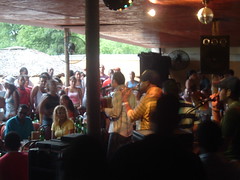
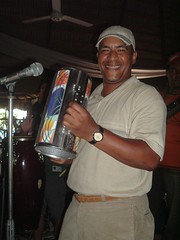
I shot this video one very dark night at the Casa de Arte in Santiago, Dominican Republic. It is of my friends the Turbí brothers, heads of the group Mello de San Juan, performing palos music. They are originally from San Juan de la Maguana, in the Southwest, but now live in Santiago. The second part of the clip focuses on people dancing to the music.

Ah, fieldwork! The ups! The downs! The standing around looking at one's watch...

7/5/06
You know, trying to get interviews done in New York is really no different than trying to get interviews done in the DR. You think you’ve scheduled something, but it falls through, so you reschedule, and reschedule, and reschedule… and you can’t have any semblance of a social life because you’re planning around the interviews you thought you scheduled and rescheduled, and you even base your sleep schedule around these elusive musician-types, and they have no idea what kind of hell they are putting you through. Aaaaaghh!!!

In spite of all that, I actually did manage to get two done last week. First up was King de la Rosa, who I’d run into at Macoris Restaurant the week before. We’d agreed on a time (5 PM Monday) and a place (his apartment in the Bronx) but I figured it would be wise to give him a reminder call in the morning. So I dialed the number – and got a friendly message from Verizon telling me the number wasn’t in service. Great Well, I could always just go there and hope he remembered – I did have his address, and he had said he would be teaching accordion lessons all afternoon. If I came a bit early I should be able to catch him.

I did that, and found his place, in a big block of four apartment buildings near Yankee Stadium, without too much trouble. I even found his bizarre apartment number (E3X? who ever heard of such a thing??) amidst the hundreds of buttons on the intercom next to the gate. But I received no answer. I pondered my next move, and thought of calling some people who’d be likely to have King’s correct phone number. I tried Tano, who plays bass with him. No go, but he gave me the number of the guy who plays guira with him. He didn’t have it either. Then I tried Juan Almonte, the restauranteur. He didn’t have it but suggested Bolivar, the new owner of Macoris, would. But when I called over there, they informed me he wouldn’t be in for another three hours. Not too helpful for me waiting on a sidewalk in the Bronx. I decided to get a milkshake at a diner I’d passed and rethink the situation.

The only flavor of ice cream at the diner, the Argentine waitress told me, was walnut. This seemed odd, but what the heck, I decided to try the walnut milkshake. Not bad. A soccer game was on - my Dominican York neighbor at the counter and I discussed how we knew nothing about this game, and then I opened up my book on Paraguay, a country I then discussed with the waitress (soup=good, economy=bad, was her evaluation). Afterwards, I figured I’d give the apartment building one last try before calling it a day.

Back at the ranch, someone opened the outer gate for me. Go on in, they told me. Well, it wouldn’t do much good if King still weren’t at home, but I went in and wandered around the very, shall we say, “urban” ambience of the courtyard until a kid carrying a drycleaning bag over his shoulder walked past me, opening the door to King’s building. “Do you live here?” I asked him. He did. “Do you know King de la Rosa? E3X?” “Umm... hold on a second... wait right here...” he mumbled as he ran up the stairs, leaving me to admire a lobby that might have once been grand, with its mosaic floor, high ceilings, and big 1930s copper light fixture, but was now just dingy and littered. Soon a chubby girl in an oversize t-shirt came down and confirmed that King lived on the third floor and that I should go up and knock.

I did that - well, actually, I rang the push-button bell below the peephole instead, and an elderly woman came to the door to let me in. There was no living room to speak of, so she showed me to a bedroom where King had just finished giving the last accordion lesson of the day. He was glad to see me. “But why didn’t you call?”

Explanations out of the way, we went on to a very satisfactory interview, complete with demonstrations of various accordion techniques. All the walking around, waiting, calling, milkshake-drinking, and interviewing had made it late - it was already nine, and I’d thought I would have been home by then. Still, I couldn’t very well turn down King’s offer to introduce me to his brother Arsenio, who I’d also been wanting to interview. “Does he live near here?” “Yes, he does,” King said as we exited into the courtyard. He’d barely finished saying so before we entered the building directly across and walked up one flight, arriving at Arsenio’s place - conveniently located, indeed.

Arsenio has gone evangelical and no longer plays gigs, but the sense of showmanship hasn’t left him. He was happy to have an audience, and pulled out a full-size piano accordion, enormous compared with the button accordions I’m now used to from merengue tipico. He proceeded to work through an incredibly varied repertoire for the next forty-five minutes, playing everything from Italian music to paso dobles and tangos, finally a little vallenato and a merengue for good measure.

Clearly, when we finished it was even later, but now I was hungry, so I couldn’t turn down King’s offer of dinner. “There’s a place near hear with good American food. Let’s go there,” he suggested, and brought me to the same diner as before. It was an all-diner day. At least it was a successful one - both in terms of the interview and the tuna melt.

Next up was Tano, a bass player and one of the first tipico musicians to move to Brooklyn. He’s also the bass player on the famous album Juan Luis Guerra recorded with accordionist Francisco Ulloa (Fogaraté). He’d agreed to a Tuesday interview, but when I called him on Tuesday, he was still working on laying down some tracks in the recording studio, so we put it off til Wednesday. He even offered to pick me up at the train station in East New York Wednesday evening, so I wouldn’t have to walk around alone, and then we could head over to Macoris together as he’d be playing there with King at 11. But when Wednesday evening rolled around, he was nowhere to be found. Alejandro picked me up instead.

Back when we were an item he was just scraping by, but now he’s in this big popular band and raking in the dough, relatively speaking. His best friend Diogenes “El Original” is saxophonist for the same group. Alejandro took me by his place to say hi to Diogenes and hear some stuff they were working on recording at home. I found out that with his newfound wealth Diogenes has bought a house in Boston, where he lives with his wife and kids when he’s not performing in New York or abroad. Alejandro, on the other hand, has stayed in the same old apartment in East New York. However, he’s made some changes too: no more roommates (there used to be a whole bunch of them there in order to make the rent) and a whole ton of new recordings and computer equipment taking up the space where sofas and chairs used to be. It’s interesting how when North Americans become upwardly mobile, one of the first things they do is move to a “better neighborhood.” Dominicans, on the other hand, stay in the same place in order to keep the same neighbors and maintain social ties, instead working on fixing up their house in situ. This holds true both for New York Dominicans and those on the island, so that even in the crummiest areas one can see a few houses that have sporuted second floors, columns and balconies, and fresh paint jobs.

Anyways, among Alejandro’s new toys was a nice keyboard, so of course they wanted me to play something, and of course I couldn’t really play anything as I hadn’t even touched a piano in a year (traveling the world and piano-playing don’t go together too well, I’ve found). But they dug my salsa riffs even though they were sloppy. Diogenes then just had to learn the opening to Fruko’s “El Preso”before I could leave for Macoris. Back at Macoris, I caught up with King and scolded Tano, who apologized that the recording session was taking much longer than expected (figures). We postponed once again, this time to Friday. But I wasn’t in the proper humor to stay out jamming all night so I left after one set.

Guess what happened on Friday? That’s right- no Tano. Time to rethink this situation. On Saturday, I set up something new. First, brunch with Tianna. A very delicious one at Bonita in South Williamsburg, which included the rather bizarre combination of a guacamole appetizer, an apple pancake main course, and loads of both coffee and sangría (depressant in your right hand, stimulant in the left -prepared for any occasion!). Next, an interview with Ray “Chino” Diaz, percussionist and producer, at his apartment-studio in Bushwick.

–soon to be continued---

Sunday, July 09, 2006

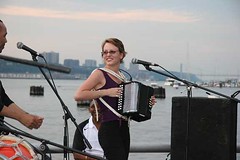
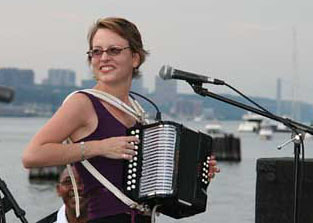
Syd as accordiongirl at Main Squeeze Accordion Festival

A friend, Bob Godfried, snapped a picture of me playing a couple merengues with friends at the Main Squeeze Accordion Festival yesterday. It took place on the pier at W. 70th St. in Manhattan. Besides merengue tipico, there was also Cajun, Balkan, Irish, Norteno, and rock music!

Friday, July 07, 2006

El Prodigio and Rafaelito Mirabal


Watch the video
At the closing ceremony for the Feria Regional del Libro in Santiago, Dominican Republic in September 2005, accordionist El Prodigio gave this surprise performance. He joined jazz pianist Rafaelito Mirabal to play Periblues (a tune Miarbal composed and El Prodigio recorded on his 2005 album, Pambiche Meets Jazz) - the first time anyone's tried to combine jazz with merengue tipico. I've excerpted some exciting moments here: President Leonel Fernandez and his wife arriving, El Prodigio's solo, Frandy Sax's solo, and the final run through the tune.

Ga-ga video

Ga-ga


Watch the video
A ga-g music and dance group dedicated to San Miguel plays in a batey (sugar cane settlement) near Barahona in the Southwestern DR. This clip shows a few moments when the dancers were performing with machetes. Filmed by Sydney Hutchinson in April 2006, d

This video was originally shared on blip.tv by salsasydney with a Creative Commons Attribution-NonCommercial-NoDerivs license.

Sunday, June 25, 2006

Shantologists meet ethnomusicologist

6/23/06
OK, ok, I know I advertised this blog as my adventures in the Dominican Republic, and now I’m in New York, but I’m just going to keep writing anyway and YOU CAN’T STOP ME. At any rate, New York is just another Caribbean island, isn’t it?

It certainly felt that way on Wednesday night, when I went to search out my old New York típico friends, whom I hadn’t seen in over a year. Wednesday night is the big night for hard core típico fans and musicians, who all head over to Macoris restaurant in East New York for a beer, to see who’s playing, and trade off instruments as the night wears on. In the old days when I used to go faithfully, things got started early – nine at the latest. I didn’t really want to be wandering around East New York by myself after dark, and I wanted to talk to the owner, Juan Almonte, anyway, so I hopped on the L train and arrived about 8 o’clock.

As I was walking up to the restaurant I noticed it had a new awning – blue instead of the old red – and that it said “El Nuevo Macoris.” I was expecting the old Macoris, so I was surprised when I walked in and saw new tables and chairs and a new flat-screen TV in place of the old acrylic painting of Tatico and Siano. Juan was nowhere in sight, so I asked one of the girls behind the counter when he’d be arriving. “Juan doesn’t own this place anymore,” she told me. I was in shock. Juan had been the owner of Macoris for over 15 years, and it was because of him that it was such a típico kind of place. I leave for a year and this is what happens? How could everything change so fast, after so many years of stability?

She told me he now owned a restaurant called El Triangulo on Rockaway Blvd, just over the Queens border, and gave me his number. She also told me that my friend King de la Rosa was playing tonight, but not until after 11! Not relishing the idea of sitting around waiting for three hours, I gave Juan a call. He was surprised to hear from me and told me to hop on the bus down Jamaica Avenue. When I got to 75th street I was to give him a call. I did this, although I went on to 77th street so I could enquire when music would be happening at the Rinconcito de Nagua, another típico joint. Juan then picked me up as planned and took me to El Triangulo.

The new restaurant was very nice and a pleasant place to hang out. Juan, always a good host, gave me a huge dinner of fish, rice, and beans, and a beer for good measure. He had a plan: he’d sent friends to dig up a tambora, a güira, and an accordion so I could play a few merengues a trio with them. As soon as I finished we did this, a full set of eight merengues with Juan on tambora and various friends on güira and vocals. They were surprised and happy to see how much I’d learned with Rafaelito over the last nine months. But soon the accordion’s owner had to leave, Juan had to get back to work, and I had to get to Macoris. Promising to call me the next time music was planned, Juan drove me back in time to hear King in the middle of his first set.

I walked in to find many surprised faces of friends I hadn’t seen in ages. There was King, of course, who made me promise to stay long enough to play a few tunes here; Tano on bass; Cesar on tambora; Ray “Chino” Diaz, the percussionist and music producer, on a stool in the corner; and guitarist Edilio Paredes at a table in front of the band. And wait a second – what was that whole table of white guys doing here? It had to be the doing of my friend Greg, the only other gringo típico fan besides myself, and indeed it was. I had stumbled into his bachelor’s party, as he was getting married in ten days and wanted to use this as an excuse to fulfill his dream of a gringo típico night at Macoris. That was a surprise. I certainly don’t think I’ve ever attended a bacherlor’s party before.

All this was very lucky for me. I found three people I’d wanted to interview (King, Tano, and Ray) all in one place and was able to set up the interviews right then and there. I got in touch with Greg, who I’d also wanted to see. Cesar offered me more tambora lessons, King offered me accordion lessons, and Tano offered to rehearse with me. And of course, I got more free beer. So it was a profitable night, if a long one – I didn’t even get to play my tunes (three of them) until about 2 AM. And after me, Edilio took the stage for a couple of tunes (although he’s principally a guitarist, he learned to play accordion from King and now does both with his group Super Uba).

Also lucky was that I could get a ride home with Greg and the boys instead of paying a car service. About 3 AM or so, I stumbled into my friend Tianna’s place in Greenpoint, where I’m staying for about a month, and promptly sliced off the edge of my fingertip, I think on the razor in my cosmetics bag. Dripping blood, I searched for something to wrap around it. I went in the bathroom and found there was no toilet paper. I went in the kitchen and found no paper towels. I went back in the bathroom to look for band aids – there weren’t any. Finally I realized a tampon was my only option. Hey, they’re absorbent, aren’t they? And then I laughed and laughed as I brushed my teeth, washed my face, and put on my pajamas, all with a tampon stuck to my finger.

Postscript to that story: I thought I’d stopped the bleeding enough to go to sleep, so I found a Kleenex in my purse to wrap around it and did so. I woke up at 8 AM needing to go to the bathroom, and as I went downstairs I noticed my finger was STILL bleeding – five hours later. I felt a bit lightheaded, and there were still no bandaids. I fell back into bed feeling I would pass out. What does one do to stop bleeding, I wondered, trying to remember my ancient Red Cross training. A tourniquet! Of course! But what would I use? The elastic hairband sitting on the living room table should do the job, I thought, and so I wrapped it around my finger and hoped for the best as I drifted off to sleep again. When I again awoke a couple hours later I saw the trick had worked, although the finger was throbbing a bit. I was pretty proud of my inventive first aid, though I wondered how my accordion playing might be affected.

Luckily, on Friday, when my accordion skills were next called on I found I could play just fine even with my newly-purchased band aid. For a change from my usual Dominican fare, my friend and now roommate Tianna had invited me to play sea shanties with her and some friends on a boat on Saturday. She promised it would be one of the wackier gigs I’d likely ever play, and really, who can resist sea shanties, so I agreed to join the impromptu band formed of Tianna and her friends Hannah, Zeke, and Nathan. Nathan works at the Lomax archives and had done a fine job of digging up old shanties for us to sing.

The accordion would definitely add the right piratey touch to the ensemble, but I worried I wouldn’t find anything I could play with them because my accordion is in B-flat/E-flat, keys that combine well with the sax for típico musicians but which I didn’t think would be much used in the shanty repertoire. As it turned out, Hannah happened to have an ancient Hohner acquired at a flea market and never played, in the much more useful keys (shantily-speaking) of G and C. The only problem was that it had no shoulder straps, nor even a place to attach them, and the thumb strap was broken. The only way to play it was over the knee, fixed in place with one’s chin. This posture couldn’t be comfortable for very long. Thank goodness I hit on the answer: duct tape. This addition much improved the thumb strap and enabled me to muddle through the whole rehearsal without much incident, making it up as I went along and thoroughly enjoying singing harmony in hearty sailor style.

That was the only rehearsal we all got together, though, and the only time I was able to hear the songs before our big debut on Saturday. In Hannah’s van we - five musicians, two friends, a dog, and ten instruments – journeyed to the Gowanus canal, where we found the boat tied up at the very dead end of First Street. This very nonseaworthy ship (it must be moved each day by the dozen-volunteers-hauling-on-a-rope method) had been donated to Tianna and friends, and they thus created the Empty Vessel Project to fix it up and make it useful for musical events of all types. It’s come a long way but still sports a garbage bag ceiling, random holes and pits of varying danger levels, and a toilet made of a bucket that must be manually emptied after each event (a task all EV members fear).

The Gowanus, a stagnant morass of toxic chemicals, isn’t the most scenic spot on earth, but it was definitely novel to be on a boat in the middle of Brooklyn. There was a gangplank to walk up, citronella candles aplenty, and a generator powering the strings of fairy lights that lit the place. A bar was being set up in one corner and on the other end a DJ with a broken leg was setting up his equipment on an ironing board and an old bathtub with a plank on top. With his clomping cast he sounded much more pirate-like than the rest of us, although we had at least made an attempt at a sailor look in navy blue and white. The other workers were dressed in lace, corsets, fishnet tights, polka-dotted hairnets, fishtails, and all other manner of outlandish attire. I figured they were a bunch of Goths, and they might be, but I later found out from one of them that they’d all been in Coney Island’s Mermaid Parade that afternoon. That would also explain it.

I quickly realized the boat setting offered all kinds of opportunities for me to make puns: I hoped we wouldn’t “rock the boat” with our rockin’ sea shanties; I didn’t want to “go overboard” with them, etc. I could have gone all night but luckily for my co-conversants I had to get ready to play by first having a beer and then setting up the instruments and lyric sheets. We had been afraid someone or some instrument might pitch overboard, or that we might sink altogether, but in fact something far worse than this happened: as Zeke helped the crew extract speakers from crates and set them up, he stepped backwards right into Nathan’s guitar with a sickening crack. Nathan, who was out searching for food with Hannah at the moment, was very gracious about the accident but it did put a bit of a damper on our moods.

The gig itself went fairly well considering the amount of rehearsal time we’d had. There was only one song that I’d completely forgotton, and the rest came back easily enough, as they had very catchy tunes and fun-to-sing choruses: Heave away! HEY! Haul away! HEY! At any rate, this crowd didn’t much care that we botched some of them up. It was the spirit of the thing that counted, and we injected the needed saltiness into the festivities.

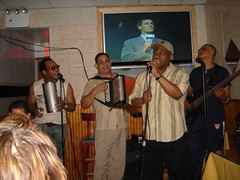
King de la Rosa and Edilio Paredes

King, one of the great accordionists, is joined by Edilio, a great guitarist and singer, on a Wednesday night at Macoris Restaurant in East New York. Tano is on bass (he was the bass player on the acclaimed Juan Luis Guerra CD, Fogarate). But who's that on the TV?

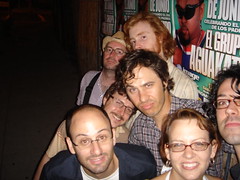
Bachelor party


Bachelor party
Originally uploaded by salsasydney2000.
I accidentally ran into my friend Greg's bachelor party and we snapped this picture, very appropriately next to posters of Aguakate, who will play at Greg's wedding.

Thursday, June 15, 2006

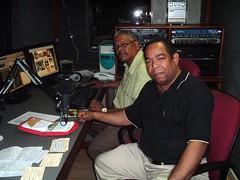
Ricoche and Victor Reyes

In the deejays' booth at La Super Regional in Santiago.

Gaspar and Tatico


Gaspar and Tatico
Originally uploaded by salsasydney2000.
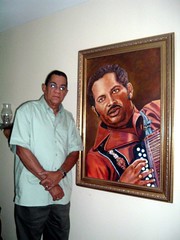
Gaspar Rodriguez, host of Arriba el Merengue TV show, poses with a portrait of his friend Tatico at home in Gurabo.

Santiago to New York

6/11 - 6/15/06
Last Friday, the tables were turned on me. My friend Juan Miguel wanted to write a newspaper article about me and my research, so instead of me doing the interview I had to be interviewed myself. He’d give it a bit more glamour by including not only my teacher Rafaelito but also the big star El Prodigio in the story and photos. So at 10 AM, I was all ready for the photo session at the Centro Leon with a new outfit and manicure. A bit later, El Prodigio and his manager Yordy showed up, but unfortunately Rafaelito was sick and unable to come. Nonetheless, we all had a good time catching up as I hadn’t spoken with El Prodigio in a number of months. He invited me to play at his show on Sunday and we also agreed to meet up during his tour of New York in August to discuss some ideas for projects we had. He’s very interested in jazz and jazz-merengue fusions, so I thought I could introduce him to some people that might give him some new ideas.

Afterwards, I’d arranged with soundman Ricoche to go with him to meet businessman/típico patron Arnulfo Gutierrez, but when I arrived at La Super Regional, he’d already left. So that was off, but I was able to finally schedule an interview with Che, my favorite bass player, for 11 PM that night. He currently plays with Geovanny Polanco and I had to go to his show at the Tipico Monte Bar anyway, having promised Geovanny the day before. I did my best to get in a nap before the show, since at the TMB they always start so late, but it wasn’t good enough – I still felt exhausted and a bit grumpy when I finally met with Che that night. Still, it was an interesting interview, though we had to conduct it somewhat uncomfortably in the parking lot in one of the singer’s cars. Afterwards, I went in and took a table stage right with Che’s wife. The place was completely packed with young people. I thoroughly enjoyed the first set, as I hadn’t seen Geovanny play since his new CD had come out and thus was able to hear some tunes that were new to me. In the middle, he sent a saludo or greeting to me, “la musicologa.” The rest of the audience looked around curiously, doubtlessly thinking he was referring to some new típico star. The first set ended at 1:30 AM. When Geovanny came off the stage, he told me to prepare myself to play with them during the next set. But there was little chance I would still be awake and mobile enough to play at 3 AM so I gave it a miss. I had loads to do the next day, and a 5 AM bedtime wouldn’t help things any!

I’d mostly planned the next day to be a day of farewells and visiting people I hadn’t seen in sometime. First I got together with my carnival friends, stopping by Tonito’s house, then moving on to Betania’s where Jose Reyes came to meet us. We discussed our costume plans for next year, and Jose made some suggestions. We could save money by reusing the same mask, just repainting it and decorating differently. He liked the design and though we should keep using it so it would become a recognizable mark of Los Confraternos. Our mask combines the two main traditional types, joyero and pepinero, by having both smooth and spiky sections on the horns, and combining the wide beak of one with the upturned snout of the other. And I was assigned the task of investigating fabric selections. They hoped I would be able to find fabrics in the US that no other group would have, and that might turn out to be cheaper as well due to a monopoly in fabric sales in Santiago.

After that I realized it was already 5:30 and I’d been due to make an appearance at Denio’s house for a farewell-to-palos dinner “after five,” so I’d better hurry on over there. As I parked on the curb under the tree at the head of the walkway leading to his house, Denio and a few others were there to meet me, anxiously awaiting my arrival (as an American, I’d been expected to arrive closer to “on time”). Rum and beer were also awaiting me, and soon the party was going strong with palos and son in rotation on the stereo as the rest of the group arrived, including even Monchy and Papo, who hadn’t been to rehearsals since I’d started. Denio and the woman who helps with his kids were preparing yuca and stewed meat, along with some cooked vegetables and cheese for me, the lone vegetarian. They had just gotten food on the table when the power went out. Boy, was it dark! Soon candles appeared for us to eat by, and I chatted with Papo about music, universities, and New York: he’d spent most of his life there, but was now teaching languages at UTESA, a technical university in Santiago. He explained that to teach at one of the bigger, better-known schools like UASD, one had to have political connections, which he didn’t. As we talked it started raining, which sort of ruined our plans for a backyard palos rehearsal, so the guys brought the drums in instead. We played and drank, drank and played until after 11 – my last chance to practice until 2007! - when we figured we should both let the neighbors sleep and get some sleep ourselves. I had a record three performances scheduled for the next day, so I needed the rest.

I started the day by practicing. I needed at least six good songs for the gigs I was to play, and I had to choose them carefully, as I didn’t know who was likely to know the arrangements I would play. I also wanted to try out some merengues I’d never performed before, but wasn’t sure I trusted anyone but Rafaelito’s musicians to accompany me in those uncertain moments. I had planned to go over and rehearse the new tunes with Chiqui, but when I called he was already leaving for his own gig. Then I tried Rafaelito, but he was also unavailable. This was because El Ciego’s father had died just that morning and he had to attend the burial, unusually scheduled for that same day. For me, this meant not only that I would be unable to rehearse my new tunes but that I was now down to only two gigs, as one of the three had been an invitation by El Ciego to play with him at Rancho Merengue.

I prepared as best I could for performing with El Prodigio and then headed out to Champion’s Palace, a place out past Rancho Merengue and La Tinaja on the highway to Navarrete, which was where El Prodigio had told me he’d be playing at 5. But as I neared the Palace, I realized that was wrong, as the sign stated Nicol Pena was playing there today. Luckily, another sign appeared to point the way – El Prodigio was actually at Andy Ranch.

As I arrived there it began to rain: not a good sign for a gig at this outdoor, swimming- pool-oriented Rancho. I thought the place would empty out, but luckily it was only a drizzle and was over fairly quickly. The flip side was that the sweltering, humid heat returned just as quickly, making me regret my elbow-length sleeves. I sat with some people I didn’t know back behind the stage, the tamborero’s wife and friends, and ordered a Coke that it took 40 minutes for me to receive. Then I had to wait another half hour to get my change. At least El Prodigio was happy to see me, even though I scolded him for telling me the wrong place. Between sets, he introduced me to some friends who bought us a beer, but we didn’t have time to drink it before it was time for the second set. Halfway through this one, I took the stage to the surprise of all (or at least those who hadn’t seen me play before). I played La Cartera Vacia while El Prodigio sang, and then he asked me to call a second song. I selected El Puente Seco, but he said his saxophonist didn’t know it, being really a jazz musician rather than típico, so I went with El Cuento Comparon instead. Although the saxophonist didn’t know the mambos I played, he picked them up quickly. One man in the audience was so incredulous that I was playing, he came up on stage and put his ear right against the accordion. After listening for a minute, he stood up and nodded, indicating to the audience that it was no trick.

After we finished the place cleared out pretty quick, and I headed down the street to La Tinaja. I thought I would be late, arriving at 8, but they’d only just started. I greeted the emcee who has sung with me on several occasions but whose name I can never remember and entered the club, where I found Raul, Rafaelito’s son, seated in front of the stage. I took a seat beside him and listened to the first set, during which my hunger grew, so afterwards I went out to the roadhouse in front to see what they had to offer. The emcee accompanied me as I ordered rice, white beans, green salad, and a piece of fried cheese. After a while Rafaelito and the other musicians came in too, and we all ate enormous purple grapes together, dicussing (for some reason) asteroids and mass extinctions until it was time to begin the second set. When we came back, I found that two girls –friends of the Roman family- who had been at Andy Ranch had showed up here, too, following me from show to show. When my turn came I decided to risk it and try out one of my new numbers, El Tiguerito, even though I hadn’t ever played it with anyone else. With my friend the emcee singing, it came out quite well, and I followed it up with El Puente Seco, since I hadn’t been able to do that one at the previous gig. These went off so well that the sound man Cigua, so called because he is tiny like the Cigua bird, told me someone had said to him, “she plays like a man!” High praise indeed in tipico world.

I was pretty tired after all that excitement, but I still had one more stop to make. Otherwise, I didn’t know if I’d have time to say my goodbyes to John Taveras and my other friends among the staff at Rancho Merengue. So I hurried across the street, where I said goodbye to William, the emcee, Chimon güira, and several others. I made plans with Vilo to pick up the tambora I’d ordered, now nearly completed, on Tuesday. And finally John showed up as I waited in the drizzle outside, sad to hear I was leaving so soon. Like everyone else I’ve told I’m leaving he said, “but you’re coming right back, right?” “Well – next year,” I explained. “What?!? How can you leave for so long??” “Well, I am from there, not here,” I reminded him.” “No, you belong to us now,” he said, echoing the same sentiment I’d now heard dozens of times.

Monday was a day mostly for running errands. But I did work in one last dominoes game at Chiqui’s, and then Chiqui accompanied me to say my farewells to El Buty, the güira maker. But neither of them was satisfied with this goodbye, so they both agreed to come to my place to help me with my final packing on Thursday. I played with Buty’s cotorra, a smallish green parrot, friendly but not yet able to talk at only 6 months of age, until I realized I was about to be late for my last accordion lesson. There, I learned Las Indias de Bani at Manuary’s request. I’ll play it for him when I come back next year.

On Tuesday I’d scheduled a meeting with a different Chiqui, this one a cultural specialist at the Centro Leon, who had agreed to help me with my socioeconomic map of Santiago. While there, I planned to say my goodbyes to my friends there. After Chiqui gave me the data I needed, and Camilo presented me with a book of his poetry, I had a meeting with director Rafael Emilio where I gave him a give of a piece of Indian pottery from Arizona and filled him in on my accomplishments in the DR, and he in exchange presented me with a nice coffee-table book of photography by a Dominican artist of whom I’m a fan. Oddly enough, he also photographs Arizona scenery. Then I went back to see the friendly faces in the tabacalera (tobacco-rolling house) and purchase a doll of a tobacco worker in the middle of rolling a cigar. I picked mine mostly for his outfit: orange shirt, floral tie, and blue plaid pants. Stylish. But after lunch, where I had a final chat with my friends in the cafeteria, I had to make a quick split in order to get the rest of my scheduled activites done.

First, the tambora. Vilo had given me vague directions to his house in an unmapped development just behind La Tinaja: “Turn right at the road before the bridge. Then ask someone where I live.” This actually worked just fine, although I missed the turn the first time around and had to double back. On the predictable horrible road, I stopped at a group of dominoes-players to ask directions, and it turned out I new one of the women there, a friend of the Roman’s. They pointed me further down the road, and indicated I should turn right before the school. When I saw the school I asked again and easily found the house. Vilo was on the phone, so I waited on the porch, where a light breeze helped me shed some of the pounds of sweat I was wearing as a consequence of the long drive in the hot sun. When he got off, he showed me my lovely tambora, a Syd-sized black one at a special Syd price, as well as some other models he was working on. We discussed how to get a goat skin (from a goat butcher down the street), how much to pay (300 pesos), how many tamboras one can get from a single goat (not even one, since each side requires two coverings), and how to tell the right-hand side from the left-hand side (the right hand side should play the male goat, and you can tell because the male goat has a black stripe down its back, which will then be down the middle of the tambora head).

I couldn’t dally too long, though, as at 5 I had arranged to interview Francisco Ulloa at long last. I’d been told he wasn’t playing much anymore because he had gone evangelical. I found that he is still playing, not only at his Sunday gig at Rancho Merengue but in other towns as well, but that he is also an evangelical Christian. Nonetheless, I enjoyed talking with him about his status as “the ambassador of merengue típico,” and his collaborations with Juan Luis Guerra and Felle Vega. But again, I couldn’t stay long as I had yet another appointment afterwards: this time with Arriba el Merengue host Gaspar Rodriguez and friend Bismar, who had offered to help me make copies of some historic típico footage Gaspar had on video. But as it turned out Bismar was called upon to work that evening, thereby foiling our plans. I decided to stop by Gaspar’s anyway, just to say goodbye.

He wasn’t there when I arrived, so I waited on the balcony with their maid/nanny drinking a glass of pear juice. When Gaspar and his wife finally showed up I was nearly falling asleep, but roused myself enough to snap some photos of the portrait of Tatico that hangs on Gaspar’s wall. Then they invited me to stay for dinner. To pass the time, the maid brought me beer and Gaspar brought me piles of photos and videos to watch. He had some amazing 1960s pictures of El Ciego and of Tatico. When I turned them over I found they were shot by Lalan, the merenguero and newspaperman that figures in the famous merengue “La Balacera” that Tatico composed about a memorable night the two of them spent in jail together. On video, we watched Nico Lora, Guandulito, El Negrito Figueroa (accompanied by a drunken dancer I found hysterically funny, and whom they told me was named Joel, a fanatical follower of the late accordionist), and Siano Arias (during this one, shot in a New York [?] apartment, the other late accordionist Diogenes Jimenez could be observed asleep on a chair). It was amazing to be able to watch these ghosts from the past I’d heard about but never seen, and I’m hoping to obtain copies soon. Anyway, it was all so entertaining I ended up staying past 11 PM without realizing it!

Wednesday morning being mostly free, I decided to take care of a few things with my car and thereby say goodbye to my mechanic, El Negro, who had taken such good care of me and El Cacharrito. At 2 I was scheduled to interview businessman Juan De Leon (Papote’s brother): Ricoche had set this up as an apology for botching our meeting time the other day. But when we arrived, Juan hadn’t yet returned from a business trip to Puerto Plata, so that was put off yet again. I did comply with my obligation to be reinterviewed on La Super Regional that afternoon, which was entertaining, although when asked to name my favorite performers, I missed a couple I probably should have acknowledged due to the stress of being on the spot. At least I got Fefita in there, and she called in after I was done to express her gratitude. After that, I went back to Tonito’s to pick up some bootleg DVDs he wanted to give me. He’d heard the interview and was tickled I’d mentioned my carnival activities with Los Confraternos.

I woke up on Thursday not quite believing it would be my last day in the DR after 9 months. But I didn’t have much time to reflect on it with such a full day scheduled. First I had to go to the police headquarters at the old airport with my lawyer, Eddy, to get my car inspected. Once they determined it hadn’t been stolen, I could finally get the registration transferred to my name. Afterwards, I had fifteen minutes before my rescheduled interview with Juan de Leon and Ricoche, so I stopped to put gas in the car. My temper already short, I went into a bit of a fury when none of their card readers would accept any of my perfectly good credit cards. This is one thing that has driven me a bit nuts here – every so often the bank won’t let a credit card pass simply because it is in the Dominican Republic. I’m not quite sure why this continues to look suspicious after I’ve lived 9 months in the country, but whatever. Half an hour, a trip to the ATM, and some swear words later, I finally made it out of there and, somewhat frazzled, to the interview at Juan’s office above a car repair shop: definitively my last interview in the DR in 2006. Next it was home to pack, get my deposit back from Dona Ana, and receive my visitors.

In the end, most of the Taveras clan made the trek down to my neighborhood: Chiqui, Laura, Yary, Felo, and even Chiqui’s sister Yahaira. They brought me a present of mangos from Dajabon. They looked delicious, but I knew there was no way I could bring them back with me or even eat them before leaving. Fun times packing bags, taking down mosquito nets, and washing dishes, all in sweltering heat, followed. Eventually El Buty showed up as well with the jars of sweets he’d been wanting to give me before I left, prepared specially by his wife. When we finished hauling all the luggage downstairs, where it would wait for me in Dona Ana’s apartment until my early departure the next morning, we celebrated with a game of dominoes, Coke, and Presidente I ordered from the colmado. (I’m going to miss having a corner store that delivers.) In order to protect my glass dining table from El Buty, who tends to slam dominoes down hard in classic Dominican style, we covered it with a flattened cardboard box.

But I still had more to do. First, I’d promised to visit Rafaelito and Domingo before leaving. Then, I was scheduled to have drinks with the Centro Leon crowd at a nearby bar, Palermo, at 8. This left little time for either dominoes or visiting, so we hurried to the car, El Buty to follow us in his blue pickup with a güira decal… only to find that his car wouldn’t start. He quickly determined the problem was lack of petroleum products, so now we had to return to the scene of my earlier gasoline-fueled fury with a gas can. Bringing this back to the waiting Buty, we found his car still wouldn’t start. And wouldn’t start. Really, this was becoming quite comical. And then it did start.

Out in El Ingenio, I made my farewells – though not tearful ones, as we knew that I’d be back next year. Rafaelito tried but couldn’t find the CD of his father I’d been wanting to get a copy of. Well, now he has seven months to search. I presented him with a can of chipotle chiles in recognition of the fact that he’s the only Dominican who eats spicy food with me. And I presented Domingo with a bag of mangos. After this, I only just had time for a quick but very necessary shower before my next appointment, picking up Noelia on the way. At Palermo we found Jose Enrique, the photographer, smoking outside with Carlos Andujar, the anthropologist. Carlos told me I had to leave to get my accordion, bring it back and play them a song. Too late, I told him: if I had to move one more inch, or if one more person gave me one more task to do, I was going to scream. So I perched myself on a barstool in the air-conditioned comfort of Palermo, ordered a house special (something involving rum, soda, and peach liquor) and a sandwich, and was soon feeling much better. Also in attendance at various times were Angela, Claudia (my movie-watching buddy from the gift shop) and a friend, Pedro Jose aka Pilito (who confessed I’d inspired him to start eating spicy food, and was making great progress on this front). Although Carlos had a bit too much whisky, it was all in all a good sendoff, and I went to bed satisfied if a bit sad, and strangely uncomfortable in the absence of my mosquito net.

The morning of my departure went surprisingly smoothly. Don Rafael helped me load the car, and my four enormous suitcases, two carry-ons, and carnival mask fit with room to spare. I found Hector awaiting me right where he said, at a gas station on Las Hermanas Mirabal. I presented him with two gifts: the Dajabon mangos (or all but one I’d decided to try to smuggle back) and a cell phone I was no longer going to use, since he didn’t have one. And at the airport, I encountered less than the expected resistance to my mounds of baggage, although I did end up having to pay $230 to get them back to the US. The tambora was worth it, though.

Now I’m back in New York, going through culture shock again. First of all, it was FREEZING when I got back. And then there was an odd lack of potholes and excess of traffic lights in the streets. I could drink the water, flush the toilet paper, and speak English to people in stores. But no plantains, no accordions, and for these and other reasons I found myself a little down when I woke up on my birthday Tuesday. Until my new cell phone rang, now playing Beethoven instead of “Lowrider.” I answered but no one replied for a few seconds. Then I heard an accordion striking up the tune of “Cumpleanos Feliz,” and then, was it Laura singing to me? With this phone call, from Santiago to New York, the Taveras family to me, the two sides of my life came together again and I felt content, even if I was 31.
Monday, June 12, 2006

The End Approaches...

6/5/06
After Heather left, I decided to investigate the options for sending some of my mountains of excess baggage back to the US, since David was there for exactly the same reason. In the cargo office, we found out that the minimum charge to send a package was 6000 pesos! Nearly 200 bucks, even if the package was only the size of an eyeglass case. Man, things went up since two years ago, when I send a big old marimba over for only $100. Luckily, as we again entered the airport, I heard someone call my name: the voice of reason? No, it was a member of Los Tuaregs, one of Santiago’s big carnival groups, who I’d met back in March during our parade through Ensanche Bolivar. Turns out he works for American airlines. He offered advice on bringing my carnival mask back: hand-carry it in a plastic bag. I protested I’d already have 2 carry-ons, what with my accordion and my bag of computer and camera equipment, but he said it didn’t matter if I asked for it to be stowed at the gate. Well, that was a load off my back, so to speak.

That done, I just had time to run home for my accordion before my lesson time. And after that, I only just had time to get home again before a torrential downpour began. If you’ve been following my chronicles, you’ll know how rain in Santiago is and you’ll already have guessed that I was about to be trapped in my home for some time. That was indeed the case – I couldn’t even make any phone calls since I discovered I was out of phone card minutes too late to do anything about it. So much for Monday.

Forced to arise early Tuesday by my friend Juan Miguel, I fueled up on coffee and headed to PUCMM, the private Catholic university where he teaches (its initials stand for Pontificia Universidad Catolica Madre y Maestra, but it’s better known as “Pucamaima”). He was all set to help me obtain the socioeconomic map of Santiago I needed for my dissertation. In exchange I had to help him edit an abstract of a paper he was proposing to give at an all-Bourdieu conference. We were successful on both counts, and also it was nice to see the verdant campus I’d never before visited. I felt strangely at home in the geography lab, surrounded by all the map paraphernalia that reminded me of my dad’s office when I was a kid. All in all, I grudgingly had to admit it had been worth arising early. After we finished our work, Juan Miguel called El Prodigio to set up a meeting he’d been talking about for a while. He hoped to write an article on the two of us, Rafaelito, and my merengue activities before I left.

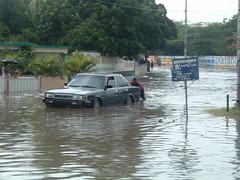
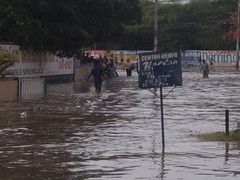
In the afternoon, I set up an impromptu interview with old-time accordionist Julian Ramirez at his home, where I’d never been before. It was a nice place in a newly-built middle-class area, and he lived there with his daughter, the accordionist Raquel Arias. I’d never met her before – in fact, I think she’s the only of the female accordionists I hadn’t met or interviews. This was because, after having a few hits in the 1990s, she gave up her musical career in favor of evangelical Christian pursuits. This hasn’t deterred her father’s wild ways in the least, and he recently recorded a new album of double-entendre merengues. We discussed his years with the Trio Reynoso in the 1960s, his recollections of Tatico, and his views on modern merengue típico until I noticed just how close the thunder was getting and figured I’d better hurry to my next appointment at Rafaelito’s before disaster struck. My timing was right, as the downpour started just after I walked through the door. But I started getting worried as it went on and on, walking to the porch and peering suspiciously through the gate at the roundabout every so often. My worst fears were soon confirmed as the “lake” filled up, and I snapped a couple of pictures of people wading and drivers pushing their conchos, a souvenir of my time in El Ingenio.

The kitten Mauricio kept me company, falling asleep in my lap as I worked on my computer until Rafaelito got back from picking up his son Yorly from school. I felt my car was probably safe, as I’d parked it away from the highest water line I’d yet seen, but the rain was major and soon water was lapping around the tires. It was also lapping at Rafaelito’s door, and every time a big rig went by the waves it created splashed dirty water into the living room. Manaury took cinder blocks from the backyard and began to build a barricade. Mauricio got worried and climbed from my hands all the way up onto my shoulder, finally perching on the back of my neck. Some debris got caught on my car’s bumper and Manaury waded out to pull it away as Yorly and I balanced ourselves on a low brick wall to get a better, if precarious, look at the action.

I thought I might as well wait a couple of hours for the water to come down before attempting an escape from the neighborhood. In the meantime, Manaury copied a couple of CDs for me and I showed Rafaelito the basics of the Finale music notation program that had aroused his interest when I showed him the transcriptions I’d done a couple of months ago. But at 9 PM, the water in the roundabout was still at an impassible level. Rafaelito had to go out too, however, so he led me through a very roundabout back route through hidden and narrow, pockmarked dirt roads that eventually let us out back on the Circunvalacion, below the problem area. From there it was smooth sailing. I reached home safe but exhausted, though I still had to help Juan Miguel finish his Bourdieu abstract. After an hour and a half of my grueling questioning, he and I decided to call it done.

The next day, Wednesday, I was startled to find I had most of the day free, as I’d been unable to schedule any of the mountains of interviews I was planning for my last week in the DR for that day. Instead, I went to the gym for one last time, and then to the Lizardo archives for one last time. I was scheduled to be interviewed myself by Victor Reyes, a DJ on La Super Regional (the biggest típico radio station in town), at 6 PM so threw in the towel early to be sure to arrive on time. I thought I was early when I got there at 5:45 but I was wrong: I thought he’d said “at 6,” but he’d actually said “from 5 to 6.” Oops. There was only time for 5 minutes of interview before the Rancho Merengue hour ended, but we agreed to do it again just before I left next week. Still, the visit wasn’t a total loss, as I was able to interview Ricoche, Tatico’s soundman in the 1970s and today a technician at the radio station. Then, I rounded out the day with a visit to El Tiriguillo, my old haunt. I hadn’t visited in ages and felt a little guilty for having deserted my friends there. As it so happened, while some of the “regulars” like Papito were there, the owners weren’t, so I was unable to make my farewells.

On Thursday I had three appointments: one at the spa and two interviews. In between these I figured I’d better get my nails done in time for my weekend performances, but due to my haste and my car’s non-power steering, I of course made a mess of my right hand in short order. I hoped my audiences would feel it was the thought that counted. More successful were the interviews: first I visited El Ciego in his lovely house in Llanos del Gurabo, where I also met his several amusing dogs and birds. Afterwards as we chatted I told him about my car and how I’d been searching for a name for the thing. As nicknames for humans are popular and even necessary here, so are vehicle names. Rafaelito had even written a merengue about one fan’s car, “El Campirolo,” and I had dreams that one day my 1984 Honda Civic could have its own merengue as well. El Ciego asked me to tell him about it, so I did: “it’s old and a little ugly, but not too ugly. It runs OK. But when it rains a lot of water comes in from underneath. Your feet get wet and you wonder if you’re at the beach,” I told him, giving the best description I could for the blind man’s benefit. He laughed. “Let’s call it El Cacharrito,” he suggested. I liked this. It means something like “the little piece of junk,” or “the jalopy.” Chitty chitty bang bang, perhaps. “You can use the name, but you must tell everyone it was Bartolo who picked it out!” El Ciego insisted. I agreed to his terms. Later I filled Rafaelito in on the news and he agreed to compose a merengue titled “El Cacharrito” for next year when I return. “Make sure it talks about everything I’ve gone through with it in the roundabout of El Ingenio. Like when we were bailing water out of it until midnight,” I suggested.

The second interview of the day was with Geovanny Polanco, a young star in the merengue típico world. Actually, I though he was much younger than he is due to his baby face, but he’s one year older than me. It took me a while to find his house, in a newly-built gated community on top of a hill next to Cerro Alto. But find it I did, and we had a most interesting conversation. “You know what’s funny?” I asked him. “They call you el mambologo (the “mambo-logist”), while I’m a musicologa (musicologist).” “That is funny,” he agreed. He invited me to his show the next day at típico monte bar so he could play a merengue from mambologist to musicologist.. As I left I heard someone practicing güira in the gatehouse. Tipico is everywhere.

Tuesday, June 06, 2006

El Prodigio


El Prodigio
Originally uploaded by salsasydney2000.
El Prodigio plays to a full house at Andy Ranch. I played during his second set - so I guess you could consider him my opening act. (That's a joke, Prodigio!)

La Rotonda del Ingenio


La Rotonda del Ingenio
Originally uploaded by salsasydney2000.
the roundabout in front of Rafaelito's house looks like this when it rains. There are supposed to be drains, but they don't work because poor folks take advantage of the water to dump the trash the city hasn't picked up.

El lago del Ingenio


El lago del Ingenio
Originally uploaded by salsasydney2000.
and the water got even higher than this after dark...

it used to be a street!

El Ciego de Nagua

a hot and sweaty

El Ciego de Nagua
Originally uploaded by salsasydney2000.
me with El Ciego in his trophy room

Dominicans do Riverdance, too

6/2/06
Friday’s palos party probably couldn’t compare with the excitement of the Scary Bathroom, but nonetheless I was anxious to make my percussionary debut. When Heather and I arrived at the Casa de Arte, we found the capoeira group of La 37 Por Las Tablas, another art space across the street, in mid-performance. So we paleros, aka Grupo Mello de San Juan, were on second. While waiting I had time to greet all my friends in the audience, which included Chio Villalona, the folklorist from Dajabon I hadn’t seen in months. He was still wearing the little hat that marked his profession. Also present was Manochi, Tatico’s old marimbero, who I’d told about the gig and who had come just to see my debut.

The rest of the Grupo Mello were dressed for the ocassion in tropical floral shirts. I was the only one that didn’t match (in more ways than one), but I got to play balsie anyway. I thought I might be nervous but it was surprisingly fun. One of the other members of the group had told me after every rehearsal, “you never really play until you’re playing at a party. Then you’ll really get into it and you’ll see that you can play.” He was right; I even remembered more repiques or fills that I thought I’d forgotten long ago. This in spite of the drunken Colombian guy who kept trying to join us on various percussion instruments, but did so playing Colombian rhythms that didn’t really go with our Dominican ones. He was very persistent, but Hector kicked him off the palo. Then he moved on to dancing around us. I invited Manochi to join us as well, since he claimed to also play palos. Eventually he settled in on the güira, where he seemed to be very happy.

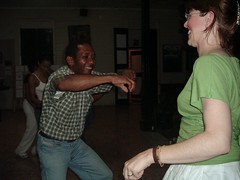
I played for probably half the set. By then my right hand was a little sore and also I realized my sister was missing; thus, I asked another palero to fill in for me while I went to look for her. I found her talking to an artist under a lime tree, from which he had pulled a very fragrant fruit to give her. But the artist wasn’t her only admirer. As I relaxed on a folding chair with a cup full of rum, this little but extraordinarily pushy guy came over to make annoying conversation and then force her to dance with him. It would have been good if he’d stuck with a basic step or two, since Heather had picked those up quickly. But he had to throw in some crazy moves of his own. One of the pictures I took captured his bizarre ape-man style pretty well. Meanwhile, Manochi called me over for a chat. He explained he had paid for his concho over here just in order to see me, but didn’t have enough to take a car back. I assured him that I’d either give him a ride or see that he got a taxi home. But then he went on to other monetary matters. We’d spoken of doing an interview in the coming week, and referring to this he said, “I was hoping that maybe you could give me a little help.” This gave me a sinking feeling. I knew of course that he meant money and I was already reliving the argument I’d had over paying for interviews a few weeks earlier. I figured I had to get out of this situation quickly. “OK, but I want to make sure you know that I don’t pay for interviews. I’ve never paid for an interview, so I can’t change my policy now.” “Oh no, I would never charge for an interview,” he assured me. “I was just thinking, maybe I could help you with something and you could help me with something too.” This sounded to me no different than paying for an interview, which clearly I couldn’t do, but I did want to help him in some small way if possible. Was there some way around this? “Let’s talk about this later and see if we can come up with something,” I suggested.

As a public, family-appropriate organization, the Casa de Arte parties never go on too late. By 10:30 we were done and I said my goodbyes to the rest of the Grupo Mello out on the sidewalk, as another drunken artist – one I always see here, and who always makes me uncomfortable with his too-friendly greetings – tried to get my phone number. I deflected him with, “I’m going back to the US very soon, so it will be disconnected,” and then Heather and I took off to give Manochi a ride home. On the way I thought I’d found a solution to our problem. “Do you have a marimba?” I asked. “No, but I borrow one from a friend whenever I need to play one.” “Do you think you could teach me how to play marimba? I have one in the US but I’ve never learned how to play it.” “Sure! Of course, no problem.” “Then why don’t you give me a lesson before I leave, just like Rafaelito gives me accordion lessons.” I knew he would understand this to mean that I’d pay him for the lesson just as I pay Rafaelito. He agreed to this and we planned that he would come by Rafaelito’s at my accordion lesson time on Monday, either to give me my marimba class just after or to do an interview and make other arrangements. Nevertheless, when we arrived at his house in Ensanche Libertad he asked me for 100 pesos. “I’m in some hard times.” Not wanting to argue the point further I gave the sum to him and told him to “consider it a down payment on my lesson.” “Oh no, I would never charge for a lesson!” he insisted. “It’s only a loan, I’ll pay you back.”

That odd and uncomfortable conversation over, I decided to show my sister one last sight before we hit the hay. I consider it a must to visit the monument at nighttime to check out the hopping teenage hangout scene. We arrived about 11 PM and it was packed as always as we strolled the road that wraps around the Trujillo-era landmark, checking out the view of the bridge at night as well as all the SUV’s filled with floor-to-ceiling sound systems. Most were blasting reggaeton, though merengue, merengue típico, and bachata could also be heard. Strolling vendors sold ice-cold Presidente beer to the partiers. As we passed around the back of the monument, we were surprised to run into someone we knew – the half-Indonesian teenage neighbor of Rafaelito’s who often comes to my lesson. He insisted on taking us inside the monument’s lobby since he had a friend in the tourism police on duty that night. Inside, surrounded by marble columns and looking out the diamond-shaped panes of glass, it was actually quite pleasant. Our Indonesian tour guide told Heather, “see the elevator? Just like Titanic!” It had one of the old sliding metal gates. “What year was it built?” she asked. “Umm… I don’t know! I don’t know anything about it! But it’s kind of old,” he concluded.

Thus informed, and after a haircut for Heather (she was just as surprised as Mom had been to see the bouffant blow-out that Margarita always does with our straight hair) on Saturday morning we headed up towards the coast for our one night at the beach. We noticed the flame-orange flamboyan trees were in bloom – just as Dominicans always say, right in time for mother’s day. After passing first through browning tobacco fields (tobacco season long gone), then emerald green canefields, and then a mountain tunnel, we decended towards the sea and the town of Puerto Plata. There, I took Heather on a quick driving tour of the sights –the 15th-century fort (burro off-duty today, seen from a distance grazing in a vegetable patch), the gingerbread architecture around the charming town square, the somewhat less attractive Brugal bottling plant. We only just had time for pizza and a salad on the Malecon before checking at our resort at Playa Dorada – this one for the astoundingly cheap price of $55 each, all inclusive.

When we arrived, we found out why – it wasn’t right on the beach, but set back from it a ways down a sandy path. But we decided we could deal with the 5-minute walk for the price. Thus we checked in and changed for the beach, heading straight for the activities desk – where we found they were closed for the day, and wouldn’t even open the next day, being that it was Sunday and Monther’s day. We were disappointed being that Heather hadn’t snorkeled in 20 years, but I put on a pathetic act and talked the guy into trying to set a couple of masks aside for us tomorrow. Instead, we relaxed on the beach with our books and a beer and treaded water a while for exercise, and then Heather bought a nice speckled shell six inches wide from a strolling vendor. That brought us up to bathtime, dinnertime, billiardtime, and finally showtime. Of course it was a must to check out the corny hotel entertainment. I was kind of hoping for a Stupid Human Tricks thing like the last time I was down here, but they only did a quick “Spanish lesson” competition before going on to the main attraction. It was an “dances of the world” program tonight with a company of four women and three men. In general the choreography was needlessly repetitive, but one woman clearly outshone the others and did a respectable job in the “bellydance,” “Spanish,” and “merengue” numbers, the last done in day-glo to Juan Luis Guerra’s recording of “El Farolito.” But in between we had to sit through some decidedly odd pseudo-interpretive dance numbers by a couple, one of which found the female partner dressed in a snakeskin unitard for unknown reasons, and another which emphasized her lack of extension, and a final one consisting primarily of lifts which put her into semi-obscene splits positions half the time. The show ended up with a Dominican versdion of Riverdance, something I never imagined I’d live to see.

Although Heather had secret desires to visit the casino, I convinced her they were unlikely to have quarter tables in this resort complex. This enabled us to get up early enough to enjoy a big breakfast and a morning of snorkeling with the masks our friend at the scuba desk had in fact sneakily set aside for us. Unfortunately, they were much too small for our Swing family noses, meaning that in order to submerge ourselves we had to hold our noses and continually press the water seeping in out of the masks. Eventually, after what seemed hours of snorkeling struggles, we did manage to see a few colorful fish. Our work done, we decided to turn in our flourescently-colored, child-size apparatuses and move on to packing and lunch. Although our time had been too short, we had taken full advantage of the beach and the free alcohol.

On the way back, we’d planned to stop and buy a couple of gifts in Puerto Plata. The shops were closed! Duh! Oh well, it was just as well. Up at the mountain tunnel, after passing through what was almost a major rainstorm before it suddenly petered out, we stopped at a roadhouse for a rum-based shopping spree and potato chips with lime. Back in Santiago we only just had time to hose ourselves off after the muggy drive before we were due to make an appearance in La Otra Banda at my palos rehearsal.

Hector, Denio and the rest were waiting for us with rum, coke, and chipped ice at the ready. Since my last rehearsal, Denio had finished plastering over the old doorway he’d sealed off in the living room and painted the whole place in off-white, finishing it off with a scallop design up near the ceiling. Progress. After chatting, we repaired to the back patio where Heather sketched the 12-inch purple bud of a blooming banana tree as we heated the drums using the lightbulbs the Turbi brothers had cleverly affixed inside the palos’ lower openings. When we started playing, it seemed like half the neighborhood showed up to join in the fun, including a very drunk, very fat man in a white undershirt who insisted on showing us all his dance moves. His drunkenness was only rivaled by that of the third Turbi brother, Daniel, who kept repeating over and over that he hoped I’d enjoyed being with them and hoped I’d be back soon as I “added beauty to the group.” He insisted on continuing the “conversation” by walking Heather and I to our car, though Hector followed and told him firmly that we really had to go. And we did have to go, as we didn’t want to be late for our appointment at Rafaelito’s, since he and Carmen had kindly invited us for dinner. We were late anyway, though, ensnared by a monumental traffic jam by the Estrella Sadhala / 27 de Febrero intersection. (Rafaelito later told us it was the result not of an accident but of everyone trying to go at once when they saw the traffic light was out.)

Carmen outdid herself as usual, with breaded and fried fish, tostones, green salad, rice and beans, and the obligatory can of jalapenos in my honor. Heather, having never experienced a Carmen meal and thinking we were there more out of social obligation than anything else, exclaimed, “I didn’t know it would be GOOD!” Mauricio the cat joined us, begging for scraps. After we ate our fish we tried giving him a bean and discovered he liked those too. So much so that he tried to climb up onto the table. Bad kitty! I guess it was just as well we had Mauricio’s help, though, because we had to eat quick in order to make it to La Tinaja in time for Rafaelito’s regular show there. After one set, we decided not to wait for Monchy (the second band on the bill) to play but instead to cross the highway and visit Rancho Merengue. To the music of Francisco Ulloa we greeted friend and Heather got hit on by a military man who just wouldn’t give up. With her thus entertained, I took advantage of what I imagined would be my last opportunity this year to experience the dance stylings of Papote de Leon, the 70-year-old merenguero I’d interviewed in Tamboril a couple weeks earlier. They turned out to be nothing fancy, but smooth and fluid, one might say classic. I enjoyed it – and then Heather enjoyed getting rid of her admirer when we went home.

Monday was Memorial Day – not here of course, but in the US – and Heather had to go home. At least we had time to finish her gift shopping at the Mercado Modelo before we had to be at the airport. And at the airport, we had time for coffee and a snack before she had to be at the gate. It turned out to be a fortuitious coffee break, as Heather got her last wish of things she’d wanted to do in the DR. As we sat chatting, I was surprised to see our old friend David David sneaking up behind her back. So in the end, she was able to see the only other person she knew in the DR besides me! We reminisced about the moments on September 11 we’d all spent together. Indeed a joyous reunion, although not perhaps the ideal topic for discussion before a plane trip. Luckily, Heather wasn’t phased, and she got home safely.

Friday, June 02, 2006

Chimon guira


Chimon guira
Originally uploaded by salsasydney2000.
Chimon, guira player for Ulloa, is also a guira maker. Here he's playing a new design he came up with using veneer paper from auto detailing...

Thursday, June 01, 2006

My sister + un loco


My sister + un loco
Originally uploaded by salsasydney2000.
My sister dancing palos with some nut at the Casa de Arte.

Francisco Ulloa


Francisco Ulloa
Originally uploaded by salsasydney2000.
Francisco Ulloa "El Embajador" rehearses with saxophone at Rancho Merengue.