So I was thinking, some of you may be new readers, and if you are, you may have no idea about what the deal is with my blog. This should bring you up to speed.
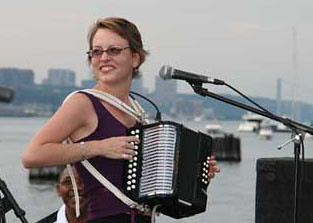
I'm an ethnomusicologist working in Latin American music and dance. I have been researching Dominican merengue tipico for six years and am now in the midst of the horrific process of writing up that research in the form of a dissertation. That, and procrastinating a lot by taking on other projects and drinking lots of beer.
Merengue tipico is the traditional kind of merengue from the northern Cibao region of the Dominican Republic. It is very different from the kind of big band/pop merengue you may have heard on the radio in instrumentation, rhythm, and repertoire. It's based around the accordion and uses several different rhythms, some highly syncopated, unlike the monorhythmic pop merengue, and is an oral tradition that incorporates improvisation, unlike orquesta merengue, which relies on written arrangements. If you want to know more about merengue tipico, you should be able to find most of what you'd need on my web site: http://merengue-ripiao.com
If you want the quick version of tipico and orquesta history, read what I wrote for this small record label: http://www.iasorecords.com/merengue.cfm
I started the blog when I moved to the Dominican Republic in 2005 as a way to document my research and other activities and get out of writing icky field notes. If you look back over the course of the blog you will see pictures and stories about merengue tipico in different contexts: in ranchos and car washes in the city of Santiago, in parties in people's houses, etc. You'll also hear about how I learned to play it on accordion and the various places I've performed.
While in the DR I got involved in several other projects as well. Being the only person yet granted access to the complete papers of Fradique Lizardo, the late Dominican folklorist, I got interested in his research on Dominican folk dance and how he started the Ballet Folklorico Dominicano, so I observed current ballet folklorico groups in different parts of the country and talked to dancers.
I also got interested in carnival - how could you not? - and joined a carnival group called Los Confraternos in Pueblo Nuevo, a Santiago barrio. I dressed up as a lechon, Santiago's traditional carnival character, with them and went through the grueling parades every Sunday through carnival season in both 2006 and 2007. If you are interested in seeing pictures of carnival, visit my posts from February of both years, as well as late January and early March (carnival lasts a long time in the DR). This year I also tried to visit other carnivals for comparative purposes, so you can also see pictures from La Vega and Cotui in February-March 2007.
My other research site is New York City, where there is a very active tipico scene, particularly in Brooklyn. Since the bulk of my NY research was done between 2001 and 2004, you won't see much of it here, but I have paid some return visits. You'll find chunks about NY tipico from June-July and October 2007, and at other random points.
When I'm not in the DR, I'm usually in Tucson, AZ, or traveling about randomly. Since tipico doesn't make much of an appearance outside of the DR and New York, when I'm away I usually post stuff random stuff from my tipico files or other observations about Dominican culture. I try to post at least once a week. Please subscribe to the feed if you want to be sure not to miss anything!
That's the blog in a nutshell. If you have any suggestions for accordion, tipico, or Dominican-themed topics you'd like me to write about, please post them here!
Showing posts with label ethnomusicology. Show all posts
Showing posts with label ethnomusicology. Show all posts
Thursday, May 24, 2007


Wednesday, May 09, 2007
Adventures in Ethnomusicology and Espionage
Some of you readers know that by trade I’m an ethnomusicologist, some of you don’t. Well, now if you didn’t, you do, and the reason I’m bringing it up is that (a) that’s what this blog is about and (b) I just watched this old Hitchcock film in which, I was surprised to discover, the hero is an ethnomusicologist, too. The movie is The Lady Vanishes from 1938. If you’ve seen Flightplan you have the basic idea, except that here the heroine is traveling on a train, not a plane, and the person who disappears is a kindly old woman she’s just met, not her daughter. Everyone denies the old woman was ever there, causing great consternation, but all is made clear at the end, and it has to do with the fact that Europe was about to enter WWII. I highly recommend the movie, especially if you too are an ethnomusicologist.
Anyway, the ethnomusicologist comes on the scene in the beginning as the heroine is trying to get a good night’s sleep in a quaint little inn somewhere in continental Europe (probably Germany, though we’re never told for sure).
A great stomping noise echoes throughout the hotel, rattling the light fixtures in the room below. The young woman staying there calls the front desk, demanding the manager put a stop to it so that she can get some sleep. Because she is one of the wealthier guests, the manager sees to it immediately.
When he opens the door to the room of the guilty party upstairs, he finds a strange scene. A young, mustachioed Englishman lies on a couch playing a very Central European-sounding melody on his clarinet as three picturesquely clothed peasants dance about in what appears to be some poor imitation of the Hungarian csardas. When he stops, they strike a pose, he makes a few notes on a pad, and then they all start up again. The manager insists that they desist.
“Will you kindly stop? They are all complaining in the hotel, you make too much noise!” he explains.
“Too much what?” the guest demands.
“Too much noise,” the manager replies in embarrassment.
“You dare to call it a noise?! The ancient music with which your peasant ancestors celebrated every wedding for countless generations, the dance they danced when your father married your mother, always supposing you were born in wedlock, which I doubt. I take it you are the manager?”
“Sure I am the manager of this-“
“Yes, unfortunately I am accustomed to squalor. Tell me who is complaining.”
“This young English lady underneath.”
“Well, you tell the young English lady underneath that I am putting on record for the benefit of mankind one of the last folk dances of central Europe, and furthermore she does not own this hotel!” he shoos the manager from his room with a flourish of his clarinet. A short while later, however, she succeeds in getting him thrown from his room with a well-placed bribe.
She should have known that he can’t be gotten rid of that easily: this man appears to be everywhere and know everyone. Later, on the train out, the woman encounters him on the coach class car, watching different peasants dance, this time to the music of violins. He reveals that he is writing a book on European folk dances, which he expects to finish in about four years. And when together they go about enquiring about the missing woman who is the subject of the film, and are introduced to some Italians, he exclaims, “Oh yes, I met her husband. He presented prizes at the folk dance festival. Minister of Propaganda,” he explains in an aside to his companion.
Naturally enough, the ethnomusicologist ends up saving the day. You could have seen that coming, no?
Basically, I wanted to bring up this movie because it is so much like my blog. Except that instead of clarinet, it’s accordion; instead of Germany, it’s the Dominican Republic; instead of a stomping pseudo-csardas it’s merengue; instead of a quaint Alpine inn clothed in snow, it’s a Santiago apartment under the boiling sun; instead of Ministers of Propaganda, it’s politicians, secretaries of tourism, and the like (although the difference there may be more of degree); instead of four years, I have one to finish what I’m writing; and instead of a train, it’s the Millenium Falcon. And of course, there is only a heroine in this story and no hero. But otherwise, the story is virtually indistinguishable. I’m hoping I too will be able to save a trainload of innocent passengers from the evil machinations of fascist spies at the end, although I could probably do without the shootout.
Subscribe to:
Posts (Atom)