2/9-2/15
In the meantime, many things were happening. Many things. I got called to go for an interview at a southern California university, which would certainly be a good location for me, so of course I accepted even though I was in the middle of fieldwork and they wanted me to go on the very dates for which I had just, finally, scheduled my return trip to Samana. This fact necessitated some frantic phone calling in order to change things around. In the end, I did reschedule my Samana recording trip for this week, although it would have to be a very quick one in order to get back to Santiago in time for my carnival talk.
So, Monday morning found me setting out for Samana at an earlyish hour, and on a rather uncomfortable series of guaguas. Well, the first one, to San Francisco de Macoris, was large and pretty OK, but from there to Nagua it was just a pickup truck, and the last leg was in the kind of overcrowded minibus one finds in Santiago – no problem for short distances, but less than ideal for longer ones. The whole time I was mostly worried about my luggage (with all my recording equipment inside) getting squished, soaked, or dropped, especially when it appeared the guy in the bed of the pickup truck was about to sit on it.
At any rate, both the luggage and I got safely to Samana, where Rossy, Luc, and I met up and had some lunch, before installing ourselves and our equipment in Luc’s rather empty three-bedroom house, which he had kindly offered as free lodging to the two ethnomusicologists. It was still rainy, as it had been for a week and a half, but when it let up to a light drizzle Rossy and I thought we should make the best of it and headed off in search of either (a) Mártires, a local traditional music teacher, or (b) Yoyó, the old merengue redondo musician who was supposed to be preparing the bamboo tubes to be used for the recording. I had a vagueish idea of where they lived, so we took a guagua up the hill and started searching. Knowing they were on top of one of these hillsides, we took the first staircase up. On top of the hill we found a brick house under construction, a madly barking scruffy dog, and a fully-constructed wooden house in the back. There were also a couple of chairs and a wire clothesline under a tree, with which I just about took my head off in an incautious moment.
I was a little afraid to advance towards the angry dog, but then an old woman emerged from the house and I asked about Yoyó. Turned out he lived on the next hill over, so we’d have to go down, up the street, and back up some different stairs. Then I asked about Mártires, and was surprised to find out that this was his very house, and she was his mother! He wasn’t home, but she was sure he was somewhere in the neighborhood, working on a conuco. She shouted in the direction of one palm-tree-studded, mist-shrouded hill, then another. We were in luck. After a minute, Mártires appeared in a straw hat. He had been off conversing with a neighboring Italian whose land he sometimes worked.
Rossy and I were invited in to the pleasant little pink and blue house, which on the inside was typically festooned with frilly satin curtains over the Persian windows. Surprisingly, for this hilltop location, a television was on in the middle of the room showing sports, with the sound now turned off. We spent the next couple of hours in pleasant conversation with him, his mother occasionally joining in in appreciation of his singing snippets of songs for us, and his sister appearing somewhat later and making us coffee. At times, it rained so hard on the tin roof it was hard to hear anything. By the time we left it was dark and the stairs slippery, so Mártires accompanied us down to the road, where we caught a motoconcho (something I usually avoid but which was unavoidable on this drizzly, quiet night).
The next day we had planned to follow up on some of the leads we’d just gotten, for example, going to talk to the head of the Oli-Oli carnival group, or searching out some groups of palos players who lived nearby. I also wanted to hunt down the old tres player my mom and I had seen playing for tourists on Cayo Levantado during our last trip.
But none of this was destined to be. From the moment we got up to the moment we went to sleep, it poured rain without stopping. In fact, at the one moment it seemed to be slowing down, around 1 PM, I said “Looks like it’s letting up. Think I’ll go check my email now,” and this statement was immediately followed by a torrential downpour. The only thing missing was the thunderclap from heaven. We did venture out for lunch at some point, but came back very wet, bedraggled, and with a broken umbrella. At least while we were out we ran into Yogeny, one of the musicians slated for the recording session we’d scheduled for that afternoon and still entertained hopes of completing. He said they were still looking for Yoyó. I mentioned the tres player and it turned out he knew him very well, even said he’d try to look for him. That would save me a trip to the town of La Pascula, where I would have had to wander all around town asking anyway.
Eventually the slated hour of 3 PM rolled around. Rossy and I were still shut in the house, hoping in vain for the rain to stop since we didn’t have any more dry clothes. It didn’t, but I had to venture out with the broken umbrella anyway in order to look for the musicians in the park. I went and found Yogeny, El Zurdo, and Miguel the tres player in the gazebo or bandshell or whatever it was. Miguel was already entertaining everyone else who was waiting out the rain, inventing rhymes especially for the occasion. El Zurdo went off and came back shortly with a guitar with which he could accompany Miguel, and they began playing sones in duet. Soon Pai showed up as well, and then Virgilio was driving by in a friend’s van, returning shortly to sing and dance with us in our impromptu rainy day party. We were still hoping Yoyo would show but after an hour we figured we should get started. The next problem was getting a taxi, since no one was on the road and walking the instruments over to Luc’s house in all this rain was out of the question. Eventually an acquaintance of Virgilio’s (maybe all the townspeople are his acquaintances?) drove by with a van and agreed to take us in two loads. So we finally got started.
I’d expected another one-hour straight shot of recording like the last time, but it turned into quite the epic session. Miguel took over and just kept on playing one song after another, apparently enjoying the audience (consisting of the other musicians, Rossy, Luc, and myself) and the beverages (he and Yogeny drank Cuba Libres, the others only juice). We thought the noise was appropriate payback for the sleepless night we’d had at the hands of the neighbors who had played loud music until 2 AM or so, filling in the gaps caused by intermittent power outages with equally loud arguments. It was also interesting to see what he chose to play. It recalled to me those ethnomusicological accounts of researchers going off to record “real” gypsy music and finding that the gypsies wanted to play American country music tunes for them. Miguel played merengues and bachatas – many of them by the popular 1960s-70s musician Eladio Romero Santos, boleros and sones – many of them Cuban, and even corridos and rancheras – from Mexico. Naturally, this was the kind of music that was popular when he was young (he was born in 1936).
I didn’t really want to be the kind of ethnomusicologist that insisted on “authenticity,” and also it sounded really good, so I mostly let him play what he wanted. I did make a few requests, though. Once I suggested something “from here” – my most successful way so far of getting what might be considered “folk” music. To this, Yogeny helpfully added, “The older the better!” Here was someone who knew the folklorists’ ways. Another time I asked Miguel to play something of his own composition, which yielded an interesting call-and-response merengue. Later on, after Pai mentioned working in the fields as a kid, I asked if they had used cantos de hacha, or work songs. Of course they had, he replied. But they weren’t used anymore because, whereas before they had worked in large groups on land owned by others, now people worked in cooperatives, and in this system only two or three people ever had to work at once, obviating the need for communal work songs. However, they still remembered those work songs, and my request elicited a call-and-response song which they accompanied in a merengue style.
Miguel was really into things for a while, but when he lost interest he really lost it. At about 8 PM he was tired and just wanted to go home. We couldn’t manage to find a taxi for him, so instead walked him down to the main road for another motoconcho ride. When we got back from that, everyone else seemed kind of tired too. We had been at it for three hours, so actually I was a bit tired myself. We called it a night, then went off to eat bacalao at a comedor.
The next day at midmorning the weather cleared up and hot sun came out. Unfortunately, I had to head back to Santiago already in order to be ready for my tertulia the next day. An inquiry at Caribe Tours provided the strange information that, due to the construction of a brand-new highway linking the Samaná peninsula with Santo Domingo via Monte Plata, taking a bus to the capital and from there another to Santiago actually took about the same amount of time as going straight to Santiago, even though it was twice the distance. That shows you how great the roads are in the Cibao. It was more expensive this way but would also be much more comfortable, and involve fewer bus changes. Also, I could go with Rossy half the way, so I decided to give it a try. Indeed, it was a pretty easy way of doing it, although it was a bit boring after my computer and phone batteries ran out and it was too dark to read.
Back in Santiago, I spent the next day preparing for the evening’s event by looking over notes, looking up things in books, and making phone calls. By 6 PM I was as ready as I’d ever be so I could go hear the talk that preceded mine, one by noteworthy folklorist Dagoberto Tejeda Ortiz on his new carnival book. Because it started late, it also ended late, and thus my own talk was also late. The nice thing was the intermission between the two, during which time a group of lechones came in and danced us out to the patio, where they madly cracked whips as we drank a beer.
Well, my program went as well as could be expected, I think. It was an academic talk that started too late, and therefore finished too late, so some people were restless. It was great to have the performers themselves there. They all had interesting stories to tell. Sergio “Mochila” gave a funny and lively performance as Roba la Gallina, even getting the whole audience to sing the traditional chants. Papote had everyone cracking up; one memorable quote, in relation to my question if he didn’t get tired going dancing every night, was “No, I don’t get tired at the parties. When I go to work, though, that’s when I get tired.” Polanquito, the 70-something lechon, appeared to be somewhat drunk and fell on the floor during his performance – on purpose. He said he “wanted to show us how it was like in the old days. This is what the lechones would do after they’d been out all day and were finally heading home.” I also learned that lechones have their own way of talking – they make kind of grunting sounds, but I hadn’t known this before as they don’t do much good with the volume of music used in today’s carnival. Someone mentioned that some lechones used to use whistles, too. (Is this why some lechon costumes have whistles on them as decorative elements?) My talk was considerably less amusing than they were, although I did have a story about phallic symbols in there.
I had predicted that people would either love my talk or hate it. It had a part about social class, carnival and merengue típico, and it had a part about the symbolism of the carnival characters, particularly the lechon, which I connected to various African diaspora manifestations of Eleggua. A number of people told me afterwards that they loved it, including the dancers themselves. But one person in particular seemed to hate it. He shall remain nameless. Although a friend of mine, it is a friendship that requires work, because he is the sort who wants to be the person who knows everything. Therefore, nothing that he doesn’t know or hasn’t already thought of can be worth knowing or thinking of. Thus, he had a whole series of questions/criticisms for me in the (very short due to time) Q&A session.
One was justified: I had said that merengue típico dancing hadn’t been studied, and of course he pointed out the work of Fradique Lizardo. I should have been more specific. I should have stated that modern-day merengue típico dancing hadn’t been studied, and merengue dancing in general hadn’t been studied anthropologically or ethnographically. Lizardo’s work is useful, but mostly for staging the dances, since he went around collecting dance steps of yesteryear for practical use in his Ballet Folklorico Dominicano. Thus, his dance book consists of lists of information like steps, costumes, occasions on which performed, etc, but is not an ethnographic work.
Strangely, the thing this person most objected to was my calling what Roba La Gallina and the Lechon do “dance”. During the lecture, I had actually already explained this point, giving the definition of “dance” from the book Anthropology of Dance, a definition that fits well with what both of these characters do. In addition, I noted, these people themselves refer to their “dance,” so who am I to say it isn’t? He apparently didn’t find this explanation sufficient. So now I added that if he wanted to include “choreography” in the definition, as he apparently did, then merengue típico also couldn’t be called a dance, since it doesn’t have choreography or even specific steps, and yet we all seem to describe it as a dance. He conceded that the lechones do “rhythmic steps,” but not dance. I wonder what a dance like merengue is to him, then, if not rhythmic steps? (Also, why is everything not what I think it is? I remember when I started studying merengue tipico, someone told me, "it's not even music." remember that?)
In a separate conversation, it seemed that his objection was really that no one else had written about these dances as dances before, including Lizardo, so therefore they couldn’t possibly be dances. I think the other implication was that no American should be able to come in and point out that Dominican scholars had neglected to study this particular area of dance. Fair enough, and certainly I don’t need to have the last word on the subject, but isn’t the point to create new dialogues, new directions for scholarship? Not to repeat the same studies everyone else has already done of carnival or of dance, but to build on them? To lend a new viewpoint that may cause people to reconsider their assumptions? Maybe even to validate what the carnavaleros have been doing for decades, without receiving any recognition? Obviously, I found this objection rather annoying, not only because it seemed a somewhat personal attack, questioning the legitimacy of my work, but because it was of little use in achieving these goals.
I had two other questions, much less polemical. One person suggested that the limping movement only existed for a functional reason, for the purpose of making the bells on the costume ring. I disagreed with this, as many other kinds of movement could also make the bells ring. (I should have added that you can’t hear the bells at all anymore anyway, but the limp is still used by many lechones.) Another asked if the lechon dance hadn’t changed over the years, since now they dance to music and formerly only to the chants of observers. This was actually a good question, to which Polanquito gave a wacky answer but then we had to call it a night.
On Friday, I recovered from the experience by avoiding the CL in favor of doing loads of errands. I bought little costumes for my nephews, picked up my own costume from the tailor, and spent most of the afternoon gluing bells and mirrors on it. Did some shopping. Blah blah.
On Saturday, I was ready to go – a replacement carnival was planned for that day because of the previous Sunday’s rainy cancellation. So I got up early, did my email, picked up my costume from Tonito’s and hurried over to Betania’s…. where, naturally, we waited. Julio helped me fix up my morcilla (the cover the tailor had made was naturally too short, which necessitated a quick amputation of the original morcilla) in the meantime. Eventually everyone was ready to go so we piled our costumes, masks, bladders, and selves into two cars and headed to Ensanche Bermudez, the barrio that was supposed to be our carnival site for the day. I was looking forward to it, because I always like these barrio events more than the big parade on Las Carreras – less crowded, more comfortable, and seeing something different every time.
After driving around the neighborhood a couple of times and seeing no one, though, it seemed unlikely that any carnival was going on. I suggested maybe the wires had gotten crossed and it was really Ensanche Bolivar, so we checked there too on our way back, but nothing. So that was it: a big buildup and no payoff, just like last Sunday only sunnier. The next day someone told me they’d decided to cancel it because it fell on Valentine’s Day. What kind of a retarded reason is that?!
Anyway, there was nothing for it. Instead I went to the bookstore to check out the selection and enjoy a fancy coffee beverage. Then I went home to sleep it off and prepare for what would hopefully be an actual carnival the next day.
On Sunday, once the email had been read, I was ready to give it another go. But first, I had an appointment with Los Reyes del Mambo, the carnival group run out of Ensanche Bolivar by Carlos Batista. He claimed the kids in his group really knew the lechon kind of dance (or “rhythmic steps”, as some would prefer) so I was going to film them doing it. My instructions were to get dropped off at the “colmadon” and someone would meet me there. My fellow passengers expressed concern over this plan, after having ascertained that I wasn’t really going to the church nearby. “Now, you’re sure you have your friend’s number? Call him as soon as we get there!” I assured htem I would, and indeed I did, and a few minutes later Carlos’s son, also named Carlos but considerably smaller, showed up to accompany me to their house, which was actually less than a block away. Also, it was easy to recognize by the three yellow upside-down lechon masks propped on sticks in the front yard, and the whips, recently painted blue, drying on the clothesline. Also, everyone present was dressed in their team t-shirts, an attractive blue color with grey trim and the Reyes mascot on the back – a little man designed after an Incan mask.So the Kings of Mambo are really Incan kings!
In fact, Carlos the younger and a cousin of his did dance for me in two forms, which Carlos referred to as “traditional” and “modern,” and both with and without whips. Then Carlos gave me a little explanation on video of the limping movement and the changes in style. I took a look at their costumes, which also figure the little Incan guy on the back (later on they added a body to him, which is clothed in a Henry VIII type fur-trimmed robe). I would have liked to stay longer, but I was worried about keeping my own group waiting for me so I hitched a ride back down to Betania’s. Where, naturally, everyone was standing around waiting. Well, not exactly standing around: Julio was repainting and re-glittering masks, Betania was sewing something, Katiry’s boyfriend was gluing bells, our newest female member was dancing, and some teenagers were teaching others how to use the whip or to move like a lechon. This I filmed, and then one of them took over as narrator of my film and took me around to look at and explain all the carnival accountrements that could be found in and around the yard.
Eventually, somehow, we all got dressed and ready to go – well, six of us were in costume; the other two weren’t quite ready with theirs yet and will join next week Then we set off through the streets of Pueblo Nuevo, just like old times. The strange thing is, I can never quite remember how to move like a lechon until I put on the mask and hear some music. That, and seeing other lechones, somehow allows my body to find the right moves again. And once I start,. it’s actually hard to stop until I take the mask off again. There’s something comforting about having the mask on, even if it is stiflingly hot and sweaty inside, and something horribly lame about just standing around in the street with all this get-up on. I had one vejiga in each hand – the third one I’d bought had mysteriously deflated in the interim – which eeps my hands comfortably occupied and also reminds me to keep my elbows up (something I’d been told lechones should always do).
Wearing the mask gives you license to act a little wacky (granted, some lechones don’t need a mask, or license, for that). But some people like Julio, who are relatively staid in everyday life, become surprisingly energetic and funny inside the costume. Julio was coming up with all kinds of fancy footwork and even doing leg-only jumping jacks while dressed up, to the amusement of onlookers. My narrator usually does more comically sexual moves, like those one might see on a dance floot when reggeton is playing, and this is always a crowd favorite. I tend toward a more bouncy, skipping kind of merengue with a little bit of limp, although I often switch to typical palos movements when they play Eneroliza, which they always do. (It seems to me that the same exact carnival songs have been used every year that I’ve participated: Baile en la Calle, a medley of palos and salve sung by Eneroliza, a few other things. This year there was also a reggaeton number and a nonsense merengue approaching quebradita in its rhythm. And on the way home, with our masks off, they played some merengue típico and then a set of all reggaeton or hiphop, possibly to take us back down with slower beats.)
Once I get going, I eventually get into the zone, where you’re not quite sure how much time has passed and you’re not really thinking about anything in particular. It’s whenever I stop to think about it that I get tired and think about how much sweat is running down my shirt inside my costume, how hot the sun is and how my costume just soaks it right up, how my feet or my knee are kind of hurting, how the music is way too loud and it makes my head pound, and how it’s hard to breathe in there. Every so often, though, you get a short break when an assistant brings you a little plastic pouch of cold water from the bed of the “disco lite.” In past years, there would be some rum going around too, but this year only one person had any and not much, and one beer made the rounds at one point. You wouldn’t want to drink too much because of dehybration, but you do want to drink a little, to give yourself the energy to keep on going.
While I move along, I watch the spectators and they watch me. Many are taking films or photos with cell phones or cameras. If they want a photo, we’re supposed to pose in a typical lechon style. Sometimes they want us to hold babies, and the babies aren’t always too sure about this. Sometimes they want us to shake a kid’s hand, or to dance with them. I like the feeling of anonymity inside the mask. Most of the time, no one knows I’m not Dominican, although sometimes when someone gets a straight shot and can look straight into the mask and see my eyes, I notice a look of surprise. Also, it would help to have gloves to cover up my blindingly white and clearly female hands. I might work on that later. Some spectators are more malicious and want to through confetti straight into your mask, into your mouth if they can manage it, so you have to watch out for them too. I don’t usually whack people with the bladders, although this is the traditional thing to do, but some people specifically ask you to and then I try to oblige.
At any rate, this is how it is on Las Carreras. Before that, our spectators are peoplpe standing in the doorways of their houses or on streetcorners by the colmados, or even families packed onto little motorbikes and temporarily stopped to take a look. Old women sitting on the sidewalk raise up their arms and move to the music along with us as we pass. And afterwards, we make our way home through the same streets, now unmasked and relaxed as we cool off – by this time, night is just faling. Random people from the neighborhood join us, following along behind our isco lite and singing or dancing along. One nattily dressed transvestite comes along, standing right by the speakers. He is in a blue sequined dress that barely reached the tops of his thighs, a long wig and red heels. He is accompanied by a small girl in a lechon costume -- his daughter? At one point she asks me, wordlessly, to fix her stuck zipper. When I do, she runs back up to join him again.
So finally, with the month half over, we had one real carnival day. I’m a little worried by rumors that there may not be any carnival on Feb 27 this year. Apparently, some dorky church people are complaining that combining carnival with independence day ruins the “solemnity” of the latter, or some such ridiculous thing. No matter that this has been the tradition for a zillion years now, and that without it, independence day would just be any other boring state holiday, in which the people do not in any way participate. How is that what they want? And how is it up to the church how a national holiday should be celebrated? This is one of the stupidest things I’d ever heard and I’ll be really mad if they actually succeed.
In the meantime, I must report, I had to cancel my job interview in California - - because I got a job offer!! Details to come. All the better not to have to interrupt fieldwork or to prepare three talks. Unfortunately, I’d already been shopping for interview clothes, not an easy task for me. They did come in handy at the tertulia, though.
Showing posts with label traditional music. Show all posts
Showing posts with label traditional music. Show all posts
Wednesday, February 18, 2009


Tuesday, January 27, 2009
Back in action: Fiesta de la Virgen de Altagracia, Samaná, 2009
Hello faithful readers!
My now-annual visit to the DR is now well underway. Although I arrived safely, my luggage did not. Somewhere between JFK and Syracuse, where I stopped off for a quick interview on my way west from Berlin, the bag with all my clothes in it got lost. I suspect it is still sitting in customs gathering dust, whereas I myself have hardly had time to sit still for a minute since getting here.
I got in on the 16th and found Santiago looking pretty much the same, only I had forgotten my clever shortcuts from before so ended up taking a rather long detour between the airport and the Centro Leon. There I met with the woman who’d be renting me a room for my stay this year, since my previous apartment was already taken.
All the errands that followed hardly bear mentioning. I did take a moment to reconnect with the good people of the Centro, however. I’ll be doing a little program there on Feb. 12 and, hopefully, we’ll still be able to get the ball rolling on the ethnomusicology summer school I proposed some time back. More on that later.
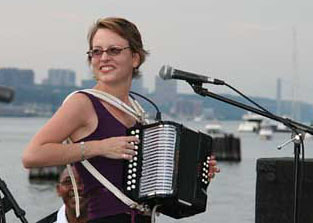
That reminds me that I need to tell you the purpose of this year’s visit. Because I actually finished my dissertation and graduated in September (!!), I am NOT going to be working much on merengue típico this trip – I probably won’t even be playing accordion, since I’m going to at least make the attempt not to get distracted from my task. Instead, I’ve been awarded a grant from the Society for Ethnomusicology to do a study on dance and movement in Santiago’s carnival. I am interested in how movement defines both the characters of carnival and the sense of place, even Santiago itself. For example, people often point to the way Santiago’s lechones move and the way the diablos cojuelos of La Vega jump around as a key difference between the two carnivals, and the two neighboring towns. I will therefore be looking at how movement defines things like place, class, and gender in Santiago by examining the movements of carnival participants and comparing with those of merengue típico dancers.
But before I could get to work on that, I had one other thing to do. Perhaps you remember from earlier years how I have gone to Samaná repeatedly over the past couple of years in various futile attempts to convince local musicians to play merengue redondo, a form of folk merengue unique to the area, for me and my recorder. Although I’d met the man reputed to be one of the last people knowledgeable about this form, he kept telling me I’d just have to come back on January 21, the feast day of the Virgin of Altagracia. This year I made sure I’d be in the country on that day especially for that purpose.
And so the night after I came in, my mom flew down to meet me and accompany me on this mission. As both she and her bags were – amazingly - at the airport on time, we had a day for shopping and visiting before we had to hit the road. We thus paid our now-traditional visits to the Mercado Modelo (tourist market) and Calle del Sol, then to Rafaelito and Carmen, and Laura and the kids. At Rafaelito’s we found the front room redecorated yet again, and were invited back for dinner following our road trip; and at Laura’s, while we were sad to note Chiqui’s continued absence and rather shady behavior over in New York, we did have a rousing dominoes tournament on the balcony of their new, breezy second-floor apartment.
The next day we hit the road – only two hours later than planned, and thus in good Dominican time. The roads were good up to San Francisco de Macoris, the drug-dealing capital and usual pit stop (they have a big grocery/department store with food and decent bathrooms), and afterwards more typically potholed. It was pretty uneventful but still took more than 4 hours to go the 200 kilometers. I hadn’t known they built a new toll road that goes up to Nagua from the capital through Monte Plata, which makes the trip from Santo Domingo now much faster and more direct than the one from Santiago. Also more comfortable, as the nice buses run a direct route from the capital to Samana, whereas the only direct service from Santiago is on the world’s more uncomfortable vans, which allow about 12 inches’ knee room between seats. So while Samana is considered part of the greater Cibao, it remains more difficult to travel there from elsewhere in the Cibao. Besides the potholes, the most interesting thing we saw on the road was a procession of a group of women with colorful cut-paper flags, a few of them carrying a small figure of the virgin inn a little house.
Road trips are always pretty tiring in this country, but we didn’t have time to rest. As soon as we got checked in to our hotel – the guide book and the hotel’s name had promised a bay view from our room, but new construction meant we only had a view of the backs of some houses and a dirt lot – we had to go searching for my friend Virgilio, the former mayor and my guide for all things Samanense. I’d been trying to call him for a month with no luck: his home number apparently belonged to someone else now, and I could only ever get his voicemail on the cell number.
After stopping at his old apartment on the Malecon, it was clear why he’d been hard to locate – he’d moved! No one answered the door at any apartment there, but a visit to the store across the street produced helpful information from the proprietor and we soon found his new house. Today was inauguration day and while CNN had been full of the news we wanted to hear back in Santiago, we got no news on the radio and had no TV in our non-bay-view hotel, and were a bit starved for Obama coverage. We found Virgilio, his son, and his father all gathered round the TV watching the continuing Obama coverage, but unfortunately we had missed the speech. However, Virgilio had other important news for us. First, his cell phone had been stolen, which explained the rest of the story. Second, it was actually tonight that was the big night for the Virgin here: there would be an all-night palos party getting underway shortly.
That didn’t leave us much time to prepare. Batteries still had to be charged, equipment tested, and dinner eaten, not to mention showers taken. A bit tired, we were nonetheless ready at the appointed time. But we couldn’t find Virgilio. After a couple of calls and a drive-by, we found out he was at the basketball game that we’d been able to hear emanating from the sports stadium, and went over there to pick him up. As it turned out, our phone call had reached him just as he was singing hte national anthem over the loudspeaker. Oops.
So we headed out to Acosta, a little village about 3 km east of town. At 9:30 the street was already quite crowded and it was difficult to get through., so Virgilio took over the wheel and got us parked. It was also nice to have his and his son’s help with the equipment – I’d had to get a much bigger microphone stand since the little portable one was one of the things packed in the lost bag, and also I couldn’t keep ahold of the microphone case once everything was set up and I was working on protecting the equipment and getting the recording done. It wasn’t an easy task in the space at hand.
Outside, the street was decorated with strings of those colored, triangular flags one sees at car lots and people were either standing around or resting on motorbikes in order to watch the fireworks going off. There were no streetlights, so except when something was exploding it was pretty dark.
Inside was where the music was going on, in a small, tin-roofed house with one large and two small rooms. In the large room, the paleros were set up in one corner, facing the wall and a window through which some people were watching, their backs to the room. The rest of the room was packed full of revelers, some dancing, some singing, many drinking. I set up my microphone near a doorway next to the drummers and was then stuck there for the rest of the night, unable to move with all my equipment through the crowd. My mom took over the role of videographer, however, and roamed around the house filming. One of the small rooms held an altar to the Virgin and a few people sitting quietly or praying, my mom reported. The whole thing was brightly lit, so someone must have had a generator or an inverter.
This style of palos was a little different than what I was used to, including one person always hitting a tresillo rhythm on the side of one drum with a stick. Another person played a really big güira. The older men present improvised verses, sometimes apparently competing with one another, while the rest sung responses, usually wordless. They did not do any songs familiar to me from my time with Grupo Mello in Santiago, not so surprisingly I guess, since my friends were originally from the Southwest, near San Juan de la Maguana, not the Cibao.
I saw a few people I knew: Yoyó, the merengue redondo expert, and Mártires, the local music teacher. Virgilio also introduced me to the owner of the establishment and patron of the party, who proudly told me that his family had been responsible for this ritual for 150 years. We made plans to come back to talk to him the next day, but that never happened. I also talked briefly with one of the singers, who then improvised some verses in praise of mine and my mother’s beauty, and expressing his desire to go home with us.
Sometime around midnight, we decided it was time to go. Although the music would continue all night, changing palos groups every few hours, it was very hot, very crowded, we’d run out of battery at some point, and anyway, Virgilio informed us that fighting generally began sometime after midnight. AS the musicians drank more and more, every year they got into brawls over whose turn it was, or who was the best, or any other reason.
So we got a bit of sleep, but not too much, as Virgilio had suggested we get up early to try and meet with some musicians in the morning. There would be an 8 AM mass and then a procession around 9 AM, and apparently this would be a good time for musician finding. As usual, however, it didn’t work that way. Even though we were late getting going anyway, when we passed by Yoyó’s place, a little shack on a hill, we were told he’d only recently gone to bed. When we went through Acosta, we found most of the town in bed, except for a group of three tígueres still on a drinking spree. They stopped us and asked for money. When Virgilio asked what for, they said, “Whatever!” Because of their honesty I tried to find some change to give them, but we honestly didn’t have any, and they didn’t seem to mind too much.
Down on the Malecón, we did find a trio of musicians getting ready to play merengue típico for the cruise ship passengers just arriving. Virgilio introduced us: one was Pai, Yoyó’s partner in merengue redondo, and another was his son. They agreed to play some stuff for us later, but since they’d be there until 4, there was no hurry. We decided we might as well see some sights in the meantime, as my mom’s time in the country was short. One tour company told us a boat to Los Haitises would be leaving in just a few minutes and if we hurried we could get on it, so we really hurried and made it down to the dock in time – in time to wait around for an hour. The wait time was not a total loss, however, since we could listen to the típico. They played the usual standards, but Pai did have a unique way of playing the tambora. Meanwhile, my mom talked to some people coming of the cruise ship and found out they’d been told to “look but not buy anything.” This I found incredibly offensive. How dare they (a) make up people’s minds for them and (b) refuse to bring desperately needed resources into the communities whose ports, resources, and labor they are using! I wish I could tell you which company to boycott or send angry letters to, but unfortunately there were 2 ships in that day. This is certainly something that tourism scholars and policy-makers should be looking into, however.
In the end, guess what, we weren’t even allowed to go. Cruise ship people only. Instead, we hired a local with a boat to take us out to the beach on Cayo Levantado, where we spent a pleasant couple of hours, after which I felt recuperated and ready to deal with more musicians (unfortunately, I was also a little sunburned). We even found another musician deserving of a later visit – an old tres player from a nearby town, who was playing waltzes and corridos (not the Mexican kind) accompanied by a younger partner on guitar.
Having already arranged a time and meeting place with the musicians, all that was left was to look for a recording location, and hope they’d actually show up. Searches for a suitable indoor location were unsuccessful: city offices were closed as was the radio station, and the local music professional was sleeping after a gig (we woke him, but only briefly). Parks were too noisy, so Virgilio’s suggestion of a nearby, mostly-deserted beach was the best we could do on short notice.
Back at our meeting point, we found no musicians, so got ice cream. Then we found two musicians, followed shortly by one more. One, Yoyó, was still missing, off in search of a marimba, apparently. The sun getting lower on the horizon, we had just decided to go look for him at his house when he arrived.
Now the trick was getting everyone and their instruments to the beach, with just one tiny car with a trunk big enough for a single suitcase stood on end. We ended up doing it in two trips, so it was good that the place was only 5 minutes away. It was a beautiful spot in an enclosed little bay with cliffs on either side and white sand in the middle, the kind of thing that would have been good for a music video - at least, if someone had cleaned up the trash, and without the big new resort whose walls formed the backdrop. The dumb thing is that the hotel didn’t even use that nice beach, but by building there had effectively kicked out the locals who used to use it. The musicians told us that Samanenses had used to go down there in the evenings, make up a big pot of rice, throw rocks at the mango tree to get the fruit down, and generally make merry. Since the hotel had gone up – which Pai’s son had himself worked on plastering – things had been kept quiet and locals now went elsewhere.
Well, we livened things up again at Puerto Escondido, if only for an hour. Merengue redondo, bamboulá, even a merengue típico and a popular merengue about Samaná were played on accordion, guira, a tambora turned upright, and a marimba Yoyó made himself. It sounded so nice on the beach at night that one of the hotel security guards came down to listen in (I just had to make sure he turned off his noisy walkie talkie).
The marimba isn’t native to Samaná but Yoyó explained he heard it on a visit to the capital as a young man, liked it, and went home and made his own. So this was actually the “modern” instrumentation for merengue redondo, adapted from merengue típico and based on the higher availability of these instruments. When pressed, however, Yoyó said that when he was a child merengue redondo was accompanied by atabal and bamboo tubes as percussion. Now they only play these instruments occasionally and with enough prior notice to prepare the bamboo – a few old folks in the mountains still hire them to play this kind of music and they indicated that I could do the same, if I so desired, and I think I do.
Unfortunately, we got started so late that the sun went down about 15 minutes after starting, making further filming impossible, although we kept playing a little longer until the wind came up and made that impossible too. Oh well, it was a good start and more than I’d been able to record on three previous trips to Samaná. I hope to come back soon for the bamboo and the tres.
Our next day was set to be pure vacation. We had made a reservation for a whale-watching trip, since the season in which the humpback whales visit the bay had just begun, and while I’d been out to see them before, my mom hadn’t. Once again we patronized the tours led by Kim, a Canadian marine biologist who’s lived in the area for over twenty years and is responsible for the development of whale-oriented tourism here as well as conservation measures. (Her off-season job is breeding mules at her country home.) We were told not to have high hopes of seeing the big guys, as only 50% of trips since the season started had been successful, but our captain Pimpo would do his best. (Yes, I did ask him why he was called Pimpo, and he claimed not to know! I told him to ask his mom.)
Last time on this trip I experienced the only bout of seasickness I’d ever had in my life and it was pretty awful. Today, with no cold, I was luckier even though the seas were really rough and we were pitching all over the place and could barely even stand up for a second. We did indeed go for a long time without seeing a thing, but then we encountered a school of bottlenose dolphins, two of which leaped out of the water to greet us. Then Pimpo got a call from some other boats following a pair of humpbacks, and we hurried out to get in line. It was really spectacular: last time I’d seen mothers and babies, but they were pretty mellow and I never saw more than their back. This time, these two were actually jumping completely out of the water, turning around with noses out, flipping their tails, in short, making an amazing show for us. The hard part was getting a picture with ten people sitting between us and the whales, and the boat going up and down the big swells like a rollercoaster, but we did manage a couple of whale portraits.
On this trip, we also made a new friend: a French geographer consulting for local tourism organizations and making recommendations for sustainable development of the industry. His brother, as it turned out, is a sociologist specializing in Cuban music who will be visiting soon, so maybe they will come along to my future merengue redondo party. At any rate, I thought it would be good for this guy to meet Virgilio, since both are involved with tourism, so we brought him to the Mercado family house. However, Virgilio had left early that morning to go to the capital for some carnival organization business. Instead, we played with his adorable daughter for a little while before hitting the road once again. (She is about 4 and engaged me in conversations like the following. After asking the names of all the family members she could think of, she said, “What are your children’s names?” “I don’t have any children.” “Oh, they died?” “No, I never had any children. What about you?” “No, I don’t have any, either,” said very seriously.)
Since we were setting off so late, we decided not to go so far but instead to stay in Las Terrenas, a beach town with a big expat population – particularly French – on the northern coast. There we found that things were changing rapidly. The stretch of beach at the eastern side of town where we drove in, where we had stayed in one of many adorable and colorful little bungalows last time, was now being paved over with giant condo and resort buildings. Thus we decided to opt for the other end of town. But due to the recent heavy rains, we found the road impassable for our tiny car. Eventually we found a good candidate on a side road, where we got a bungalow decorated with a pirate theme. It was a relaxing spot to spent the next 20 hours, minus the time we spent eating tapas and crepes, sitting on the beach, and shopping for gifts. After that we had t o hit the road again for the long and uneventful if potholed drive back. At least we knew that at the end a delicious dinner was waiting for us at the Roman house. In this we were not disappointed. There we ate locrio (with jalapenos added just for my benefit), habichuelas, pastelon, spaghetti, and salad followed by pineapple upside down cake, all with little Mauricia, the new cat, looking on. (Perhaps you remember that Rafaelito’s cats are all named Mauricio because they all say “mau.” Since this one is a girl, I suggested the altered form and it appears to have stuck.)
Then it was mom’s last day already – time really flew. It was naturally spent in a flurry of shopping, though this time principally for a carnival costume for my nephew who was just turning five. He is rather theatrical and has developed a taste for costumes of all types. Because it was still early in carnival season, this was a difficult mission, and necessitated visits to four different shops, each shopkeeper giving us directions to the next, and even so, we were unsuccessful. At this point I was completely frustrated with driving around on this ridiculous scavenger hunt so we got a purple feathered boa instead, which I hope will be a fabulous addition to the costume trunk. Maybe I can get the little lechon suit later.
After all our errands were done, we celebrated by going to the cinema to see Twilight, which both of us had read and my mom had already seen twice (although never before with Spanish subtitles). And after that, we had our traditional dinner at Amici, the incredibly delicious Italian restaurant across the street from my former apartment. It did not disappoint. Even the limoncello we remembered was still there.
The plan for the next day was to get up ridiculously early, take mom to the airport, return the car, do the paperwork for my lost baggage at the Delta office while there, then go home, have a nap, write and read a little before going to Rafaelito’s gig in the evening. Alas, things did not work out as planned. After arriving at the airport we found that mom’s 9:30 flight had been rescheduled for 4:30 in the afternoon! The crew hadn’t had the required amount of sleep. Neither had we, so we went back to my place where I tried, mostly unsuccessfully, to nap. At noon we went back again, I used the meal voucher they’d given as a consolation prize, did the required tasks, and went home again for another unsuccessful nap attempt. Clearly, no reading or writing was meant to be done this day. I did nonetheless make it to the gig, hitching a ride with the Roman family to Las Vegas, a disco out on the Santiago-Navarrete highway, where I enjoyed the tail end of El Ciego’s set and two of Rafaelito’s, all while filming the dance activity as best I could. I also talked to a few of the notable dancers present in order to convince them to (a) submit to an interview, if they hadn’t already and (b) participate in my upcoming event at the Centro Leon.
Afterwards, Rafaelito took me and the kids (his youngest son and daughter, niece, and stepson) to eat a Naboa, a kind of snack they make at only one food cart in town. It was made of a ball of Mapuey, a root vegetable, with a cheese filling, dipped in some kind of crust and deep fried. Totally unhealthy but just the kind of thing you want at 2 AM.
stay tuned for carnival news!
My now-annual visit to the DR is now well underway. Although I arrived safely, my luggage did not. Somewhere between JFK and Syracuse, where I stopped off for a quick interview on my way west from Berlin, the bag with all my clothes in it got lost. I suspect it is still sitting in customs gathering dust, whereas I myself have hardly had time to sit still for a minute since getting here.
I got in on the 16th and found Santiago looking pretty much the same, only I had forgotten my clever shortcuts from before so ended up taking a rather long detour between the airport and the Centro Leon. There I met with the woman who’d be renting me a room for my stay this year, since my previous apartment was already taken.
All the errands that followed hardly bear mentioning. I did take a moment to reconnect with the good people of the Centro, however. I’ll be doing a little program there on Feb. 12 and, hopefully, we’ll still be able to get the ball rolling on the ethnomusicology summer school I proposed some time back. More on that later.
That reminds me that I need to tell you the purpose of this year’s visit. Because I actually finished my dissertation and graduated in September (!!), I am NOT going to be working much on merengue típico this trip – I probably won’t even be playing accordion, since I’m going to at least make the attempt not to get distracted from my task. Instead, I’ve been awarded a grant from the Society for Ethnomusicology to do a study on dance and movement in Santiago’s carnival. I am interested in how movement defines both the characters of carnival and the sense of place, even Santiago itself. For example, people often point to the way Santiago’s lechones move and the way the diablos cojuelos of La Vega jump around as a key difference between the two carnivals, and the two neighboring towns. I will therefore be looking at how movement defines things like place, class, and gender in Santiago by examining the movements of carnival participants and comparing with those of merengue típico dancers.
But before I could get to work on that, I had one other thing to do. Perhaps you remember from earlier years how I have gone to Samaná repeatedly over the past couple of years in various futile attempts to convince local musicians to play merengue redondo, a form of folk merengue unique to the area, for me and my recorder. Although I’d met the man reputed to be one of the last people knowledgeable about this form, he kept telling me I’d just have to come back on January 21, the feast day of the Virgin of Altagracia. This year I made sure I’d be in the country on that day especially for that purpose.
And so the night after I came in, my mom flew down to meet me and accompany me on this mission. As both she and her bags were – amazingly - at the airport on time, we had a day for shopping and visiting before we had to hit the road. We thus paid our now-traditional visits to the Mercado Modelo (tourist market) and Calle del Sol, then to Rafaelito and Carmen, and Laura and the kids. At Rafaelito’s we found the front room redecorated yet again, and were invited back for dinner following our road trip; and at Laura’s, while we were sad to note Chiqui’s continued absence and rather shady behavior over in New York, we did have a rousing dominoes tournament on the balcony of their new, breezy second-floor apartment.
The next day we hit the road – only two hours later than planned, and thus in good Dominican time. The roads were good up to San Francisco de Macoris, the drug-dealing capital and usual pit stop (they have a big grocery/department store with food and decent bathrooms), and afterwards more typically potholed. It was pretty uneventful but still took more than 4 hours to go the 200 kilometers. I hadn’t known they built a new toll road that goes up to Nagua from the capital through Monte Plata, which makes the trip from Santo Domingo now much faster and more direct than the one from Santiago. Also more comfortable, as the nice buses run a direct route from the capital to Samana, whereas the only direct service from Santiago is on the world’s more uncomfortable vans, which allow about 12 inches’ knee room between seats. So while Samana is considered part of the greater Cibao, it remains more difficult to travel there from elsewhere in the Cibao. Besides the potholes, the most interesting thing we saw on the road was a procession of a group of women with colorful cut-paper flags, a few of them carrying a small figure of the virgin inn a little house.
Road trips are always pretty tiring in this country, but we didn’t have time to rest. As soon as we got checked in to our hotel – the guide book and the hotel’s name had promised a bay view from our room, but new construction meant we only had a view of the backs of some houses and a dirt lot – we had to go searching for my friend Virgilio, the former mayor and my guide for all things Samanense. I’d been trying to call him for a month with no luck: his home number apparently belonged to someone else now, and I could only ever get his voicemail on the cell number.
After stopping at his old apartment on the Malecon, it was clear why he’d been hard to locate – he’d moved! No one answered the door at any apartment there, but a visit to the store across the street produced helpful information from the proprietor and we soon found his new house. Today was inauguration day and while CNN had been full of the news we wanted to hear back in Santiago, we got no news on the radio and had no TV in our non-bay-view hotel, and were a bit starved for Obama coverage. We found Virgilio, his son, and his father all gathered round the TV watching the continuing Obama coverage, but unfortunately we had missed the speech. However, Virgilio had other important news for us. First, his cell phone had been stolen, which explained the rest of the story. Second, it was actually tonight that was the big night for the Virgin here: there would be an all-night palos party getting underway shortly.
That didn’t leave us much time to prepare. Batteries still had to be charged, equipment tested, and dinner eaten, not to mention showers taken. A bit tired, we were nonetheless ready at the appointed time. But we couldn’t find Virgilio. After a couple of calls and a drive-by, we found out he was at the basketball game that we’d been able to hear emanating from the sports stadium, and went over there to pick him up. As it turned out, our phone call had reached him just as he was singing hte national anthem over the loudspeaker. Oops.
So we headed out to Acosta, a little village about 3 km east of town. At 9:30 the street was already quite crowded and it was difficult to get through., so Virgilio took over the wheel and got us parked. It was also nice to have his and his son’s help with the equipment – I’d had to get a much bigger microphone stand since the little portable one was one of the things packed in the lost bag, and also I couldn’t keep ahold of the microphone case once everything was set up and I was working on protecting the equipment and getting the recording done. It wasn’t an easy task in the space at hand.
Outside, the street was decorated with strings of those colored, triangular flags one sees at car lots and people were either standing around or resting on motorbikes in order to watch the fireworks going off. There were no streetlights, so except when something was exploding it was pretty dark.
Inside was where the music was going on, in a small, tin-roofed house with one large and two small rooms. In the large room, the paleros were set up in one corner, facing the wall and a window through which some people were watching, their backs to the room. The rest of the room was packed full of revelers, some dancing, some singing, many drinking. I set up my microphone near a doorway next to the drummers and was then stuck there for the rest of the night, unable to move with all my equipment through the crowd. My mom took over the role of videographer, however, and roamed around the house filming. One of the small rooms held an altar to the Virgin and a few people sitting quietly or praying, my mom reported. The whole thing was brightly lit, so someone must have had a generator or an inverter.
This style of palos was a little different than what I was used to, including one person always hitting a tresillo rhythm on the side of one drum with a stick. Another person played a really big güira. The older men present improvised verses, sometimes apparently competing with one another, while the rest sung responses, usually wordless. They did not do any songs familiar to me from my time with Grupo Mello in Santiago, not so surprisingly I guess, since my friends were originally from the Southwest, near San Juan de la Maguana, not the Cibao.
I saw a few people I knew: Yoyó, the merengue redondo expert, and Mártires, the local music teacher. Virgilio also introduced me to the owner of the establishment and patron of the party, who proudly told me that his family had been responsible for this ritual for 150 years. We made plans to come back to talk to him the next day, but that never happened. I also talked briefly with one of the singers, who then improvised some verses in praise of mine and my mother’s beauty, and expressing his desire to go home with us.
Sometime around midnight, we decided it was time to go. Although the music would continue all night, changing palos groups every few hours, it was very hot, very crowded, we’d run out of battery at some point, and anyway, Virgilio informed us that fighting generally began sometime after midnight. AS the musicians drank more and more, every year they got into brawls over whose turn it was, or who was the best, or any other reason.
So we got a bit of sleep, but not too much, as Virgilio had suggested we get up early to try and meet with some musicians in the morning. There would be an 8 AM mass and then a procession around 9 AM, and apparently this would be a good time for musician finding. As usual, however, it didn’t work that way. Even though we were late getting going anyway, when we passed by Yoyó’s place, a little shack on a hill, we were told he’d only recently gone to bed. When we went through Acosta, we found most of the town in bed, except for a group of three tígueres still on a drinking spree. They stopped us and asked for money. When Virgilio asked what for, they said, “Whatever!” Because of their honesty I tried to find some change to give them, but we honestly didn’t have any, and they didn’t seem to mind too much.
Down on the Malecón, we did find a trio of musicians getting ready to play merengue típico for the cruise ship passengers just arriving. Virgilio introduced us: one was Pai, Yoyó’s partner in merengue redondo, and another was his son. They agreed to play some stuff for us later, but since they’d be there until 4, there was no hurry. We decided we might as well see some sights in the meantime, as my mom’s time in the country was short. One tour company told us a boat to Los Haitises would be leaving in just a few minutes and if we hurried we could get on it, so we really hurried and made it down to the dock in time – in time to wait around for an hour. The wait time was not a total loss, however, since we could listen to the típico. They played the usual standards, but Pai did have a unique way of playing the tambora. Meanwhile, my mom talked to some people coming of the cruise ship and found out they’d been told to “look but not buy anything.” This I found incredibly offensive. How dare they (a) make up people’s minds for them and (b) refuse to bring desperately needed resources into the communities whose ports, resources, and labor they are using! I wish I could tell you which company to boycott or send angry letters to, but unfortunately there were 2 ships in that day. This is certainly something that tourism scholars and policy-makers should be looking into, however.
In the end, guess what, we weren’t even allowed to go. Cruise ship people only. Instead, we hired a local with a boat to take us out to the beach on Cayo Levantado, where we spent a pleasant couple of hours, after which I felt recuperated and ready to deal with more musicians (unfortunately, I was also a little sunburned). We even found another musician deserving of a later visit – an old tres player from a nearby town, who was playing waltzes and corridos (not the Mexican kind) accompanied by a younger partner on guitar.
Having already arranged a time and meeting place with the musicians, all that was left was to look for a recording location, and hope they’d actually show up. Searches for a suitable indoor location were unsuccessful: city offices were closed as was the radio station, and the local music professional was sleeping after a gig (we woke him, but only briefly). Parks were too noisy, so Virgilio’s suggestion of a nearby, mostly-deserted beach was the best we could do on short notice.
Back at our meeting point, we found no musicians, so got ice cream. Then we found two musicians, followed shortly by one more. One, Yoyó, was still missing, off in search of a marimba, apparently. The sun getting lower on the horizon, we had just decided to go look for him at his house when he arrived.
Now the trick was getting everyone and their instruments to the beach, with just one tiny car with a trunk big enough for a single suitcase stood on end. We ended up doing it in two trips, so it was good that the place was only 5 minutes away. It was a beautiful spot in an enclosed little bay with cliffs on either side and white sand in the middle, the kind of thing that would have been good for a music video - at least, if someone had cleaned up the trash, and without the big new resort whose walls formed the backdrop. The dumb thing is that the hotel didn’t even use that nice beach, but by building there had effectively kicked out the locals who used to use it. The musicians told us that Samanenses had used to go down there in the evenings, make up a big pot of rice, throw rocks at the mango tree to get the fruit down, and generally make merry. Since the hotel had gone up – which Pai’s son had himself worked on plastering – things had been kept quiet and locals now went elsewhere.
Well, we livened things up again at Puerto Escondido, if only for an hour. Merengue redondo, bamboulá, even a merengue típico and a popular merengue about Samaná were played on accordion, guira, a tambora turned upright, and a marimba Yoyó made himself. It sounded so nice on the beach at night that one of the hotel security guards came down to listen in (I just had to make sure he turned off his noisy walkie talkie).
The marimba isn’t native to Samaná but Yoyó explained he heard it on a visit to the capital as a young man, liked it, and went home and made his own. So this was actually the “modern” instrumentation for merengue redondo, adapted from merengue típico and based on the higher availability of these instruments. When pressed, however, Yoyó said that when he was a child merengue redondo was accompanied by atabal and bamboo tubes as percussion. Now they only play these instruments occasionally and with enough prior notice to prepare the bamboo – a few old folks in the mountains still hire them to play this kind of music and they indicated that I could do the same, if I so desired, and I think I do.
Unfortunately, we got started so late that the sun went down about 15 minutes after starting, making further filming impossible, although we kept playing a little longer until the wind came up and made that impossible too. Oh well, it was a good start and more than I’d been able to record on three previous trips to Samaná. I hope to come back soon for the bamboo and the tres.
Our next day was set to be pure vacation. We had made a reservation for a whale-watching trip, since the season in which the humpback whales visit the bay had just begun, and while I’d been out to see them before, my mom hadn’t. Once again we patronized the tours led by Kim, a Canadian marine biologist who’s lived in the area for over twenty years and is responsible for the development of whale-oriented tourism here as well as conservation measures. (Her off-season job is breeding mules at her country home.) We were told not to have high hopes of seeing the big guys, as only 50% of trips since the season started had been successful, but our captain Pimpo would do his best. (Yes, I did ask him why he was called Pimpo, and he claimed not to know! I told him to ask his mom.)
Last time on this trip I experienced the only bout of seasickness I’d ever had in my life and it was pretty awful. Today, with no cold, I was luckier even though the seas were really rough and we were pitching all over the place and could barely even stand up for a second. We did indeed go for a long time without seeing a thing, but then we encountered a school of bottlenose dolphins, two of which leaped out of the water to greet us. Then Pimpo got a call from some other boats following a pair of humpbacks, and we hurried out to get in line. It was really spectacular: last time I’d seen mothers and babies, but they were pretty mellow and I never saw more than their back. This time, these two were actually jumping completely out of the water, turning around with noses out, flipping their tails, in short, making an amazing show for us. The hard part was getting a picture with ten people sitting between us and the whales, and the boat going up and down the big swells like a rollercoaster, but we did manage a couple of whale portraits.
On this trip, we also made a new friend: a French geographer consulting for local tourism organizations and making recommendations for sustainable development of the industry. His brother, as it turned out, is a sociologist specializing in Cuban music who will be visiting soon, so maybe they will come along to my future merengue redondo party. At any rate, I thought it would be good for this guy to meet Virgilio, since both are involved with tourism, so we brought him to the Mercado family house. However, Virgilio had left early that morning to go to the capital for some carnival organization business. Instead, we played with his adorable daughter for a little while before hitting the road once again. (She is about 4 and engaged me in conversations like the following. After asking the names of all the family members she could think of, she said, “What are your children’s names?” “I don’t have any children.” “Oh, they died?” “No, I never had any children. What about you?” “No, I don’t have any, either,” said very seriously.)
Since we were setting off so late, we decided not to go so far but instead to stay in Las Terrenas, a beach town with a big expat population – particularly French – on the northern coast. There we found that things were changing rapidly. The stretch of beach at the eastern side of town where we drove in, where we had stayed in one of many adorable and colorful little bungalows last time, was now being paved over with giant condo and resort buildings. Thus we decided to opt for the other end of town. But due to the recent heavy rains, we found the road impassable for our tiny car. Eventually we found a good candidate on a side road, where we got a bungalow decorated with a pirate theme. It was a relaxing spot to spent the next 20 hours, minus the time we spent eating tapas and crepes, sitting on the beach, and shopping for gifts. After that we had t o hit the road again for the long and uneventful if potholed drive back. At least we knew that at the end a delicious dinner was waiting for us at the Roman house. In this we were not disappointed. There we ate locrio (with jalapenos added just for my benefit), habichuelas, pastelon, spaghetti, and salad followed by pineapple upside down cake, all with little Mauricia, the new cat, looking on. (Perhaps you remember that Rafaelito’s cats are all named Mauricio because they all say “mau.” Since this one is a girl, I suggested the altered form and it appears to have stuck.)
Then it was mom’s last day already – time really flew. It was naturally spent in a flurry of shopping, though this time principally for a carnival costume for my nephew who was just turning five. He is rather theatrical and has developed a taste for costumes of all types. Because it was still early in carnival season, this was a difficult mission, and necessitated visits to four different shops, each shopkeeper giving us directions to the next, and even so, we were unsuccessful. At this point I was completely frustrated with driving around on this ridiculous scavenger hunt so we got a purple feathered boa instead, which I hope will be a fabulous addition to the costume trunk. Maybe I can get the little lechon suit later.
After all our errands were done, we celebrated by going to the cinema to see Twilight, which both of us had read and my mom had already seen twice (although never before with Spanish subtitles). And after that, we had our traditional dinner at Amici, the incredibly delicious Italian restaurant across the street from my former apartment. It did not disappoint. Even the limoncello we remembered was still there.
The plan for the next day was to get up ridiculously early, take mom to the airport, return the car, do the paperwork for my lost baggage at the Delta office while there, then go home, have a nap, write and read a little before going to Rafaelito’s gig in the evening. Alas, things did not work out as planned. After arriving at the airport we found that mom’s 9:30 flight had been rescheduled for 4:30 in the afternoon! The crew hadn’t had the required amount of sleep. Neither had we, so we went back to my place where I tried, mostly unsuccessfully, to nap. At noon we went back again, I used the meal voucher they’d given as a consolation prize, did the required tasks, and went home again for another unsuccessful nap attempt. Clearly, no reading or writing was meant to be done this day. I did nonetheless make it to the gig, hitching a ride with the Roman family to Las Vegas, a disco out on the Santiago-Navarrete highway, where I enjoyed the tail end of El Ciego’s set and two of Rafaelito’s, all while filming the dance activity as best I could. I also talked to a few of the notable dancers present in order to convince them to (a) submit to an interview, if they hadn’t already and (b) participate in my upcoming event at the Centro Leon.
Afterwards, Rafaelito took me and the kids (his youngest son and daughter, niece, and stepson) to eat a Naboa, a kind of snack they make at only one food cart in town. It was made of a ball of Mapuey, a root vegetable, with a cheese filling, dipped in some kind of crust and deep fried. Totally unhealthy but just the kind of thing you want at 2 AM.
stay tuned for carnival news!
Subscribe to:
Comments (Atom)