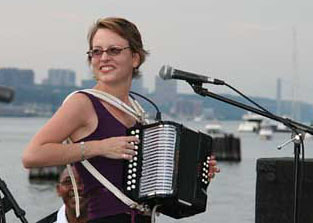
here is a links to my photos of musicians in Samaná.
http://picasaweb.google.com/salsasydney/SamanaJanuary2009#
Tuesday, January 27, 2009


Back in action: Fiesta de la Virgen de Altagracia, Samaná, 2009
Hello faithful readers!
My now-annual visit to the DR is now well underway. Although I arrived safely, my luggage did not. Somewhere between JFK and Syracuse, where I stopped off for a quick interview on my way west from Berlin, the bag with all my clothes in it got lost. I suspect it is still sitting in customs gathering dust, whereas I myself have hardly had time to sit still for a minute since getting here.
I got in on the 16th and found Santiago looking pretty much the same, only I had forgotten my clever shortcuts from before so ended up taking a rather long detour between the airport and the Centro Leon. There I met with the woman who’d be renting me a room for my stay this year, since my previous apartment was already taken.
All the errands that followed hardly bear mentioning. I did take a moment to reconnect with the good people of the Centro, however. I’ll be doing a little program there on Feb. 12 and, hopefully, we’ll still be able to get the ball rolling on the ethnomusicology summer school I proposed some time back. More on that later.
That reminds me that I need to tell you the purpose of this year’s visit. Because I actually finished my dissertation and graduated in September (!!), I am NOT going to be working much on merengue típico this trip – I probably won’t even be playing accordion, since I’m going to at least make the attempt not to get distracted from my task. Instead, I’ve been awarded a grant from the Society for Ethnomusicology to do a study on dance and movement in Santiago’s carnival. I am interested in how movement defines both the characters of carnival and the sense of place, even Santiago itself. For example, people often point to the way Santiago’s lechones move and the way the diablos cojuelos of La Vega jump around as a key difference between the two carnivals, and the two neighboring towns. I will therefore be looking at how movement defines things like place, class, and gender in Santiago by examining the movements of carnival participants and comparing with those of merengue típico dancers.
But before I could get to work on that, I had one other thing to do. Perhaps you remember from earlier years how I have gone to Samaná repeatedly over the past couple of years in various futile attempts to convince local musicians to play merengue redondo, a form of folk merengue unique to the area, for me and my recorder. Although I’d met the man reputed to be one of the last people knowledgeable about this form, he kept telling me I’d just have to come back on January 21, the feast day of the Virgin of Altagracia. This year I made sure I’d be in the country on that day especially for that purpose.
And so the night after I came in, my mom flew down to meet me and accompany me on this mission. As both she and her bags were – amazingly - at the airport on time, we had a day for shopping and visiting before we had to hit the road. We thus paid our now-traditional visits to the Mercado Modelo (tourist market) and Calle del Sol, then to Rafaelito and Carmen, and Laura and the kids. At Rafaelito’s we found the front room redecorated yet again, and were invited back for dinner following our road trip; and at Laura’s, while we were sad to note Chiqui’s continued absence and rather shady behavior over in New York, we did have a rousing dominoes tournament on the balcony of their new, breezy second-floor apartment.
The next day we hit the road – only two hours later than planned, and thus in good Dominican time. The roads were good up to San Francisco de Macoris, the drug-dealing capital and usual pit stop (they have a big grocery/department store with food and decent bathrooms), and afterwards more typically potholed. It was pretty uneventful but still took more than 4 hours to go the 200 kilometers. I hadn’t known they built a new toll road that goes up to Nagua from the capital through Monte Plata, which makes the trip from Santo Domingo now much faster and more direct than the one from Santiago. Also more comfortable, as the nice buses run a direct route from the capital to Samana, whereas the only direct service from Santiago is on the world’s more uncomfortable vans, which allow about 12 inches’ knee room between seats. So while Samana is considered part of the greater Cibao, it remains more difficult to travel there from elsewhere in the Cibao. Besides the potholes, the most interesting thing we saw on the road was a procession of a group of women with colorful cut-paper flags, a few of them carrying a small figure of the virgin inn a little house.
Road trips are always pretty tiring in this country, but we didn’t have time to rest. As soon as we got checked in to our hotel – the guide book and the hotel’s name had promised a bay view from our room, but new construction meant we only had a view of the backs of some houses and a dirt lot – we had to go searching for my friend Virgilio, the former mayor and my guide for all things Samanense. I’d been trying to call him for a month with no luck: his home number apparently belonged to someone else now, and I could only ever get his voicemail on the cell number.
After stopping at his old apartment on the Malecon, it was clear why he’d been hard to locate – he’d moved! No one answered the door at any apartment there, but a visit to the store across the street produced helpful information from the proprietor and we soon found his new house. Today was inauguration day and while CNN had been full of the news we wanted to hear back in Santiago, we got no news on the radio and had no TV in our non-bay-view hotel, and were a bit starved for Obama coverage. We found Virgilio, his son, and his father all gathered round the TV watching the continuing Obama coverage, but unfortunately we had missed the speech. However, Virgilio had other important news for us. First, his cell phone had been stolen, which explained the rest of the story. Second, it was actually tonight that was the big night for the Virgin here: there would be an all-night palos party getting underway shortly.
That didn’t leave us much time to prepare. Batteries still had to be charged, equipment tested, and dinner eaten, not to mention showers taken. A bit tired, we were nonetheless ready at the appointed time. But we couldn’t find Virgilio. After a couple of calls and a drive-by, we found out he was at the basketball game that we’d been able to hear emanating from the sports stadium, and went over there to pick him up. As it turned out, our phone call had reached him just as he was singing hte national anthem over the loudspeaker. Oops.
So we headed out to Acosta, a little village about 3 km east of town. At 9:30 the street was already quite crowded and it was difficult to get through., so Virgilio took over the wheel and got us parked. It was also nice to have his and his son’s help with the equipment – I’d had to get a much bigger microphone stand since the little portable one was one of the things packed in the lost bag, and also I couldn’t keep ahold of the microphone case once everything was set up and I was working on protecting the equipment and getting the recording done. It wasn’t an easy task in the space at hand.
Outside, the street was decorated with strings of those colored, triangular flags one sees at car lots and people were either standing around or resting on motorbikes in order to watch the fireworks going off. There were no streetlights, so except when something was exploding it was pretty dark.
Inside was where the music was going on, in a small, tin-roofed house with one large and two small rooms. In the large room, the paleros were set up in one corner, facing the wall and a window through which some people were watching, their backs to the room. The rest of the room was packed full of revelers, some dancing, some singing, many drinking. I set up my microphone near a doorway next to the drummers and was then stuck there for the rest of the night, unable to move with all my equipment through the crowd. My mom took over the role of videographer, however, and roamed around the house filming. One of the small rooms held an altar to the Virgin and a few people sitting quietly or praying, my mom reported. The whole thing was brightly lit, so someone must have had a generator or an inverter.
This style of palos was a little different than what I was used to, including one person always hitting a tresillo rhythm on the side of one drum with a stick. Another person played a really big güira. The older men present improvised verses, sometimes apparently competing with one another, while the rest sung responses, usually wordless. They did not do any songs familiar to me from my time with Grupo Mello in Santiago, not so surprisingly I guess, since my friends were originally from the Southwest, near San Juan de la Maguana, not the Cibao.
I saw a few people I knew: Yoyó, the merengue redondo expert, and Mártires, the local music teacher. Virgilio also introduced me to the owner of the establishment and patron of the party, who proudly told me that his family had been responsible for this ritual for 150 years. We made plans to come back to talk to him the next day, but that never happened. I also talked briefly with one of the singers, who then improvised some verses in praise of mine and my mother’s beauty, and expressing his desire to go home with us.
Sometime around midnight, we decided it was time to go. Although the music would continue all night, changing palos groups every few hours, it was very hot, very crowded, we’d run out of battery at some point, and anyway, Virgilio informed us that fighting generally began sometime after midnight. AS the musicians drank more and more, every year they got into brawls over whose turn it was, or who was the best, or any other reason.
So we got a bit of sleep, but not too much, as Virgilio had suggested we get up early to try and meet with some musicians in the morning. There would be an 8 AM mass and then a procession around 9 AM, and apparently this would be a good time for musician finding. As usual, however, it didn’t work that way. Even though we were late getting going anyway, when we passed by Yoyó’s place, a little shack on a hill, we were told he’d only recently gone to bed. When we went through Acosta, we found most of the town in bed, except for a group of three tígueres still on a drinking spree. They stopped us and asked for money. When Virgilio asked what for, they said, “Whatever!” Because of their honesty I tried to find some change to give them, but we honestly didn’t have any, and they didn’t seem to mind too much.
Down on the Malecón, we did find a trio of musicians getting ready to play merengue típico for the cruise ship passengers just arriving. Virgilio introduced us: one was Pai, Yoyó’s partner in merengue redondo, and another was his son. They agreed to play some stuff for us later, but since they’d be there until 4, there was no hurry. We decided we might as well see some sights in the meantime, as my mom’s time in the country was short. One tour company told us a boat to Los Haitises would be leaving in just a few minutes and if we hurried we could get on it, so we really hurried and made it down to the dock in time – in time to wait around for an hour. The wait time was not a total loss, however, since we could listen to the típico. They played the usual standards, but Pai did have a unique way of playing the tambora. Meanwhile, my mom talked to some people coming of the cruise ship and found out they’d been told to “look but not buy anything.” This I found incredibly offensive. How dare they (a) make up people’s minds for them and (b) refuse to bring desperately needed resources into the communities whose ports, resources, and labor they are using! I wish I could tell you which company to boycott or send angry letters to, but unfortunately there were 2 ships in that day. This is certainly something that tourism scholars and policy-makers should be looking into, however.
In the end, guess what, we weren’t even allowed to go. Cruise ship people only. Instead, we hired a local with a boat to take us out to the beach on Cayo Levantado, where we spent a pleasant couple of hours, after which I felt recuperated and ready to deal with more musicians (unfortunately, I was also a little sunburned). We even found another musician deserving of a later visit – an old tres player from a nearby town, who was playing waltzes and corridos (not the Mexican kind) accompanied by a younger partner on guitar.
Having already arranged a time and meeting place with the musicians, all that was left was to look for a recording location, and hope they’d actually show up. Searches for a suitable indoor location were unsuccessful: city offices were closed as was the radio station, and the local music professional was sleeping after a gig (we woke him, but only briefly). Parks were too noisy, so Virgilio’s suggestion of a nearby, mostly-deserted beach was the best we could do on short notice.
Back at our meeting point, we found no musicians, so got ice cream. Then we found two musicians, followed shortly by one more. One, Yoyó, was still missing, off in search of a marimba, apparently. The sun getting lower on the horizon, we had just decided to go look for him at his house when he arrived.
Now the trick was getting everyone and their instruments to the beach, with just one tiny car with a trunk big enough for a single suitcase stood on end. We ended up doing it in two trips, so it was good that the place was only 5 minutes away. It was a beautiful spot in an enclosed little bay with cliffs on either side and white sand in the middle, the kind of thing that would have been good for a music video - at least, if someone had cleaned up the trash, and without the big new resort whose walls formed the backdrop. The dumb thing is that the hotel didn’t even use that nice beach, but by building there had effectively kicked out the locals who used to use it. The musicians told us that Samanenses had used to go down there in the evenings, make up a big pot of rice, throw rocks at the mango tree to get the fruit down, and generally make merry. Since the hotel had gone up – which Pai’s son had himself worked on plastering – things had been kept quiet and locals now went elsewhere.
Well, we livened things up again at Puerto Escondido, if only for an hour. Merengue redondo, bamboulá, even a merengue típico and a popular merengue about Samaná were played on accordion, guira, a tambora turned upright, and a marimba Yoyó made himself. It sounded so nice on the beach at night that one of the hotel security guards came down to listen in (I just had to make sure he turned off his noisy walkie talkie).
The marimba isn’t native to Samaná but Yoyó explained he heard it on a visit to the capital as a young man, liked it, and went home and made his own. So this was actually the “modern” instrumentation for merengue redondo, adapted from merengue típico and based on the higher availability of these instruments. When pressed, however, Yoyó said that when he was a child merengue redondo was accompanied by atabal and bamboo tubes as percussion. Now they only play these instruments occasionally and with enough prior notice to prepare the bamboo – a few old folks in the mountains still hire them to play this kind of music and they indicated that I could do the same, if I so desired, and I think I do.
Unfortunately, we got started so late that the sun went down about 15 minutes after starting, making further filming impossible, although we kept playing a little longer until the wind came up and made that impossible too. Oh well, it was a good start and more than I’d been able to record on three previous trips to Samaná. I hope to come back soon for the bamboo and the tres.
Our next day was set to be pure vacation. We had made a reservation for a whale-watching trip, since the season in which the humpback whales visit the bay had just begun, and while I’d been out to see them before, my mom hadn’t. Once again we patronized the tours led by Kim, a Canadian marine biologist who’s lived in the area for over twenty years and is responsible for the development of whale-oriented tourism here as well as conservation measures. (Her off-season job is breeding mules at her country home.) We were told not to have high hopes of seeing the big guys, as only 50% of trips since the season started had been successful, but our captain Pimpo would do his best. (Yes, I did ask him why he was called Pimpo, and he claimed not to know! I told him to ask his mom.)
Last time on this trip I experienced the only bout of seasickness I’d ever had in my life and it was pretty awful. Today, with no cold, I was luckier even though the seas were really rough and we were pitching all over the place and could barely even stand up for a second. We did indeed go for a long time without seeing a thing, but then we encountered a school of bottlenose dolphins, two of which leaped out of the water to greet us. Then Pimpo got a call from some other boats following a pair of humpbacks, and we hurried out to get in line. It was really spectacular: last time I’d seen mothers and babies, but they were pretty mellow and I never saw more than their back. This time, these two were actually jumping completely out of the water, turning around with noses out, flipping their tails, in short, making an amazing show for us. The hard part was getting a picture with ten people sitting between us and the whales, and the boat going up and down the big swells like a rollercoaster, but we did manage a couple of whale portraits.
On this trip, we also made a new friend: a French geographer consulting for local tourism organizations and making recommendations for sustainable development of the industry. His brother, as it turned out, is a sociologist specializing in Cuban music who will be visiting soon, so maybe they will come along to my future merengue redondo party. At any rate, I thought it would be good for this guy to meet Virgilio, since both are involved with tourism, so we brought him to the Mercado family house. However, Virgilio had left early that morning to go to the capital for some carnival organization business. Instead, we played with his adorable daughter for a little while before hitting the road once again. (She is about 4 and engaged me in conversations like the following. After asking the names of all the family members she could think of, she said, “What are your children’s names?” “I don’t have any children.” “Oh, they died?” “No, I never had any children. What about you?” “No, I don’t have any, either,” said very seriously.)
Since we were setting off so late, we decided not to go so far but instead to stay in Las Terrenas, a beach town with a big expat population – particularly French – on the northern coast. There we found that things were changing rapidly. The stretch of beach at the eastern side of town where we drove in, where we had stayed in one of many adorable and colorful little bungalows last time, was now being paved over with giant condo and resort buildings. Thus we decided to opt for the other end of town. But due to the recent heavy rains, we found the road impassable for our tiny car. Eventually we found a good candidate on a side road, where we got a bungalow decorated with a pirate theme. It was a relaxing spot to spent the next 20 hours, minus the time we spent eating tapas and crepes, sitting on the beach, and shopping for gifts. After that we had t o hit the road again for the long and uneventful if potholed drive back. At least we knew that at the end a delicious dinner was waiting for us at the Roman house. In this we were not disappointed. There we ate locrio (with jalapenos added just for my benefit), habichuelas, pastelon, spaghetti, and salad followed by pineapple upside down cake, all with little Mauricia, the new cat, looking on. (Perhaps you remember that Rafaelito’s cats are all named Mauricio because they all say “mau.” Since this one is a girl, I suggested the altered form and it appears to have stuck.)
Then it was mom’s last day already – time really flew. It was naturally spent in a flurry of shopping, though this time principally for a carnival costume for my nephew who was just turning five. He is rather theatrical and has developed a taste for costumes of all types. Because it was still early in carnival season, this was a difficult mission, and necessitated visits to four different shops, each shopkeeper giving us directions to the next, and even so, we were unsuccessful. At this point I was completely frustrated with driving around on this ridiculous scavenger hunt so we got a purple feathered boa instead, which I hope will be a fabulous addition to the costume trunk. Maybe I can get the little lechon suit later.
After all our errands were done, we celebrated by going to the cinema to see Twilight, which both of us had read and my mom had already seen twice (although never before with Spanish subtitles). And after that, we had our traditional dinner at Amici, the incredibly delicious Italian restaurant across the street from my former apartment. It did not disappoint. Even the limoncello we remembered was still there.
The plan for the next day was to get up ridiculously early, take mom to the airport, return the car, do the paperwork for my lost baggage at the Delta office while there, then go home, have a nap, write and read a little before going to Rafaelito’s gig in the evening. Alas, things did not work out as planned. After arriving at the airport we found that mom’s 9:30 flight had been rescheduled for 4:30 in the afternoon! The crew hadn’t had the required amount of sleep. Neither had we, so we went back to my place where I tried, mostly unsuccessfully, to nap. At noon we went back again, I used the meal voucher they’d given as a consolation prize, did the required tasks, and went home again for another unsuccessful nap attempt. Clearly, no reading or writing was meant to be done this day. I did nonetheless make it to the gig, hitching a ride with the Roman family to Las Vegas, a disco out on the Santiago-Navarrete highway, where I enjoyed the tail end of El Ciego’s set and two of Rafaelito’s, all while filming the dance activity as best I could. I also talked to a few of the notable dancers present in order to convince them to (a) submit to an interview, if they hadn’t already and (b) participate in my upcoming event at the Centro Leon.
Afterwards, Rafaelito took me and the kids (his youngest son and daughter, niece, and stepson) to eat a Naboa, a kind of snack they make at only one food cart in town. It was made of a ball of Mapuey, a root vegetable, with a cheese filling, dipped in some kind of crust and deep fried. Totally unhealthy but just the kind of thing you want at 2 AM.
stay tuned for carnival news!
My now-annual visit to the DR is now well underway. Although I arrived safely, my luggage did not. Somewhere between JFK and Syracuse, where I stopped off for a quick interview on my way west from Berlin, the bag with all my clothes in it got lost. I suspect it is still sitting in customs gathering dust, whereas I myself have hardly had time to sit still for a minute since getting here.
I got in on the 16th and found Santiago looking pretty much the same, only I had forgotten my clever shortcuts from before so ended up taking a rather long detour between the airport and the Centro Leon. There I met with the woman who’d be renting me a room for my stay this year, since my previous apartment was already taken.
All the errands that followed hardly bear mentioning. I did take a moment to reconnect with the good people of the Centro, however. I’ll be doing a little program there on Feb. 12 and, hopefully, we’ll still be able to get the ball rolling on the ethnomusicology summer school I proposed some time back. More on that later.
That reminds me that I need to tell you the purpose of this year’s visit. Because I actually finished my dissertation and graduated in September (!!), I am NOT going to be working much on merengue típico this trip – I probably won’t even be playing accordion, since I’m going to at least make the attempt not to get distracted from my task. Instead, I’ve been awarded a grant from the Society for Ethnomusicology to do a study on dance and movement in Santiago’s carnival. I am interested in how movement defines both the characters of carnival and the sense of place, even Santiago itself. For example, people often point to the way Santiago’s lechones move and the way the diablos cojuelos of La Vega jump around as a key difference between the two carnivals, and the two neighboring towns. I will therefore be looking at how movement defines things like place, class, and gender in Santiago by examining the movements of carnival participants and comparing with those of merengue típico dancers.
But before I could get to work on that, I had one other thing to do. Perhaps you remember from earlier years how I have gone to Samaná repeatedly over the past couple of years in various futile attempts to convince local musicians to play merengue redondo, a form of folk merengue unique to the area, for me and my recorder. Although I’d met the man reputed to be one of the last people knowledgeable about this form, he kept telling me I’d just have to come back on January 21, the feast day of the Virgin of Altagracia. This year I made sure I’d be in the country on that day especially for that purpose.
And so the night after I came in, my mom flew down to meet me and accompany me on this mission. As both she and her bags were – amazingly - at the airport on time, we had a day for shopping and visiting before we had to hit the road. We thus paid our now-traditional visits to the Mercado Modelo (tourist market) and Calle del Sol, then to Rafaelito and Carmen, and Laura and the kids. At Rafaelito’s we found the front room redecorated yet again, and were invited back for dinner following our road trip; and at Laura’s, while we were sad to note Chiqui’s continued absence and rather shady behavior over in New York, we did have a rousing dominoes tournament on the balcony of their new, breezy second-floor apartment.
The next day we hit the road – only two hours later than planned, and thus in good Dominican time. The roads were good up to San Francisco de Macoris, the drug-dealing capital and usual pit stop (they have a big grocery/department store with food and decent bathrooms), and afterwards more typically potholed. It was pretty uneventful but still took more than 4 hours to go the 200 kilometers. I hadn’t known they built a new toll road that goes up to Nagua from the capital through Monte Plata, which makes the trip from Santo Domingo now much faster and more direct than the one from Santiago. Also more comfortable, as the nice buses run a direct route from the capital to Samana, whereas the only direct service from Santiago is on the world’s more uncomfortable vans, which allow about 12 inches’ knee room between seats. So while Samana is considered part of the greater Cibao, it remains more difficult to travel there from elsewhere in the Cibao. Besides the potholes, the most interesting thing we saw on the road was a procession of a group of women with colorful cut-paper flags, a few of them carrying a small figure of the virgin inn a little house.
Road trips are always pretty tiring in this country, but we didn’t have time to rest. As soon as we got checked in to our hotel – the guide book and the hotel’s name had promised a bay view from our room, but new construction meant we only had a view of the backs of some houses and a dirt lot – we had to go searching for my friend Virgilio, the former mayor and my guide for all things Samanense. I’d been trying to call him for a month with no luck: his home number apparently belonged to someone else now, and I could only ever get his voicemail on the cell number.
After stopping at his old apartment on the Malecon, it was clear why he’d been hard to locate – he’d moved! No one answered the door at any apartment there, but a visit to the store across the street produced helpful information from the proprietor and we soon found his new house. Today was inauguration day and while CNN had been full of the news we wanted to hear back in Santiago, we got no news on the radio and had no TV in our non-bay-view hotel, and were a bit starved for Obama coverage. We found Virgilio, his son, and his father all gathered round the TV watching the continuing Obama coverage, but unfortunately we had missed the speech. However, Virgilio had other important news for us. First, his cell phone had been stolen, which explained the rest of the story. Second, it was actually tonight that was the big night for the Virgin here: there would be an all-night palos party getting underway shortly.
That didn’t leave us much time to prepare. Batteries still had to be charged, equipment tested, and dinner eaten, not to mention showers taken. A bit tired, we were nonetheless ready at the appointed time. But we couldn’t find Virgilio. After a couple of calls and a drive-by, we found out he was at the basketball game that we’d been able to hear emanating from the sports stadium, and went over there to pick him up. As it turned out, our phone call had reached him just as he was singing hte national anthem over the loudspeaker. Oops.
So we headed out to Acosta, a little village about 3 km east of town. At 9:30 the street was already quite crowded and it was difficult to get through., so Virgilio took over the wheel and got us parked. It was also nice to have his and his son’s help with the equipment – I’d had to get a much bigger microphone stand since the little portable one was one of the things packed in the lost bag, and also I couldn’t keep ahold of the microphone case once everything was set up and I was working on protecting the equipment and getting the recording done. It wasn’t an easy task in the space at hand.
Outside, the street was decorated with strings of those colored, triangular flags one sees at car lots and people were either standing around or resting on motorbikes in order to watch the fireworks going off. There were no streetlights, so except when something was exploding it was pretty dark.
Inside was where the music was going on, in a small, tin-roofed house with one large and two small rooms. In the large room, the paleros were set up in one corner, facing the wall and a window through which some people were watching, their backs to the room. The rest of the room was packed full of revelers, some dancing, some singing, many drinking. I set up my microphone near a doorway next to the drummers and was then stuck there for the rest of the night, unable to move with all my equipment through the crowd. My mom took over the role of videographer, however, and roamed around the house filming. One of the small rooms held an altar to the Virgin and a few people sitting quietly or praying, my mom reported. The whole thing was brightly lit, so someone must have had a generator or an inverter.
This style of palos was a little different than what I was used to, including one person always hitting a tresillo rhythm on the side of one drum with a stick. Another person played a really big güira. The older men present improvised verses, sometimes apparently competing with one another, while the rest sung responses, usually wordless. They did not do any songs familiar to me from my time with Grupo Mello in Santiago, not so surprisingly I guess, since my friends were originally from the Southwest, near San Juan de la Maguana, not the Cibao.
I saw a few people I knew: Yoyó, the merengue redondo expert, and Mártires, the local music teacher. Virgilio also introduced me to the owner of the establishment and patron of the party, who proudly told me that his family had been responsible for this ritual for 150 years. We made plans to come back to talk to him the next day, but that never happened. I also talked briefly with one of the singers, who then improvised some verses in praise of mine and my mother’s beauty, and expressing his desire to go home with us.
Sometime around midnight, we decided it was time to go. Although the music would continue all night, changing palos groups every few hours, it was very hot, very crowded, we’d run out of battery at some point, and anyway, Virgilio informed us that fighting generally began sometime after midnight. AS the musicians drank more and more, every year they got into brawls over whose turn it was, or who was the best, or any other reason.
So we got a bit of sleep, but not too much, as Virgilio had suggested we get up early to try and meet with some musicians in the morning. There would be an 8 AM mass and then a procession around 9 AM, and apparently this would be a good time for musician finding. As usual, however, it didn’t work that way. Even though we were late getting going anyway, when we passed by Yoyó’s place, a little shack on a hill, we were told he’d only recently gone to bed. When we went through Acosta, we found most of the town in bed, except for a group of three tígueres still on a drinking spree. They stopped us and asked for money. When Virgilio asked what for, they said, “Whatever!” Because of their honesty I tried to find some change to give them, but we honestly didn’t have any, and they didn’t seem to mind too much.
Down on the Malecón, we did find a trio of musicians getting ready to play merengue típico for the cruise ship passengers just arriving. Virgilio introduced us: one was Pai, Yoyó’s partner in merengue redondo, and another was his son. They agreed to play some stuff for us later, but since they’d be there until 4, there was no hurry. We decided we might as well see some sights in the meantime, as my mom’s time in the country was short. One tour company told us a boat to Los Haitises would be leaving in just a few minutes and if we hurried we could get on it, so we really hurried and made it down to the dock in time – in time to wait around for an hour. The wait time was not a total loss, however, since we could listen to the típico. They played the usual standards, but Pai did have a unique way of playing the tambora. Meanwhile, my mom talked to some people coming of the cruise ship and found out they’d been told to “look but not buy anything.” This I found incredibly offensive. How dare they (a) make up people’s minds for them and (b) refuse to bring desperately needed resources into the communities whose ports, resources, and labor they are using! I wish I could tell you which company to boycott or send angry letters to, but unfortunately there were 2 ships in that day. This is certainly something that tourism scholars and policy-makers should be looking into, however.
In the end, guess what, we weren’t even allowed to go. Cruise ship people only. Instead, we hired a local with a boat to take us out to the beach on Cayo Levantado, where we spent a pleasant couple of hours, after which I felt recuperated and ready to deal with more musicians (unfortunately, I was also a little sunburned). We even found another musician deserving of a later visit – an old tres player from a nearby town, who was playing waltzes and corridos (not the Mexican kind) accompanied by a younger partner on guitar.
Having already arranged a time and meeting place with the musicians, all that was left was to look for a recording location, and hope they’d actually show up. Searches for a suitable indoor location were unsuccessful: city offices were closed as was the radio station, and the local music professional was sleeping after a gig (we woke him, but only briefly). Parks were too noisy, so Virgilio’s suggestion of a nearby, mostly-deserted beach was the best we could do on short notice.
Back at our meeting point, we found no musicians, so got ice cream. Then we found two musicians, followed shortly by one more. One, Yoyó, was still missing, off in search of a marimba, apparently. The sun getting lower on the horizon, we had just decided to go look for him at his house when he arrived.
Now the trick was getting everyone and their instruments to the beach, with just one tiny car with a trunk big enough for a single suitcase stood on end. We ended up doing it in two trips, so it was good that the place was only 5 minutes away. It was a beautiful spot in an enclosed little bay with cliffs on either side and white sand in the middle, the kind of thing that would have been good for a music video - at least, if someone had cleaned up the trash, and without the big new resort whose walls formed the backdrop. The dumb thing is that the hotel didn’t even use that nice beach, but by building there had effectively kicked out the locals who used to use it. The musicians told us that Samanenses had used to go down there in the evenings, make up a big pot of rice, throw rocks at the mango tree to get the fruit down, and generally make merry. Since the hotel had gone up – which Pai’s son had himself worked on plastering – things had been kept quiet and locals now went elsewhere.
Well, we livened things up again at Puerto Escondido, if only for an hour. Merengue redondo, bamboulá, even a merengue típico and a popular merengue about Samaná were played on accordion, guira, a tambora turned upright, and a marimba Yoyó made himself. It sounded so nice on the beach at night that one of the hotel security guards came down to listen in (I just had to make sure he turned off his noisy walkie talkie).
The marimba isn’t native to Samaná but Yoyó explained he heard it on a visit to the capital as a young man, liked it, and went home and made his own. So this was actually the “modern” instrumentation for merengue redondo, adapted from merengue típico and based on the higher availability of these instruments. When pressed, however, Yoyó said that when he was a child merengue redondo was accompanied by atabal and bamboo tubes as percussion. Now they only play these instruments occasionally and with enough prior notice to prepare the bamboo – a few old folks in the mountains still hire them to play this kind of music and they indicated that I could do the same, if I so desired, and I think I do.
Unfortunately, we got started so late that the sun went down about 15 minutes after starting, making further filming impossible, although we kept playing a little longer until the wind came up and made that impossible too. Oh well, it was a good start and more than I’d been able to record on three previous trips to Samaná. I hope to come back soon for the bamboo and the tres.
Our next day was set to be pure vacation. We had made a reservation for a whale-watching trip, since the season in which the humpback whales visit the bay had just begun, and while I’d been out to see them before, my mom hadn’t. Once again we patronized the tours led by Kim, a Canadian marine biologist who’s lived in the area for over twenty years and is responsible for the development of whale-oriented tourism here as well as conservation measures. (Her off-season job is breeding mules at her country home.) We were told not to have high hopes of seeing the big guys, as only 50% of trips since the season started had been successful, but our captain Pimpo would do his best. (Yes, I did ask him why he was called Pimpo, and he claimed not to know! I told him to ask his mom.)
Last time on this trip I experienced the only bout of seasickness I’d ever had in my life and it was pretty awful. Today, with no cold, I was luckier even though the seas were really rough and we were pitching all over the place and could barely even stand up for a second. We did indeed go for a long time without seeing a thing, but then we encountered a school of bottlenose dolphins, two of which leaped out of the water to greet us. Then Pimpo got a call from some other boats following a pair of humpbacks, and we hurried out to get in line. It was really spectacular: last time I’d seen mothers and babies, but they were pretty mellow and I never saw more than their back. This time, these two were actually jumping completely out of the water, turning around with noses out, flipping their tails, in short, making an amazing show for us. The hard part was getting a picture with ten people sitting between us and the whales, and the boat going up and down the big swells like a rollercoaster, but we did manage a couple of whale portraits.
On this trip, we also made a new friend: a French geographer consulting for local tourism organizations and making recommendations for sustainable development of the industry. His brother, as it turned out, is a sociologist specializing in Cuban music who will be visiting soon, so maybe they will come along to my future merengue redondo party. At any rate, I thought it would be good for this guy to meet Virgilio, since both are involved with tourism, so we brought him to the Mercado family house. However, Virgilio had left early that morning to go to the capital for some carnival organization business. Instead, we played with his adorable daughter for a little while before hitting the road once again. (She is about 4 and engaged me in conversations like the following. After asking the names of all the family members she could think of, she said, “What are your children’s names?” “I don’t have any children.” “Oh, they died?” “No, I never had any children. What about you?” “No, I don’t have any, either,” said very seriously.)
Since we were setting off so late, we decided not to go so far but instead to stay in Las Terrenas, a beach town with a big expat population – particularly French – on the northern coast. There we found that things were changing rapidly. The stretch of beach at the eastern side of town where we drove in, where we had stayed in one of many adorable and colorful little bungalows last time, was now being paved over with giant condo and resort buildings. Thus we decided to opt for the other end of town. But due to the recent heavy rains, we found the road impassable for our tiny car. Eventually we found a good candidate on a side road, where we got a bungalow decorated with a pirate theme. It was a relaxing spot to spent the next 20 hours, minus the time we spent eating tapas and crepes, sitting on the beach, and shopping for gifts. After that we had t o hit the road again for the long and uneventful if potholed drive back. At least we knew that at the end a delicious dinner was waiting for us at the Roman house. In this we were not disappointed. There we ate locrio (with jalapenos added just for my benefit), habichuelas, pastelon, spaghetti, and salad followed by pineapple upside down cake, all with little Mauricia, the new cat, looking on. (Perhaps you remember that Rafaelito’s cats are all named Mauricio because they all say “mau.” Since this one is a girl, I suggested the altered form and it appears to have stuck.)
Then it was mom’s last day already – time really flew. It was naturally spent in a flurry of shopping, though this time principally for a carnival costume for my nephew who was just turning five. He is rather theatrical and has developed a taste for costumes of all types. Because it was still early in carnival season, this was a difficult mission, and necessitated visits to four different shops, each shopkeeper giving us directions to the next, and even so, we were unsuccessful. At this point I was completely frustrated with driving around on this ridiculous scavenger hunt so we got a purple feathered boa instead, which I hope will be a fabulous addition to the costume trunk. Maybe I can get the little lechon suit later.
After all our errands were done, we celebrated by going to the cinema to see Twilight, which both of us had read and my mom had already seen twice (although never before with Spanish subtitles). And after that, we had our traditional dinner at Amici, the incredibly delicious Italian restaurant across the street from my former apartment. It did not disappoint. Even the limoncello we remembered was still there.
The plan for the next day was to get up ridiculously early, take mom to the airport, return the car, do the paperwork for my lost baggage at the Delta office while there, then go home, have a nap, write and read a little before going to Rafaelito’s gig in the evening. Alas, things did not work out as planned. After arriving at the airport we found that mom’s 9:30 flight had been rescheduled for 4:30 in the afternoon! The crew hadn’t had the required amount of sleep. Neither had we, so we went back to my place where I tried, mostly unsuccessfully, to nap. At noon we went back again, I used the meal voucher they’d given as a consolation prize, did the required tasks, and went home again for another unsuccessful nap attempt. Clearly, no reading or writing was meant to be done this day. I did nonetheless make it to the gig, hitching a ride with the Roman family to Las Vegas, a disco out on the Santiago-Navarrete highway, where I enjoyed the tail end of El Ciego’s set and two of Rafaelito’s, all while filming the dance activity as best I could. I also talked to a few of the notable dancers present in order to convince them to (a) submit to an interview, if they hadn’t already and (b) participate in my upcoming event at the Centro Leon.
Afterwards, Rafaelito took me and the kids (his youngest son and daughter, niece, and stepson) to eat a Naboa, a kind of snack they make at only one food cart in town. It was made of a ball of Mapuey, a root vegetable, with a cheese filling, dipped in some kind of crust and deep fried. Totally unhealthy but just the kind of thing you want at 2 AM.
stay tuned for carnival news!
Wednesday, September 24, 2008
Batey Libertad pide su ayuda (asks for your help)
You may remember a previous posting about Batey Libertad. Bateyes are where agricultural workers live, and are among the poorest places in the DR. My friends on Batey Libertad have been asking me for some time for some help in getting money for fixing up their church, which is in sad need of some help. You probably know I am not a religious person, but everyone has a right to their own kind of comfort, and this church/community center certainly provides that to many batey residents. I feel bad I haven't been able to help them out so far, so please help me to remedy this situation!
I've added a "Donate" button to my page over there on the left. Please donate whatever you can to my Batey Libertad fund. This money will go into a Paypal account, and I will then send that money on to them. I'm not a non-profit so I can't offer you tax deductions or anything, but I do promise you that whatever you donate will go straight to the church at Batey Libertad (minus the approx. 6% I pay in fees for sending money to the DR). Even $5 or $10 would make a difference to them - that's already 165 or 330 pesos!
Previously, they had written to me explaining their need for a few fans and some paint, as well. You can take a look at the church in this previous post:
http://accordiongirl.blogspot.com/2007/06/batey-libertad-church.html
Here is the new letter I received from my friend Yanlico from Batey Libertad this morning. In short, the gist of it is that the church already had some problems and then was robbed several times this year. The robbers stole their speakers, microphone, chairs, robes, and decorative items. Besides needing to replace these items, they want to put bars on the windows and secure the door in order to prevent future thefts.
"Reciba un fuerte saludo y muchas bendiciones en el nombre de Dios.
"Le escribo en el nombre de la Iglesia Cristiana en Batey Libertad. Después de este cordial saludo, quiero manifestarle los siguientes.
"Desde el inicio de este año 2008, hemos sido víctimas de robos en el templo, donde han llevado algunos objetos útiles e importantes. La primera vez se robaron cosas decorativas como, manteles, sillas, micrófonos y hasta las flores y otros. Hace dos meses atrás también nos robaron dos bocinas (speaker) y un micrófono de gran valor que hasta ahora no podemos comprarlo, suerte que tuvimos guardados la otra bocina.
"Entonces, por estas razones hemos decidido y planificar la idea de que la única forma de estar seguro es ponerle más seguro a las puertas y ventanas reforzándolas con hierro y así no tendríamos que llevar y traer las cosas en cada momento de los cultos. Por eso estamos pidiendo ayuda y colaboración. Primero comenzamos con los miembros de la iglesia y luego las otras personas amigos y colaboradores de la comunidad como usted y sus amigos. Solo quiero recordarle que no es algo obligatorio.
"Pues, según una cotización que hicieron, el costo de los materiales ascendió a un monto de $10,000.00 sin la mano de obra que costaría $3,000.00. Espero que cooperen con lo que puedan y así no estarían ayudando a la iglesia sino estarían cooperando con la obra de Dios. Muchas gracias.
"Bendición,
"Yanlico"
I've added a "Donate" button to my page over there on the left. Please donate whatever you can to my Batey Libertad fund. This money will go into a Paypal account, and I will then send that money on to them. I'm not a non-profit so I can't offer you tax deductions or anything, but I do promise you that whatever you donate will go straight to the church at Batey Libertad (minus the approx. 6% I pay in fees for sending money to the DR). Even $5 or $10 would make a difference to them - that's already 165 or 330 pesos!
Previously, they had written to me explaining their need for a few fans and some paint, as well. You can take a look at the church in this previous post:
http://accordiongirl.blogspot.com/2007/06/batey-libertad-church.html
Here is the new letter I received from my friend Yanlico from Batey Libertad this morning. In short, the gist of it is that the church already had some problems and then was robbed several times this year. The robbers stole their speakers, microphone, chairs, robes, and decorative items. Besides needing to replace these items, they want to put bars on the windows and secure the door in order to prevent future thefts.
"Reciba un fuerte saludo y muchas bendiciones en el nombre de Dios.
"Le escribo en el nombre de la Iglesia Cristiana en Batey Libertad. Después de este cordial saludo, quiero manifestarle los siguientes.
"Desde el inicio de este año 2008, hemos sido víctimas de robos en el templo, donde han llevado algunos objetos útiles e importantes. La primera vez se robaron cosas decorativas como, manteles, sillas, micrófonos y hasta las flores y otros. Hace dos meses atrás también nos robaron dos bocinas (speaker) y un micrófono de gran valor que hasta ahora no podemos comprarlo, suerte que tuvimos guardados la otra bocina.
"Entonces, por estas razones hemos decidido y planificar la idea de que la única forma de estar seguro es ponerle más seguro a las puertas y ventanas reforzándolas con hierro y así no tendríamos que llevar y traer las cosas en cada momento de los cultos. Por eso estamos pidiendo ayuda y colaboración. Primero comenzamos con los miembros de la iglesia y luego las otras personas amigos y colaboradores de la comunidad como usted y sus amigos. Solo quiero recordarle que no es algo obligatorio.
"Pues, según una cotización que hicieron, el costo de los materiales ascendió a un monto de $10,000.00 sin la mano de obra que costaría $3,000.00. Espero que cooperen con lo que puedan y así no estarían ayudando a la iglesia sino estarían cooperando con la obra de Dios. Muchas gracias.
"Bendición,
"Yanlico"
Free! Free at last!
You may wonder where I've been and why I haven't been posting. First, I was teaching at the University of Arizona, which took all my time. Then I moved to Berlin, where I am at the moment, working on improving my mediocre German. In Feburary I was indeed back in the DR for my usual carnival-season activities with Los Confraternos. And then......
I finished my dissertation.
I defended on Sept. 5 and my degree was apparently awarded last week.
Can you believe it? I can hardly believe it myself.
Anyway, it's titled Merengue típico in Dominican transnational communities: Gender, geography, migration, and memory in a traditional music. 700+ pages all about your, and my, favorite music. I need to get to work on turning it into a book, but frankly, I'm a little worn out and need a dissertation vacation. Anyway, anyone who wants to tackle it, feel free to email me and we'll discuss.
I'll next be in the DR in January-February for, you guessed it, some carnival research. In the meantime, I'll try to do a better job of keeping all you faithful readers up to date.
By the way, if you haven't taken a look at or listened to the tipico CD I co-produced for Smithsonian Folkways, what are you waiting for?? It has all my favorite stuff on it and I wrote the liner notes myself. They are highly educational and you can even download them for free. I don't earn any royalties from it, but La India Canela does, so you might as well buy the CD while you're at it.
Here's the album: http://www.folkways.si.edu/albumdetails.aspx?itemID=3206
And here you can watch a video about it: http://www.smithsonianglobalsound.org/feature_28A.aspx
I finished my dissertation.
I defended on Sept. 5 and my degree was apparently awarded last week.
Can you believe it? I can hardly believe it myself.
Anyway, it's titled Merengue típico in Dominican transnational communities: Gender, geography, migration, and memory in a traditional music. 700+ pages all about your, and my, favorite music. I need to get to work on turning it into a book, but frankly, I'm a little worn out and need a dissertation vacation. Anyway, anyone who wants to tackle it, feel free to email me and we'll discuss.
I'll next be in the DR in January-February for, you guessed it, some carnival research. In the meantime, I'll try to do a better job of keeping all you faithful readers up to date.
By the way, if you haven't taken a look at or listened to the tipico CD I co-produced for Smithsonian Folkways, what are you waiting for?? It has all my favorite stuff on it and I wrote the liner notes myself. They are highly educational and you can even download them for free. I don't earn any royalties from it, but La India Canela does, so you might as well buy the CD while you're at it.
Here's the album: http://www.folkways.si.edu/albumdetails.aspx?itemID=3206
And here you can watch a video about it: http://www.smithsonianglobalsound.org/feature_28A.aspx
Tuesday, November 13, 2007
Blog transfer
Hi folks,
So I decided that this blog should be entirely devoted to merengue tipico and the Dominican Republic. Therefore, I'm moving all entries about my other travels and activities to another location: http://sydtravels.blogspot.com. New writing will likely appear there in December, when I'll be in Germany.
I'm sorry for the long delay in posting, but I hope to return to my old blogging ways after the semester ends, and I'm finished teaching this incredibly labor-intensive lecture course in Mexican music.
Thanks for sticking with me!
-accordiongirl
So I decided that this blog should be entirely devoted to merengue tipico and the Dominican Republic. Therefore, I'm moving all entries about my other travels and activities to another location: http://sydtravels.blogspot.com. New writing will likely appear there in December, when I'll be in Germany.
I'm sorry for the long delay in posting, but I hope to return to my old blogging ways after the semester ends, and I'm finished teaching this incredibly labor-intensive lecture course in Mexican music.
Thanks for sticking with me!
-accordiongirl
Monday, June 18, 2007
Thanks for the 404s
I've fixed the links the best I could for your continued enjoyment, faithful readers. But now you may have to wait a bit for the next installment. I leave tomorrow for a month in Europe where I will be having more adventures, many of them involving various types of accordions. I'll still post pictures and stories when I have the chance, though.
In the meantime, those of you who are in New York may wish to visit this year's installment of the Main Squeeze Accordion Festival, July 7 2-9 PM Riverside Park, Pier 1 at 70th St. I'm told that our friend Ernestidio Rodriguez has been invited back to play again this year (unfortunately I won't be able to join him this time) - though I don't know if this is going forward as he doesn't appear on the current program! If any of you go, let me know.
http://www.ireallyshouldbewriting.com/accordionfestival/
Have fun and stay tuned!
In the meantime, those of you who are in New York may wish to visit this year's installment of the Main Squeeze Accordion Festival, July 7 2-9 PM Riverside Park, Pier 1 at 70th St. I'm told that our friend Ernestidio Rodriguez has been invited back to play again this year (unfortunately I won't be able to join him this time) - though I don't know if this is going forward as he doesn't appear on the current program! If any of you go, let me know.
http://www.ireallyshouldbewriting.com/accordionfestival/
Have fun and stay tuned!
Wednesday, June 13, 2007
Birthday links
Hey guys, it’s my birthday today!
My gift to you are some links for listening to típico.
LIVE STREAMING RADIO:
La Super Regional
http://www.superregional.com/
Radio Típico
http://www.radiotipico.com/
GROUPS
Fulanito web site – first group to combine perico ripiao & hip hop
http://www.fulanito.com/
Many groups have MySpace pages where you can hear some of their music. Here are a few.
Rafaelito Roman http://profile.myspace.com/104690413
Raul Roman http://profile.myspace.com/index.cfm?fuseaction=user.viewprofile&friendid=105889957
El Ciego de Nagua http://www.myspace.com/elciegodenagua
Cristian Guira http://www.myspace.com/cristianlaguira
Geniswing http://www.myspace.com/geniswing
El Prodigio http://www.myspace.com/elprodigioylasuperbanda
Nicol Peña http://www.myspace.com/nicolpea
Geovanny Polanco http://www.myspace.com/geovannypolanco
There are many more, but it’s pretty easy to find them under the “friends” section of these guys.
MISC.
Merengue & Bachata – República Dominicana(site with sound clips of major musicians in these genres) http://home-3.tiscali.nl/~pjetax/
My gift to you are some links for listening to típico.
LIVE STREAMING RADIO:
La Super Regional
http://www.superregional.com/
Radio Típico
http://www.radiotipico.com/
GROUPS
Fulanito web site – first group to combine perico ripiao & hip hop
http://www.fulanito.com/
Many groups have MySpace pages where you can hear some of their music. Here are a few.
Rafaelito Roman http://profile.myspace.com/104690413
Raul Roman http://profile.myspace.com/index.cfm?fuseaction=user.viewprofile&friendid=105889957
El Ciego de Nagua http://www.myspace.com/elciegodenagua
Cristian Guira http://www.myspace.com/cristianlaguira
Geniswing http://www.myspace.com/geniswing
El Prodigio http://www.myspace.com/elprodigioylasuperbanda
Nicol Peña http://www.myspace.com/nicolpea
Geovanny Polanco http://www.myspace.com/geovannypolanco
There are many more, but it’s pretty easy to find them under the “friends” section of these guys.
MISC.
Merengue & Bachata – República Dominicana(site with sound clips of major musicians in these genres) http://home-3.tiscali.nl/~pjetax/
Saturday, June 09, 2007
Batey Libertad church
Hi folks-
so if you know me you know I'm not much of a churchgoer, but today I'm posting on behalf of a church. My friend Yanlico has asked for help for some badly needed repairs and upgrades to the church at Batey Libertad near Santiago. If you've been reading my blog for a while you know that the bateyes are settlements for agricultural workers in the Dominican Republic, mostly of Haitian descent, and they are the poorest parts of the country. Batey Libertad has no water supply and very few services of any kind, so the church serves to provide comfort, a community center and suchlike to many on the batey.
If any of you are involved in a church or charity group and would like to help out the Iglesia Cristiana Reformada of Batey Libertad, either through donations or a sort of adopt-a-church set up, please contact me. You would find yourselves some lifelong friends in the DR!
Their immediate needs are:
2 ceiling fans and 4 wall-mounted fans (it's realllllly hot there!)
50 plastic chairs
1 desk/table
2 microphones
contruction of a cement patio in front of church
Here are some pictures Yanlico sent of the church, churchgoers, services and classes.


so if you know me you know I'm not much of a churchgoer, but today I'm posting on behalf of a church. My friend Yanlico has asked for help for some badly needed repairs and upgrades to the church at Batey Libertad near Santiago. If you've been reading my blog for a while you know that the bateyes are settlements for agricultural workers in the Dominican Republic, mostly of Haitian descent, and they are the poorest parts of the country. Batey Libertad has no water supply and very few services of any kind, so the church serves to provide comfort, a community center and suchlike to many on the batey.
If any of you are involved in a church or charity group and would like to help out the Iglesia Cristiana Reformada of Batey Libertad, either through donations or a sort of adopt-a-church set up, please contact me. You would find yourselves some lifelong friends in the DR!
Their immediate needs are:
2 ceiling fans and 4 wall-mounted fans (it's realllllly hot there!)
50 plastic chairs
1 desk/table
2 microphones
contruction of a cement patio in front of church
Here are some pictures Yanlico sent of the church, churchgoers, services and classes.


Thursday, June 07, 2007
fixed it!
Who are you, Cerveza in Tucson? Thanks for spotting the broken link. It is now fixed and you can enjoy the genius that is El Prodigio.
Friday, June 01, 2007
Tipico Videos
I realize I need to have more sound and video available to people, especially since many of you have probably not had the opportunity to hear live merengue tipico. I put some examples up last summer but it was very time consuming, so instead, I thought of posting some annotated links this time around. When I first went up with my tipico website, merengue-ripiao.com, in 2001, there was virtually nothing else available on the web about the music. Well, things have changed a lot since then. Now many tipico groups have websites, and with the advent of MySpace and YouTube the tipico world has gotten ever more wired. So here's the first part in a series of links that will help you get to know tipico virtually. I'm starting with video and then I'll move on to sound and other websites.
A great performance by Arsenio de la Rosa, circa 1980 I’d guess from the hairstyles.
It’s his own composition about Columbus coming to the Americas, complete with paseo.
http://youtube.com/watch?v=85ET7btQut8
And his brother King de la Rosa, same period, playing “La Agarradera.” He’s playing a three-row accordion just to be different. There’s Chinito on güira and Jose el Calvo on sax with a really nice solo. And boy, people were really enthused about video effects back then.
http://youtube.com/watch?v=Zv8FAw-v7mM
Here’s King today, playing sans sax so you can really hear the accordion:
http://youtube.com/watch?v=7kP936TvdK4
Another classic: El Ciego de Nagua playing “El Cuento Comparon” – a song I myself played on my TV debut – accompanied by singer Vinicio Lopez and Jose el Calvo on sax.
http://youtube.com/watch?v=KRc-H0lyPV4
Rafaelito Roman (my teacher) playing with his two sons, Raul and Nixon
http://youtube.com/watch?v=Ql_0emJ7BzQ
Raul Roman y La Nueva Selección Tipica. This is Raul’s own group. Obviously the accordion is awesome. The saxophonist, Quiquito, is also really good. (He joined us on the recording we just did for Smithsonian Folkways with La India Canela, as did the group's conguero, Veneno.)
http://youtube.com/watch?v=Kl8cKsZKDos
Maria Diaz back in the day. Watch out for those crazy video effects.
http://youtube.com/watch?v=_wJGIpUvjTY
Fefita la Grande – the Celia Cruz of the Dominican Republic! She has a very unique style to say the least.
http://youtube.com/watch?v=gTmZa-AHwMY
Too bad this clip’s so short – here you can really see why El Prodigio is one of the best and most respected accordionists today. Also he’s with his old group from a few years back, all of whom are with Kerubanda today, including Cristian güira and Tormenta Tambora.
http://youtube.com/watch?v=hgSmQ_rpFco
Here’s el Prodigio with his new group playing the Tatico classic, “Cualquiera llora” (aka Tatico llorando)
http://youtube.com/watch?v=5RxgGI00_9g
Geovanny Polanco’s “Historia de un gran amor” is a pretty song and a good example of modern style típico.
http://youtube.com/watch?v=FQw-Ne25SRc
Geniswing is a new group composed entirely of New York-born Dominican kids. The accordionist, Geno, is 21 and the oldest in the group – their tamborero is like 15?! Amazing. Just a couple of months ago they recorded and released their first single in the DR. In April it was playing a lot on the radio. Here they play Las 7 Pasadas in a party in someone’s house. This is one of the only instrumental merengues.
http://youtube.com/watch?v=hk7PkSWVjik
And here one with singing: http://youtube.com/watch?v=o0Qt6WLiQB8
And here’s merengue típico in its original form – a trio, played in the campo. The little boy dancing is the funniest.http://youtube.com/watch?v=Ahc9QBSxB08
Another one, in Cotui, this time with marimba – although you can’t really hear it. http://youtube.com/watch?v=UE2d5-Bum7Y
And now some percussion!
Ray “Chinito” Diaz was one of the early innovators on percusión in New York. He played with King de la Rosa back in the late 70s-early 80s and developed very syncopated güira rhythms based on his experience scratching records in early hip-hop. Later he played with great NY orquestas like Milly, Jocelyn, y los Vecinos and became a producer, producing Lidia de la Rosa’s records among others. Here he takes a tambora solo.
http://youtube.com/watch?v=shNlAwkCuIY
La Kerubanda is one of the hottest groups in the DR now. The accordionist isn’t anything to write home about, but the band is great, particularly the brothers on güira and tambora (Cristian and La Tormenta). Here they play “Un ser que me persigue” (aka “El hombre mas guapo), whose lyrics are in the form of a décima and were originally a son.
http://youtube.com/watch?v=bBwINKGPe8c
La Tormenta percusión solo (sound not very good, but amazing to watch)
http://youtube.com/watch?v=e-bv7FlyR10
Conga solo from Juanchu – same band.
http://youtube.com/watch?v=YRuyYuEHFeY
This is kina of nice, a conguero demonstrates basic rhythms used to play merengue tipico.
http://youtube.com/watch?v=smobACy5U_g
A great performance by Arsenio de la Rosa, circa 1980 I’d guess from the hairstyles.
It’s his own composition about Columbus coming to the Americas, complete with paseo.
http://youtube.com/watch?v=85ET7btQut8
And his brother King de la Rosa, same period, playing “La Agarradera.” He’s playing a three-row accordion just to be different. There’s Chinito on güira and Jose el Calvo on sax with a really nice solo. And boy, people were really enthused about video effects back then.
http://youtube.com/watch?v=Zv8FAw-v7mM
Here’s King today, playing sans sax so you can really hear the accordion:
http://youtube.com/watch?v=7kP936TvdK4
Another classic: El Ciego de Nagua playing “El Cuento Comparon” – a song I myself played on my TV debut – accompanied by singer Vinicio Lopez and Jose el Calvo on sax.
http://youtube.com/watch?v=KRc-H0lyPV4
Rafaelito Roman (my teacher) playing with his two sons, Raul and Nixon
http://youtube.com/watch?v=Ql_0emJ7BzQ
Raul Roman y La Nueva Selección Tipica. This is Raul’s own group. Obviously the accordion is awesome. The saxophonist, Quiquito, is also really good. (He joined us on the recording we just did for Smithsonian Folkways with La India Canela, as did the group's conguero, Veneno.)
http://youtube.com/watch?v=Kl8cKsZKDos
Maria Diaz back in the day. Watch out for those crazy video effects.
http://youtube.com/watch?v=_wJGIpUvjTY
Fefita la Grande – the Celia Cruz of the Dominican Republic! She has a very unique style to say the least.
http://youtube.com/watch?v=gTmZa-AHwMY
Too bad this clip’s so short – here you can really see why El Prodigio is one of the best and most respected accordionists today. Also he’s with his old group from a few years back, all of whom are with Kerubanda today, including Cristian güira and Tormenta Tambora.
http://youtube.com/watch?v=hgSmQ_rpFco
Here’s el Prodigio with his new group playing the Tatico classic, “Cualquiera llora” (aka Tatico llorando)
http://youtube.com/watch?v=5RxgGI00_9g
Geovanny Polanco’s “Historia de un gran amor” is a pretty song and a good example of modern style típico.
http://youtube.com/watch?v=FQw-Ne25SRc
Geniswing is a new group composed entirely of New York-born Dominican kids. The accordionist, Geno, is 21 and the oldest in the group – their tamborero is like 15?! Amazing. Just a couple of months ago they recorded and released their first single in the DR. In April it was playing a lot on the radio. Here they play Las 7 Pasadas in a party in someone’s house. This is one of the only instrumental merengues.
http://youtube.com/watch?v=hk7PkSWVjik
And here one with singing: http://youtube.com/watch?v=o0Qt6WLiQB8
And here’s merengue típico in its original form – a trio, played in the campo. The little boy dancing is the funniest.http://youtube.com/watch?v=Ahc9QBSxB08
Another one, in Cotui, this time with marimba – although you can’t really hear it. http://youtube.com/watch?v=UE2d5-Bum7Y
And now some percussion!
Ray “Chinito” Diaz was one of the early innovators on percusión in New York. He played with King de la Rosa back in the late 70s-early 80s and developed very syncopated güira rhythms based on his experience scratching records in early hip-hop. Later he played with great NY orquestas like Milly, Jocelyn, y los Vecinos and became a producer, producing Lidia de la Rosa’s records among others. Here he takes a tambora solo.
http://youtube.com/watch?v=shNlAwkCuIY
La Kerubanda is one of the hottest groups in the DR now. The accordionist isn’t anything to write home about, but the band is great, particularly the brothers on güira and tambora (Cristian and La Tormenta). Here they play “Un ser que me persigue” (aka “El hombre mas guapo), whose lyrics are in the form of a décima and were originally a son.
http://youtube.com/watch?v=bBwINKGPe8c
La Tormenta percusión solo (sound not very good, but amazing to watch)
http://youtube.com/watch?v=e-bv7FlyR10
Conga solo from Juanchu – same band.
http://youtube.com/watch?v=YRuyYuEHFeY
This is kina of nice, a conguero demonstrates basic rhythms used to play merengue tipico.
http://youtube.com/watch?v=smobACy5U_g
Thursday, May 24, 2007
New to the blog?
So I was thinking, some of you may be new readers, and if you are, you may have no idea about what the deal is with my blog. This should bring you up to speed.
I'm an ethnomusicologist working in Latin American music and dance. I have been researching Dominican merengue tipico for six years and am now in the midst of the horrific process of writing up that research in the form of a dissertation. That, and procrastinating a lot by taking on other projects and drinking lots of beer.
Merengue tipico is the traditional kind of merengue from the northern Cibao region of the Dominican Republic. It is very different from the kind of big band/pop merengue you may have heard on the radio in instrumentation, rhythm, and repertoire. It's based around the accordion and uses several different rhythms, some highly syncopated, unlike the monorhythmic pop merengue, and is an oral tradition that incorporates improvisation, unlike orquesta merengue, which relies on written arrangements. If you want to know more about merengue tipico, you should be able to find most of what you'd need on my web site: http://merengue-ripiao.com
If you want the quick version of tipico and orquesta history, read what I wrote for this small record label: http://www.iasorecords.com/merengue.cfm
I started the blog when I moved to the Dominican Republic in 2005 as a way to document my research and other activities and get out of writing icky field notes. If you look back over the course of the blog you will see pictures and stories about merengue tipico in different contexts: in ranchos and car washes in the city of Santiago, in parties in people's houses, etc. You'll also hear about how I learned to play it on accordion and the various places I've performed.
While in the DR I got involved in several other projects as well. Being the only person yet granted access to the complete papers of Fradique Lizardo, the late Dominican folklorist, I got interested in his research on Dominican folk dance and how he started the Ballet Folklorico Dominicano, so I observed current ballet folklorico groups in different parts of the country and talked to dancers.
I also got interested in carnival - how could you not? - and joined a carnival group called Los Confraternos in Pueblo Nuevo, a Santiago barrio. I dressed up as a lechon, Santiago's traditional carnival character, with them and went through the grueling parades every Sunday through carnival season in both 2006 and 2007. If you are interested in seeing pictures of carnival, visit my posts from February of both years, as well as late January and early March (carnival lasts a long time in the DR). This year I also tried to visit other carnivals for comparative purposes, so you can also see pictures from La Vega and Cotui in February-March 2007.
My other research site is New York City, where there is a very active tipico scene, particularly in Brooklyn. Since the bulk of my NY research was done between 2001 and 2004, you won't see much of it here, but I have paid some return visits. You'll find chunks about NY tipico from June-July and October 2007, and at other random points.
When I'm not in the DR, I'm usually in Tucson, AZ, or traveling about randomly. Since tipico doesn't make much of an appearance outside of the DR and New York, when I'm away I usually post stuff random stuff from my tipico files or other observations about Dominican culture. I try to post at least once a week. Please subscribe to the feed if you want to be sure not to miss anything!
That's the blog in a nutshell. If you have any suggestions for accordion, tipico, or Dominican-themed topics you'd like me to write about, please post them here!
I'm an ethnomusicologist working in Latin American music and dance. I have been researching Dominican merengue tipico for six years and am now in the midst of the horrific process of writing up that research in the form of a dissertation. That, and procrastinating a lot by taking on other projects and drinking lots of beer.
Merengue tipico is the traditional kind of merengue from the northern Cibao region of the Dominican Republic. It is very different from the kind of big band/pop merengue you may have heard on the radio in instrumentation, rhythm, and repertoire. It's based around the accordion and uses several different rhythms, some highly syncopated, unlike the monorhythmic pop merengue, and is an oral tradition that incorporates improvisation, unlike orquesta merengue, which relies on written arrangements. If you want to know more about merengue tipico, you should be able to find most of what you'd need on my web site: http://merengue-ripiao.com
If you want the quick version of tipico and orquesta history, read what I wrote for this small record label: http://www.iasorecords.com/merengue.cfm
I started the blog when I moved to the Dominican Republic in 2005 as a way to document my research and other activities and get out of writing icky field notes. If you look back over the course of the blog you will see pictures and stories about merengue tipico in different contexts: in ranchos and car washes in the city of Santiago, in parties in people's houses, etc. You'll also hear about how I learned to play it on accordion and the various places I've performed.
While in the DR I got involved in several other projects as well. Being the only person yet granted access to the complete papers of Fradique Lizardo, the late Dominican folklorist, I got interested in his research on Dominican folk dance and how he started the Ballet Folklorico Dominicano, so I observed current ballet folklorico groups in different parts of the country and talked to dancers.
I also got interested in carnival - how could you not? - and joined a carnival group called Los Confraternos in Pueblo Nuevo, a Santiago barrio. I dressed up as a lechon, Santiago's traditional carnival character, with them and went through the grueling parades every Sunday through carnival season in both 2006 and 2007. If you are interested in seeing pictures of carnival, visit my posts from February of both years, as well as late January and early March (carnival lasts a long time in the DR). This year I also tried to visit other carnivals for comparative purposes, so you can also see pictures from La Vega and Cotui in February-March 2007.
My other research site is New York City, where there is a very active tipico scene, particularly in Brooklyn. Since the bulk of my NY research was done between 2001 and 2004, you won't see much of it here, but I have paid some return visits. You'll find chunks about NY tipico from June-July and October 2007, and at other random points.
When I'm not in the DR, I'm usually in Tucson, AZ, or traveling about randomly. Since tipico doesn't make much of an appearance outside of the DR and New York, when I'm away I usually post stuff random stuff from my tipico files or other observations about Dominican culture. I try to post at least once a week. Please subscribe to the feed if you want to be sure not to miss anything!
That's the blog in a nutshell. If you have any suggestions for accordion, tipico, or Dominican-themed topics you'd like me to write about, please post them here!
I've been tagged, damn it!
My sister (http://mamaoknits.blogspot.com/) tagged me, so now I gotta do this.
Mi hermana me lo pegó, así que ahora tengo que hacerlo yo.
The rules: Each person tagged gives 7 random facts about themselves. Those who are tagged need to write on their own blog those 7 facts as well as the rules of the game. You need to tag seven other people and list their names on your blog. Then you leave those you plan on tagging a note in their comments so they know that they have been tagged and to read your blog.
Las reglas: Es como un juego de pilla-pilla. Cada persona a quien tú se lo pegues (a quien tú pilles) tiene que dar 7 datos al azar sobre si mismo. Los a quienes se le pegaron tienen que poner los 7 datos en sus blogs junto con las reglas del juego. Tienes que pegárselo a 7 personas más y poner sus nombres en su blog. Después, dejarás un comentario en los blogs de ellos para que sepan que se lo han pegado y que tienen que leer el blog tuyo.
Those I'm Tagging: (Los a quienes se lo estoy pegando:)
Tes, living on the crispy edges of grad school: http://thebookimnotreading.blogspot.com/
Linda, a friend to turtles: http://truffles-turtles-tunes.blogspot.com/
Alex, the friendly Francophone: http://enkerli.blogspot.com/
Rossy aka PayolaMusic, una amiga en Santo Domingo: http://www.payolamusic.blogspot.com/
Accordion Guy, who oddly enough, I've never met and know nothing about, although we almost share a name: http://www.joeydevilla.com/
Let's Polka! Another accordion-happy blog made by strangers (but they look friendly): http://www.letspolka.com/
Dial "M" for Musicology. They are musicologists, I am ethnomusicologist, but they say they "want to be friends with everyone." Is it true??? http://musicology.typepad.com/
7 random facts:
I hate revealing all my secrets, but here they are.
1) At age 15 I was the host of a televised variety show on cable access titled "Syd's Show" because some friends of mine told me, "you should be on TV," and proceeded to create the show. It had a different band on every week, a bizarre set of guests, and a theme song whose lyrics went, "Syd's Show, Syd's Show. If it weren't for Syd, I don't know what I'd do - how about you?" I briefly had a co-host who laughed heartily at my jokes and clapped for everything else. Damn! I sure could use a co-host now.
2) I was a semi-professional bellydancer for five years. I can balance a sword on my head, or a tray with candles - take your pick.
3) I was a salsa dance performer and teacher in New York, a member of Razz M'Tazz mambo company. I performed once at the Congreso Mundial de la Salsa in Puerto Rico but soon thereafter I quit because I went back to school.
4) Two knee surgeries have effectively ended my dancing career - hence all the accordion playing, writing, and blogging.
5) I'm very competitive when it comes to Boggle or Blokus, but not much else.
6) My favorite vegetable from an aesthetic standpoint is the eggplant.
7) My first publication was a drawing of a neuron in the Journal of Comparative Neurology. I always thought I would go into science. And now look at me! Go figure!
Mi hermana me lo pegó, así que ahora tengo que hacerlo yo.
The rules: Each person tagged gives 7 random facts about themselves. Those who are tagged need to write on their own blog those 7 facts as well as the rules of the game. You need to tag seven other people and list their names on your blog. Then you leave those you plan on tagging a note in their comments so they know that they have been tagged and to read your blog.
Las reglas: Es como un juego de pilla-pilla. Cada persona a quien tú se lo pegues (a quien tú pilles) tiene que dar 7 datos al azar sobre si mismo. Los a quienes se le pegaron tienen que poner los 7 datos en sus blogs junto con las reglas del juego. Tienes que pegárselo a 7 personas más y poner sus nombres en su blog. Después, dejarás un comentario en los blogs de ellos para que sepan que se lo han pegado y que tienen que leer el blog tuyo.
Those I'm Tagging: (Los a quienes se lo estoy pegando:)
Tes, living on the crispy edges of grad school: http://thebookimnotreading.blogspot.com/
Linda, a friend to turtles: http://truffles-turtles-tunes.blogspot.com/
Alex, the friendly Francophone: http://enkerli.blogspot.com/
Rossy aka PayolaMusic, una amiga en Santo Domingo: http://www.payolamusic.blogspot.com/
Accordion Guy, who oddly enough, I've never met and know nothing about, although we almost share a name: http://www.joeydevilla.com/
Let's Polka! Another accordion-happy blog made by strangers (but they look friendly): http://www.letspolka.com/
Dial "M" for Musicology. They are musicologists, I am ethnomusicologist, but they say they "want to be friends with everyone." Is it true??? http://musicology.typepad.com/
7 random facts:
I hate revealing all my secrets, but here they are.
1) At age 15 I was the host of a televised variety show on cable access titled "Syd's Show" because some friends of mine told me, "you should be on TV," and proceeded to create the show. It had a different band on every week, a bizarre set of guests, and a theme song whose lyrics went, "Syd's Show, Syd's Show. If it weren't for Syd, I don't know what I'd do - how about you?" I briefly had a co-host who laughed heartily at my jokes and clapped for everything else. Damn! I sure could use a co-host now.
2) I was a semi-professional bellydancer for five years. I can balance a sword on my head, or a tray with candles - take your pick.
3) I was a salsa dance performer and teacher in New York, a member of Razz M'Tazz mambo company. I performed once at the Congreso Mundial de la Salsa in Puerto Rico but soon thereafter I quit because I went back to school.
4) Two knee surgeries have effectively ended my dancing career - hence all the accordion playing, writing, and blogging.
5) I'm very competitive when it comes to Boggle or Blokus, but not much else.
6) My favorite vegetable from an aesthetic standpoint is the eggplant.
7) My first publication was a drawing of a neuron in the Journal of Comparative Neurology. I always thought I would go into science. And now look at me! Go figure!
a prophet in my own land? not quite, but...
Hey blog pals,
just so's you know, yours truly appeared in the local weekly this week in Tucson, talking about merengue tipico, carnival, and other random things.
http://www.tucsonweekly.com/gbase/Currents/Content?oid=oid:96251
The reporter wanted me to have a name for my accordion, but I don't (took me a month to think of one for my CAT, for pete's sake), so I offered to buy a beer for the person with the best suggestion. Only problem is, you will have to come to Tucson to get that beer from me.
S.
just so's you know, yours truly appeared in the local weekly this week in Tucson, talking about merengue tipico, carnival, and other random things.
http://www.tucsonweekly.com/gbase/Currents/Content?oid=oid:96251
The reporter wanted me to have a name for my accordion, but I don't (took me a month to think of one for my CAT, for pete's sake), so I offered to buy a beer for the person with the best suggestion. Only problem is, you will have to come to Tucson to get that beer from me.
S.
Wednesday, May 16, 2007
Congos de Villa Mella
5/16/07
Well, we’re coming right up on Pentecost. I confess that I don’t actually know what Pentecost is, not having a religious bone in my body, but in the DR it is celebrated as the Fiesta del Espíritu Santo (Feast of the Holy Spirit). That is the main time of year in which the Cofradía de los Congos del Espíritu Santo gets together to play a very unique type of music in Villa Mella, Dominican Republic, just north of the capital. So I figure this is a good time to put up some info on the Congos de Villa Mella. It is I think the only major type of Dominican traditional music that I haven’t yet been able to experience in person since I’m usually not in the country in the months of May and June, but I hope to rectify the situation before long.
The Congos are a type of drum ensemble music only played in this one part of the country. Both instruments and repertoire are different from those of the more widely-distributed palos. In fact, the congos are so unique that in 2001 UNESCO declared the Cofradía de Congos del Espíritu Santo de Villa Mella one of its 19 “master works of oral and intangible heritage of humanity” worldwide. UNESCO is currently engaged in a research and preservation project with the Congos.
In Carlos Hernández Soto’s book titled Kalungah Eh! Los Congos de Villa Mella, he tells us that cofradías are voluntary associations that arose in Spain as to provide mutual help among the poor. Because blacks were excluded from white associations, they began to form their own cofradías in Seville during the 14th century. From there, the organizations came to Latin America and in the DR they still exist in San Juan de la Maguana, Cotuí, and Villa Mella. “Congos,” he goes on to tell us, was a term applied to blacks in general in the colonial Dominican Republic, since many African slaves in the DR came from the Congo River area. Today, the word refers to the music played by people associated with the Cofradía or Hermandad (brotherhood), who are still very connected to their African roots. It seems to have similarities to ritual music associated with groups of Congo origin in Cuba and Brazil.
The music of the congos is principally played for the days of Espíritu Santo, la Virgen del Rosario, and the funerals of cofradía members, but the congos are so important that now even non-member residents ask for the music to be played upon their deaths. They also play for cultural activities and fiestas patronales, but death rites are the most important use for the music of the congos. Unlike in Cuba’s African brotherhoods and secret socities, both men and women are allowed and can hold offices in the cofradía. Women are not prohibited from playing the ritual drums. The Espíritu Santo is the patron saint of the area and Hernández Soto suggests that the saint is syncretised with Kalunga, god of the dead in the Congo-Angola region.
Congueros, members of the cofradía, say that their instruments were brought directly to Villa Mella by the Espíritu Santo in the form of a man. The ensemble consists of two double-headed drums, the congo or palo mayor of about 3 feet long and the conguito or palo menor of about 12 inches. These are combined with a couple of idiophones: maracas and the canoíta (little canoe), a hollowed-out wood block with a handle that’s beat with a stick.
Congueros say they have 21 toques (pieces), since this is a sacred number, but there are actually more than that. All are sung in call-and-response fashion. The song “Palo Mayor” refers literally to the lead drum and figuratively to the group’s principle ancestor, as ancestors are generally called “tronco mayor” (main trunk) or “cabeza mayor” (main head) and children are known as “ramazones” (branches). Trees seem to be very meaningful in general to congueros, as a recent article reported that the Hermandad and an agronomist were protesting the cutting down of five trees in the park in Villa Mella that stood over the spot in which they have always played. The agronomist argued the trees, too, were part of the “patrimony of humanity.” The “king” of the hermandad, 96-year-old Pio Brazoban, called them the “soul of the fiestas.”
Hernández Soto describes the Fiesta del Espíritu Santo as follows. During the nine days before Pentecost, each part of Villa Mella elects kings and queens who all meet at the parish church on the eve of the feast. Official greetings are exchanged, and congregants enter singing “Ya llegó, ya llegó” accompanied by percussion instruments (panderos, balsie, mongo, and guiro). To the left of the entrance, the Cofradía plays and one couple at a time dances, then people pray and sing novenas. Theater and poetry may also be enacted by the youth. During these activities, the cofradía exits to the park, where they set up opposite the house of the current king of the cofradía. They take turns singing and entering the house to eat. In another part of the park, people sing and dance pri-prí (local accordion music) until morning. On the next day, Sunday, a couple dances a solemn congo piece in front of the alter during the offertory, to the accompaniment of the church choir. After mass, a procession tours the town with the image of the dove while singing pieces like “Ya llegó” and “Quítame lo malo,” and the cofradía again plays, continuing on rotation for the rest of the day.
Different music is used during funerary rites, Hernández Soto explains. For funerals of a cofradía member, the three main Congo pieces (Palo Mayor, Camino Real, and Kalunga) are played during the wake, as the body is carried to the cemetery, and again upon arrival at the grave. Kalunga is always the last piece, as it asks Kalunga to accompany the deceased on his/her journey. Thus, in the community to say “Le cantaron Kalunga” (they sung Kalunga for him/her) means “s/he died.” The cofradía meets to play again on the ninth day in front of an altar on top of which sits a doll representing the dead person and perhaps the god Kalunga as well. No dancing takes place at these rituals until they meet again to play on the Cabo de Ano, the one-year anniversary, at which all dance except the family. At the Banko ceremony, which ideally takes place on the seven-year anniversary, everyone may finally dance because the dead person has become an ancestor and no longer inhabits the home. The dead person often “mounts” a family member and dances too. At the Banko the papers from the altar are burned and the ritual enramada shelter is swept and cleaned. After this, the cofradía enters the room next to where the mourning women are secluded and play the “toques de viuda” (widow’s pieces) to officially take the family out of mourning.
What connection there between the congos and merengue típico, my usual topic? Probably not much, except perhaps in vocabulary. For instance, there is a merengue in call-and-response form called “Cumandé.” I asked several típico musicians, including my teacher, what they thought this word means and they didn’t know. (My teacher said he thought it was a Haitian word.) But according to Hernández Soto the word “kumande” appears in the song “Ya cantan lo gallo” (the roosters are already singing) and means “there is no death” in the Fon language. Since call and response is not the usual form for merengue songs, those songs (like Cumandé) that have that feature could be borrowings from other Dominican folk traditions. I’ll be very interested to see pri-prí, the accordion music from Villa Mella, to see how it is similar or different from the music I know.
FURTHER READING:
Hernández Soto, Carlos. 2004. Kalungah Eh! Los Congos de Villa Mella. Santo Domingo: Editorial Letra Grafica.
Hernández Soto, Carlos and Edis Sanchez. 1997. “Los Congos de Villa Mella, Republica Dominicana.” Latin American Music Review / Revista de Música Latinoamericana, (18)2:297-316
LINKS:
photos: http://www.melassa.org/gallerycomunidad.htm
music download: http://www.emusic.com/album/11007/11007078.html?fref=150051
UNESCO: http://www.unesco.org/culture/intangible-heritage/masterpiece.php?id=6&lg=es
documentary for purchase: http://www.melassa.org/OrderForm.html
palos, salve, & congos tracks: http://www.dominicana.com.do/musica/musicaraiz.htm
article on Palos by Martha Ellen Davis, with comparison to congos: http://svr1.cg971.fr/lameca/dossiers/ethnomusicologie/pages/davis2_eng_2003.htm
article on the trees: http://www.arquiteca.com/modules.php?name=News&file=article&sid=47&mode=&order=0&thold=0
Well, we’re coming right up on Pentecost. I confess that I don’t actually know what Pentecost is, not having a religious bone in my body, but in the DR it is celebrated as the Fiesta del Espíritu Santo (Feast of the Holy Spirit). That is the main time of year in which the Cofradía de los Congos del Espíritu Santo gets together to play a very unique type of music in Villa Mella, Dominican Republic, just north of the capital. So I figure this is a good time to put up some info on the Congos de Villa Mella. It is I think the only major type of Dominican traditional music that I haven’t yet been able to experience in person since I’m usually not in the country in the months of May and June, but I hope to rectify the situation before long.
The Congos are a type of drum ensemble music only played in this one part of the country. Both instruments and repertoire are different from those of the more widely-distributed palos. In fact, the congos are so unique that in 2001 UNESCO declared the Cofradía de Congos del Espíritu Santo de Villa Mella one of its 19 “master works of oral and intangible heritage of humanity” worldwide. UNESCO is currently engaged in a research and preservation project with the Congos.
In Carlos Hernández Soto’s book titled Kalungah Eh! Los Congos de Villa Mella, he tells us that cofradías are voluntary associations that arose in Spain as to provide mutual help among the poor. Because blacks were excluded from white associations, they began to form their own cofradías in Seville during the 14th century. From there, the organizations came to Latin America and in the DR they still exist in San Juan de la Maguana, Cotuí, and Villa Mella. “Congos,” he goes on to tell us, was a term applied to blacks in general in the colonial Dominican Republic, since many African slaves in the DR came from the Congo River area. Today, the word refers to the music played by people associated with the Cofradía or Hermandad (brotherhood), who are still very connected to their African roots. It seems to have similarities to ritual music associated with groups of Congo origin in Cuba and Brazil.
The music of the congos is principally played for the days of Espíritu Santo, la Virgen del Rosario, and the funerals of cofradía members, but the congos are so important that now even non-member residents ask for the music to be played upon their deaths. They also play for cultural activities and fiestas patronales, but death rites are the most important use for the music of the congos. Unlike in Cuba’s African brotherhoods and secret socities, both men and women are allowed and can hold offices in the cofradía. Women are not prohibited from playing the ritual drums. The Espíritu Santo is the patron saint of the area and Hernández Soto suggests that the saint is syncretised with Kalunga, god of the dead in the Congo-Angola region.
Congueros, members of the cofradía, say that their instruments were brought directly to Villa Mella by the Espíritu Santo in the form of a man. The ensemble consists of two double-headed drums, the congo or palo mayor of about 3 feet long and the conguito or palo menor of about 12 inches. These are combined with a couple of idiophones: maracas and the canoíta (little canoe), a hollowed-out wood block with a handle that’s beat with a stick.
Congueros say they have 21 toques (pieces), since this is a sacred number, but there are actually more than that. All are sung in call-and-response fashion. The song “Palo Mayor” refers literally to the lead drum and figuratively to the group’s principle ancestor, as ancestors are generally called “tronco mayor” (main trunk) or “cabeza mayor” (main head) and children are known as “ramazones” (branches). Trees seem to be very meaningful in general to congueros, as a recent article reported that the Hermandad and an agronomist were protesting the cutting down of five trees in the park in Villa Mella that stood over the spot in which they have always played. The agronomist argued the trees, too, were part of the “patrimony of humanity.” The “king” of the hermandad, 96-year-old Pio Brazoban, called them the “soul of the fiestas.”
Hernández Soto describes the Fiesta del Espíritu Santo as follows. During the nine days before Pentecost, each part of Villa Mella elects kings and queens who all meet at the parish church on the eve of the feast. Official greetings are exchanged, and congregants enter singing “Ya llegó, ya llegó” accompanied by percussion instruments (panderos, balsie, mongo, and guiro). To the left of the entrance, the Cofradía plays and one couple at a time dances, then people pray and sing novenas. Theater and poetry may also be enacted by the youth. During these activities, the cofradía exits to the park, where they set up opposite the house of the current king of the cofradía. They take turns singing and entering the house to eat. In another part of the park, people sing and dance pri-prí (local accordion music) until morning. On the next day, Sunday, a couple dances a solemn congo piece in front of the alter during the offertory, to the accompaniment of the church choir. After mass, a procession tours the town with the image of the dove while singing pieces like “Ya llegó” and “Quítame lo malo,” and the cofradía again plays, continuing on rotation for the rest of the day.
Different music is used during funerary rites, Hernández Soto explains. For funerals of a cofradía member, the three main Congo pieces (Palo Mayor, Camino Real, and Kalunga) are played during the wake, as the body is carried to the cemetery, and again upon arrival at the grave. Kalunga is always the last piece, as it asks Kalunga to accompany the deceased on his/her journey. Thus, in the community to say “Le cantaron Kalunga” (they sung Kalunga for him/her) means “s/he died.” The cofradía meets to play again on the ninth day in front of an altar on top of which sits a doll representing the dead person and perhaps the god Kalunga as well. No dancing takes place at these rituals until they meet again to play on the Cabo de Ano, the one-year anniversary, at which all dance except the family. At the Banko ceremony, which ideally takes place on the seven-year anniversary, everyone may finally dance because the dead person has become an ancestor and no longer inhabits the home. The dead person often “mounts” a family member and dances too. At the Banko the papers from the altar are burned and the ritual enramada shelter is swept and cleaned. After this, the cofradía enters the room next to where the mourning women are secluded and play the “toques de viuda” (widow’s pieces) to officially take the family out of mourning.
What connection there between the congos and merengue típico, my usual topic? Probably not much, except perhaps in vocabulary. For instance, there is a merengue in call-and-response form called “Cumandé.” I asked several típico musicians, including my teacher, what they thought this word means and they didn’t know. (My teacher said he thought it was a Haitian word.) But according to Hernández Soto the word “kumande” appears in the song “Ya cantan lo gallo” (the roosters are already singing) and means “there is no death” in the Fon language. Since call and response is not the usual form for merengue songs, those songs (like Cumandé) that have that feature could be borrowings from other Dominican folk traditions. I’ll be very interested to see pri-prí, the accordion music from Villa Mella, to see how it is similar or different from the music I know.
FURTHER READING:
Hernández Soto, Carlos. 2004. Kalungah Eh! Los Congos de Villa Mella. Santo Domingo: Editorial Letra Grafica.
Hernández Soto, Carlos and Edis Sanchez. 1997. “Los Congos de Villa Mella, Republica Dominicana.” Latin American Music Review / Revista de Música Latinoamericana, (18)2:297-316
LINKS:
photos: http://www.melassa.org/gallerycomunidad.htm
music download: http://www.emusic.com/album/11007/11007078.html?fref=150051
UNESCO: http://www.unesco.org/culture/intangible-heritage/masterpiece.php?id=6&lg=es
documentary for purchase: http://www.melassa.org/OrderForm.html
palos, salve, & congos tracks: http://www.dominicana.com.do/musica/musicaraiz.htm
article on Palos by Martha Ellen Davis, with comparison to congos: http://svr1.cg971.fr/lameca/dossiers/ethnomusicologie/pages/davis2_eng_2003.htm
article on the trees: http://www.arquiteca.com/modules.php?name=News&file=article&sid=47&mode=&order=0&thold=0
Wednesday, May 09, 2007
Adventures in Ethnomusicology and Espionage
Some of you readers know that by trade I’m an ethnomusicologist, some of you don’t. Well, now if you didn’t, you do, and the reason I’m bringing it up is that (a) that’s what this blog is about and (b) I just watched this old Hitchcock film in which, I was surprised to discover, the hero is an ethnomusicologist, too. The movie is The Lady Vanishes from 1938. If you’ve seen Flightplan you have the basic idea, except that here the heroine is traveling on a train, not a plane, and the person who disappears is a kindly old woman she’s just met, not her daughter. Everyone denies the old woman was ever there, causing great consternation, but all is made clear at the end, and it has to do with the fact that Europe was about to enter WWII. I highly recommend the movie, especially if you too are an ethnomusicologist.
Anyway, the ethnomusicologist comes on the scene in the beginning as the heroine is trying to get a good night’s sleep in a quaint little inn somewhere in continental Europe (probably Germany, though we’re never told for sure).
A great stomping noise echoes throughout the hotel, rattling the light fixtures in the room below. The young woman staying there calls the front desk, demanding the manager put a stop to it so that she can get some sleep. Because she is one of the wealthier guests, the manager sees to it immediately.
When he opens the door to the room of the guilty party upstairs, he finds a strange scene. A young, mustachioed Englishman lies on a couch playing a very Central European-sounding melody on his clarinet as three picturesquely clothed peasants dance about in what appears to be some poor imitation of the Hungarian csardas. When he stops, they strike a pose, he makes a few notes on a pad, and then they all start up again. The manager insists that they desist.
“Will you kindly stop? They are all complaining in the hotel, you make too much noise!” he explains.
“Too much what?” the guest demands.
“Too much noise,” the manager replies in embarrassment.
“You dare to call it a noise?! The ancient music with which your peasant ancestors celebrated every wedding for countless generations, the dance they danced when your father married your mother, always supposing you were born in wedlock, which I doubt. I take it you are the manager?”
“Sure I am the manager of this-“
“Yes, unfortunately I am accustomed to squalor. Tell me who is complaining.”
“This young English lady underneath.”
“Well, you tell the young English lady underneath that I am putting on record for the benefit of mankind one of the last folk dances of central Europe, and furthermore she does not own this hotel!” he shoos the manager from his room with a flourish of his clarinet. A short while later, however, she succeeds in getting him thrown from his room with a well-placed bribe.
She should have known that he can’t be gotten rid of that easily: this man appears to be everywhere and know everyone. Later, on the train out, the woman encounters him on the coach class car, watching different peasants dance, this time to the music of violins. He reveals that he is writing a book on European folk dances, which he expects to finish in about four years. And when together they go about enquiring about the missing woman who is the subject of the film, and are introduced to some Italians, he exclaims, “Oh yes, I met her husband. He presented prizes at the folk dance festival. Minister of Propaganda,” he explains in an aside to his companion.
Naturally enough, the ethnomusicologist ends up saving the day. You could have seen that coming, no?
Basically, I wanted to bring up this movie because it is so much like my blog. Except that instead of clarinet, it’s accordion; instead of Germany, it’s the Dominican Republic; instead of a stomping pseudo-csardas it’s merengue; instead of a quaint Alpine inn clothed in snow, it’s a Santiago apartment under the boiling sun; instead of Ministers of Propaganda, it’s politicians, secretaries of tourism, and the like (although the difference there may be more of degree); instead of four years, I have one to finish what I’m writing; and instead of a train, it’s the Millenium Falcon. And of course, there is only a heroine in this story and no hero. But otherwise, the story is virtually indistinguishable. I’m hoping I too will be able to save a trainload of innocent passengers from the evil machinations of fascist spies at the end, although I could probably do without the shootout.
Anyway, the ethnomusicologist comes on the scene in the beginning as the heroine is trying to get a good night’s sleep in a quaint little inn somewhere in continental Europe (probably Germany, though we’re never told for sure).
A great stomping noise echoes throughout the hotel, rattling the light fixtures in the room below. The young woman staying there calls the front desk, demanding the manager put a stop to it so that she can get some sleep. Because she is one of the wealthier guests, the manager sees to it immediately.
When he opens the door to the room of the guilty party upstairs, he finds a strange scene. A young, mustachioed Englishman lies on a couch playing a very Central European-sounding melody on his clarinet as three picturesquely clothed peasants dance about in what appears to be some poor imitation of the Hungarian csardas. When he stops, they strike a pose, he makes a few notes on a pad, and then they all start up again. The manager insists that they desist.
“Will you kindly stop? They are all complaining in the hotel, you make too much noise!” he explains.
“Too much what?” the guest demands.
“Too much noise,” the manager replies in embarrassment.
“You dare to call it a noise?! The ancient music with which your peasant ancestors celebrated every wedding for countless generations, the dance they danced when your father married your mother, always supposing you were born in wedlock, which I doubt. I take it you are the manager?”
“Sure I am the manager of this-“
“Yes, unfortunately I am accustomed to squalor. Tell me who is complaining.”
“This young English lady underneath.”
“Well, you tell the young English lady underneath that I am putting on record for the benefit of mankind one of the last folk dances of central Europe, and furthermore she does not own this hotel!” he shoos the manager from his room with a flourish of his clarinet. A short while later, however, she succeeds in getting him thrown from his room with a well-placed bribe.
She should have known that he can’t be gotten rid of that easily: this man appears to be everywhere and know everyone. Later, on the train out, the woman encounters him on the coach class car, watching different peasants dance, this time to the music of violins. He reveals that he is writing a book on European folk dances, which he expects to finish in about four years. And when together they go about enquiring about the missing woman who is the subject of the film, and are introduced to some Italians, he exclaims, “Oh yes, I met her husband. He presented prizes at the folk dance festival. Minister of Propaganda,” he explains in an aside to his companion.
Naturally enough, the ethnomusicologist ends up saving the day. You could have seen that coming, no?
Basically, I wanted to bring up this movie because it is so much like my blog. Except that instead of clarinet, it’s accordion; instead of Germany, it’s the Dominican Republic; instead of a stomping pseudo-csardas it’s merengue; instead of a quaint Alpine inn clothed in snow, it’s a Santiago apartment under the boiling sun; instead of Ministers of Propaganda, it’s politicians, secretaries of tourism, and the like (although the difference there may be more of degree); instead of four years, I have one to finish what I’m writing; and instead of a train, it’s the Millenium Falcon. And of course, there is only a heroine in this story and no hero. But otherwise, the story is virtually indistinguishable. I’m hoping I too will be able to save a trainload of innocent passengers from the evil machinations of fascist spies at the end, although I could probably do without the shootout.
Monday, April 30, 2007
Last Game
The traditional last game of dominoes before I left the DR. Here's El Mambi, Felo, Laura, Chiqui, and Robinson. Laura and I won two out of three!


Veneno
Veneno, the conga player, looks happy to be in the studio - even in this sweltering isolation booth.

Subscribe to:
Comments (Atom)